Table of Contents
Light and sound meditation device
Some people can sit down, close their eyes, breathe slowly, and slide into meditation within minutes.
Others sit down, close their eyes, and immediately enter a private cinema of unfinished work, old conversations, random worries, shopping lists, and one song lyric that refuses to die.
If that second version sounds familiar, the problem may not be that you are “bad at meditation.” Your mind may simply be too stimulated, too tired, or too used to constant input to relax on command.
That is where a sensory rhythm meditation tool becomes interesting. Instead of asking your brain to become quiet by willpower, it gives the brain a structured rhythm to follow: flickering light, pulsing sound, binaural beat patterns, and carefully designed sound sessions. This world of light and sound is strange at first, but for many beginners it feels more realistic than sitting in silence and fighting the monkey mind.
In this guide, we will look at how pulsing patterns meditation works, what brainwave entrainment means in normal language, and how popular devices like MindPlace Kasina, MindPlace Limina, and Mind Alive DAVID Delight Plus fit into the picture. We will also touch on premium systems such as Pandora Star, softer alternatives like Apollo Neuro, and simple after-session support from Manta Sleep and liposomal magnesium.
MindReset.org may earn a commission if you buy through our links. This does not increase your price and does not affect our editorial judgment.
As an Amazon Associate, we earn from qualifying purchases.
Research note: We have not personally tested every light and sound meditation device discussed on this page yet. This guide is based on product specifications, public documentation, available research, user feedback, and comparison with similar meditation and biofeedback-style tools.
This article is for general informational and buyer-guidance purposes only. It is not medical advice, diagnosis, or treatment. Light and sound meditation devices, visual stimulation, audio stimulation, brainwave-style programs, and nervous-system-related wellness tools may not be suitable for everyone. People with epilepsy, seizure history, photosensitivity, migraines, implanted medical devices, neurological conditions, medication concerns, pregnancy, or uncertainty about device suitability should speak with a qualified healthcare professional before using them.
Quick Verdict
MindPlace Kasina is our main pick for buyers who want the most flexible home light and sound meditation system. It supports downloadable audio, custom sessions, a rechargeable console, and optional eyes-open DeepVision frames. Limina is the less expensive option with more than 100 built-in sessions, while DAVID Delight Plus is better suited to buyers who prefer a fixed library and a more structured AVE format.
These devices are best treated as technology-assisted meditation and relaxation tools—not proven treatments for anxiety, insomnia, ADHD, depression, pain, or neurological conditions. Skip the category entirely if flashing light causes discomfort or if you have epilepsy, a seizure history, or possible photosensitivity without appropriate professional guidance.
| Buyer priority | Best option | Why | Skip if |
|---|---|---|---|
| Most flexible system | MindPlace Kasina | Rechargeable console, downloadable audio, custom sessions, and optional DeepVision frames | You want the lowest entry price |
| Lower-cost introduction | MindPlace Limina | More than 100 built-in sessions and manual frequency controls | You want to store your own MP3 or WAV sessions |
| Structured AVE library | DAVID Delight Plus | 28 predefined sessions, 30-day trial, and one-year warranty | You want extensive customization |
| No flashing visual stimulation | Skip all three | Every option relies on synchronized light and sound | You have photosensitivity or dislike flickering light |
Why Does Normal Meditation Feel Impossible for an Overactive Mind?
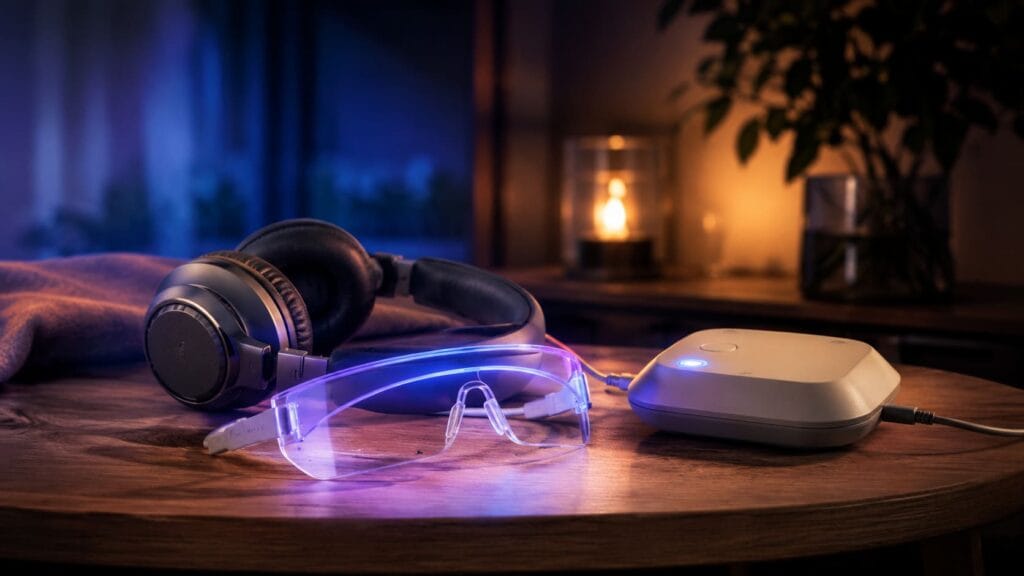
The classic advice sounds simple: sit still, breathe, observe your thoughts, and let them pass.
In real life, that can feel ridiculous when your mind is running at full speed. After a day of screens, decisions, deadlines, notifications, and emotional noise, silence does not always feel peaceful. Sometimes silence makes the internal volume louder.
Not because they are lazy, but because the gap between their current brain activity and deep meditation feels too wide. The beginner is told to “calm your mind,” but the mind refuses to take orders.
A sensory rhythm meditation device approaches the problem differently. It gives the brain something to track. Instead of fighting thought with thought, you use light and sound stimulation to create a sensory rhythm. The experience is passive, structured, and less dependent on your ability to concentrate perfectly.
What Is a Light and Sound Meditation Device?
A light and sound meditation tool is usually a small electronic system that combines flashing light with audio stimulation. Most setups include stimulation glasses or light frames, headphones, and a control unit or app. The user closes the eyes, starts a meditation session, and experiences patterns of flickering pulsing patterns at specific frequencies.
The idea is not complicated. Your brain naturally responds to rhythm. Music changes mood. Slow breathing changes state. Repetitive visual patterns can shift attention. A sound meditation system simply makes that rhythm more deliberate.
Units like MindPlace Kasina and MindPlace Limina use light and sound sessions designed for relaxation, focus, sleep preparation, creative states, or deeper inward attention. Mind Alive devices such as DAVID Delight Plus take a similar AVE direction with a more clinical-looking design.
This is why people sometimes call these tools a mind machine. That phrase sounds a bit sci-fi, but the basic principle is straightforward: use of light and sound to guide attention and state, without demanding heroic mental discipline from the user.
Understanding Light and Sound Entrainment Without the Science Fog
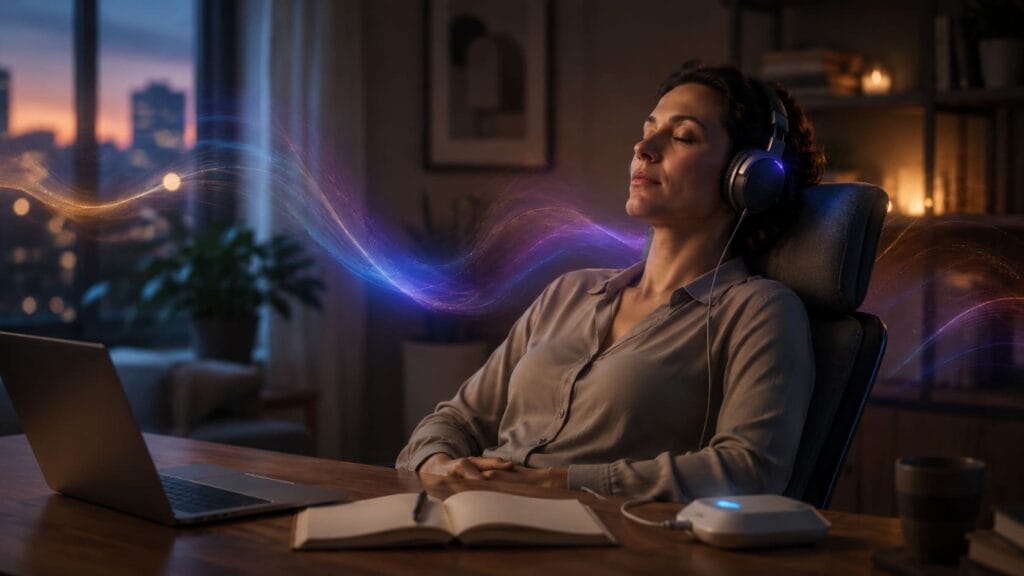
The key concept behind these devices is entrainment. In simple terms, entrainment means one rhythm influencing another rhythm.
Think of tapping your foot to music. The beat gives your body a pattern, and your body starts following. Brainwave entrainment works from a similar idea: repeated pulsing patterns frequencies may encourage the brain to synchronize with a certain rhythm.
This is often called the frequency following response. If a unit presents pulsing audio-visual rhythm at specific frequencies, the brain may begin to follow that rhythm. That does not mean the tool “forces” your brain into enlightenment. It means the sensory input gives your nervous system a clear pattern, and the mind may become less chaotic because it has something steady to follow.
This is also where words like brainwave, brain wave, audiovisual, binaural, and stimulation appear. Some sessions use a binaural beat, where each ear receives a slightly different frequency. Others use pulsing tones, ambient audio, or synchronized light stimulation. The goal is the same: create a guided visual meditation and sound environment that helps move the mind from normal waking consciousness toward a more relaxed state.
A 2025 scientific review indexed by the U.S. National Library of Medicine describes audio-visual entrainment as a non-invasive approach that uses synchronized auditory and visual rhythms to influence measurable patterns of brain activity. The review also emphasizes that outcomes depend on factors such as frequency, intensity, waveform, session design, and individual response.
A separate randomized, controlled, double-blind study involving 262 participants reported improvements in several self-reported mood measures following audio-visual stimulation. These findings support the rationale behind the category, but they do not prove that Kasina, Limina, or DAVID Delight Plus will produce identical results for every user.
What Are the Benefits of Light and Sound Meditation?
The benefits of light and sound are not magic. They are practical.
First, a audio-visual rhythm device reduces the pressure to “do meditation correctly.” You do not need to visualize a beach, repeat a mantra, count your breath, or become spiritually impressive. You put on the glasses, start a session, and let the system carry part of the load.
Second, the experience can be more engaging than silence. For a restless mind, a dark room and closed eyes may feel like an invitation for mental chaos. But flickering light, layered audio, and rhythmic stimulation give attention somewhere to land.
Third, light and sound sessions can create a ritual. The brain likes cues. Same chair, same headphones, same sound options, same evening routine. Over time, that ritual may help separate the day from the night and support relaxation before sleep.
This does not mean every session will feel profound. Some will feel calm. Some will feel odd. Some will feel like nothing special happened. That is normal. The value is not in chasing fireworks; it is in creating a repeatable pathway from mental noise toward relaxation.
MindPlace Kasina: Is This the Best Light and Sound Meditation System?
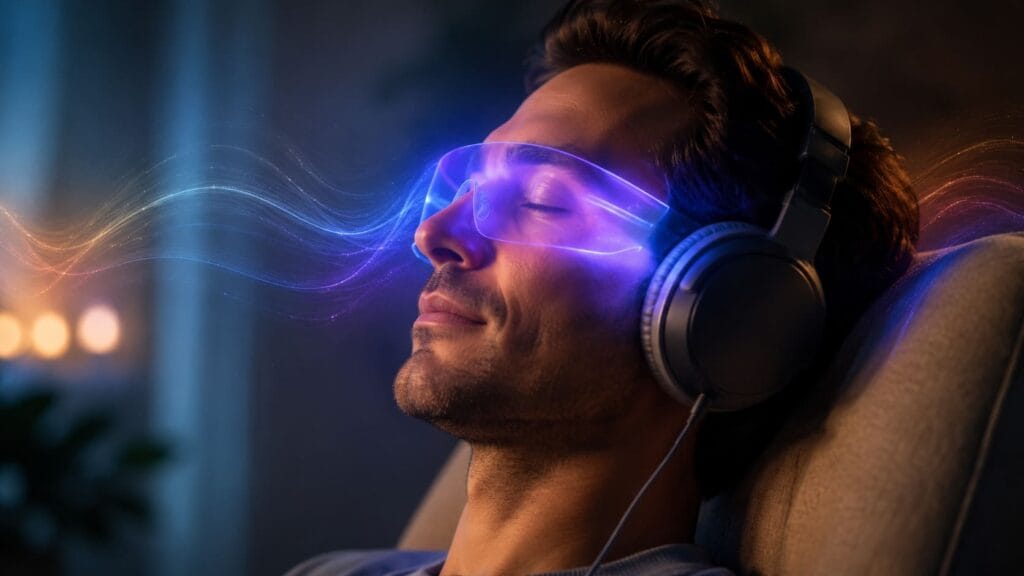
If you are looking for a consumer-friendly light and sound meditation device, MindPlace Kasina is one of the strongest names to know.
Kasina is designed around audio-visual rhythm meditation, with glasses, audio, and structured sessions. It is the kind of tool that makes the concept easy to understand: put on the glasses, choose a session, close your eyes, and let the patterns do their work.
For a beginner, the biggest advantage is structure. Instead of downloading another meditation app and then ignoring it after three days, Kasina gives the experience a physical form. The tool feels like a dedicated ritual, not another icon on your phone.
The best guided session unit is not always the most intense one. For most home users, the better question is: can you actually use it consistently? Kasina works well as a main pick because it sits between curiosity and practicality. It is not just a cheap sound machine, and it is not a huge premium light installation. It is a real light and sound meditation system that fits normal home use.
MindPlace Limina: A More Accessible Light and Sound Device for Beginners
MindPlace Limina is another interesting option, especially for people who want a more affordable entry into guided session meditation.
The Limina light setup still belongs to the same general world: light, sound, frequency, and structured meditation sessions. The difference is that Limina is often positioned as a simpler, more accessible system than Kasina.
That matters because many people do not want to start with the most expensive or intense device. They want to test whether guided session meditation actually fits their lifestyle. Limina makes sense for that person: curious, open-minded, but not ready to turn the bedroom into a neuro-lab.
The phrase MindPlace Limina light may sound technical, but the practical question is simple: do you want a dedicated light and sound tool that helps you explore relaxation without needing years of meditation training? If yes, Limina is worth comparing with Kasina.
CTA: Compare MindPlace Limina on Amazon
Mind Alive DAVID Delight Plus: A Serious guided session Machine Alternative
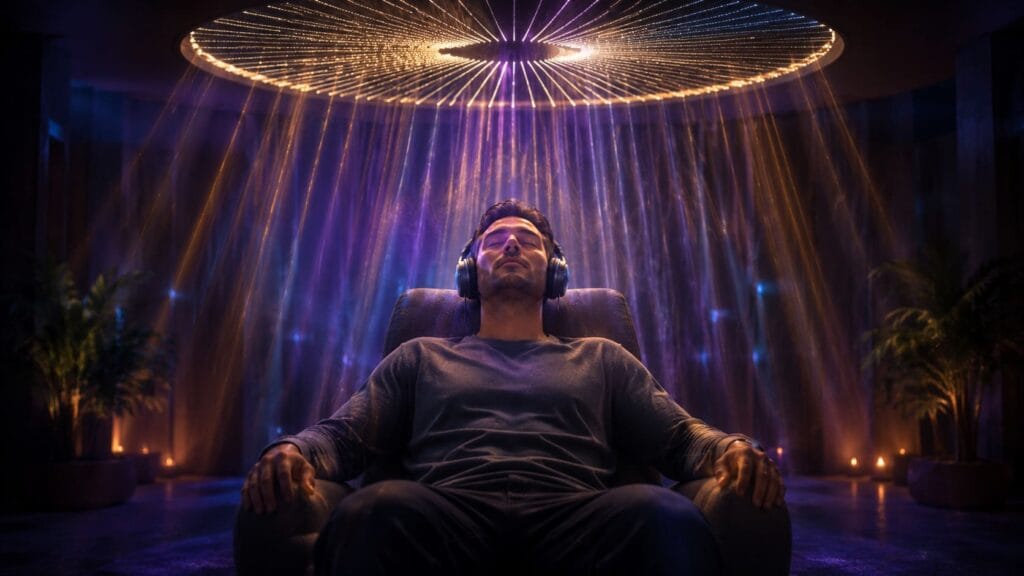
The Mind Alive DAVID Delight Plus is another well-known name in the guided session machine category. It looks less like a lifestyle wellness gadget and more like a serious brain training tool.
That can be good or bad depending on your taste. Some people like premium minimalism. Others prefer a tool that looks functional, direct, and purpose-built. DAVID Delight Plus belongs more to that second camp.
This type of light and sound mind meditation unit uses glasses and audio patterns to guide the session. It is often discussed in the same broader category as AVE devices, sound therapy, and brainwave entrainment tools. For readers comparing MindPlace and Mind Alive, DAVID Delight Plus is a logical alternative.
There is also DAVID Delight Pro, which belongs to the same Mind Alive family. For most casual users, however, the better move is not to overcomplicate the decision. Start by comparing Kasina, Limina, and DAVID Delight Plus. If you become serious about this category later, then explore the more advanced models.
Is a guided session Machine Different from a Normal Sound Machine?
No, but the confusion is understandable.
A regular sound machine usually plays white noise, rain, ocean waves, fan noise, or simple sleep sounds. Sound machines offer a pleasant background environment. That can be useful, especially for sleep, but it is not the same as light and sound stimulation.
A light and sound machine combines audio with visual rhythm. The flashing or flickering light matters. The sound matters. The frequency matters. The session design matters. It is not just “nice noise in the room.” It is a coordinated sensory experience.
That said, a guided session tool is not automatically better for every person. If your main problem is bedroom noise, a normal sound machine may be enough. If your problem is that your mind refuses to settle, a more structured light and sound meditation experience may be more interesting.
For screen-free spoken sessions and nature sounds without flashing light, compare our Morphée sleep-aid review.
This is why the category sits between meditation, sound therapy, light therapy, and neurofeedback. It is not exactly any one of those things. It borrows from all of them.
What Does a Light and Sound Meditation Session Feel Like?
The first time you use light and sound, the experience can feel unusual.
You close your eyes, but you still perceive the flickering light through the eyelids. The patterns may appear as colors, shapes, waves, tunnels, or soft movement. The audio may feel ambient, pulsing, rhythmic, or spacious. Some sessions feel energizing. Some feel dreamy. Some feel like deep rest.
A guided session meditation session may trigger a strong “what is this?” reaction at first. That is normal. The brain is not used to receiving organized visual and audio stimulation in this way.
The key is to start gently. Do not choose the most intense session first. Do not treat the device like a challenge. You are not trying to win meditation. You are creating a controlled environment where the mind can follow instead of fight.
A short session in a quiet room is enough. Sit or lie down. Avoid multitasking. Let the light and sound frequencies do their thing. When the session ends, give yourself a few minutes before jumping back into your phone or work.
Pandora Star and Premium Light Therapy Experiences: Worth Mentioning or Too Much?
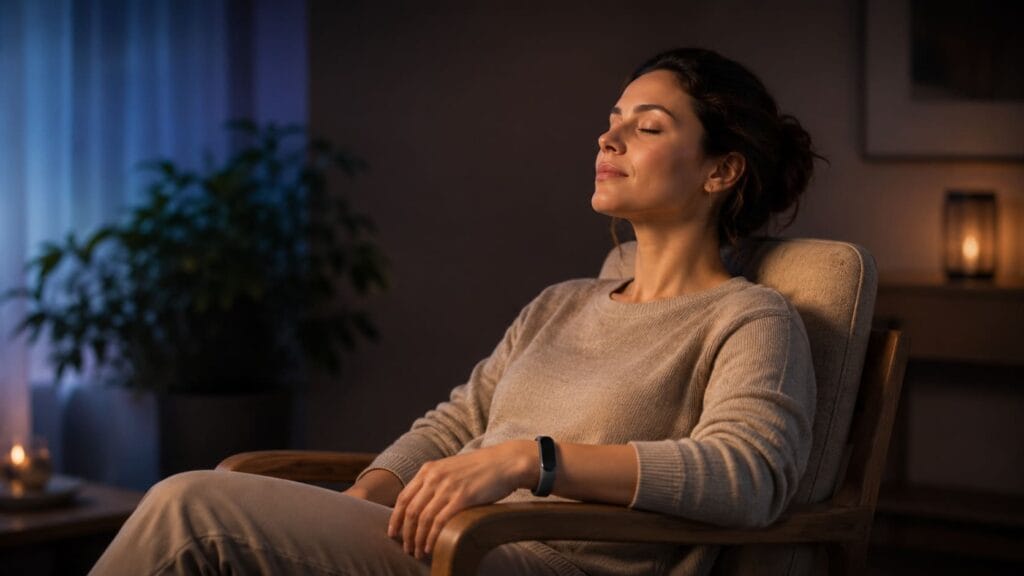
At the premium end of the market, you will find systems like Pandora Star, roXiva-style light systems, and other immersive light experiences. These are closer to experiential light environments than simple home meditation gadgets.
Pandora Star is often discussed as a high-end visual light experience. It has a more dramatic, immersive reputation than everyday consumer devices. For the right person, that can be fascinating. For the average beginner, it may be more than necessary.
This is where the buying decision becomes practical. If you are simply trying to build a realistic evening relaxation ritual, MindPlace Kasina or Limina is probably easier to justify. If you are deeply curious about premium light experiences and want something more intense, then Pandora-style systems become interesting.
The important point: more intense does not automatically mean better. A calm, repeatable meditation device that you actually use three nights a week is more valuable than an expensive star machine that becomes furniture.
What If Flickering Light Feels Too Intense?
Not everyone will enjoy flickering light. Some people are sensitive to visual stimulation. Some simply dislike the sensation. Others may prefer something that works through the body rather than the eyes.
This is where Apollo Neuro fits as a softer alternative for people who want passive support without visual stimulation. It does not create a guided visual meditation. Instead, it uses gentle vibration patterns that can be worn on the body. For people who want passive regulation without flash-based stimulation, that can feel much easier.
This is also where simple environment tools matter. After a session, a Manta sleep mask can help preserve darkness. A low-stimulation evening routine can make the transition smoother. A supplement like liposomal magnesium may fit into a wind-down routine for people already using magnesium as part of their evening stack.
Light and Sound vs Neurofeedback: Which One Comes First?
Light and sound meditation is more passive. Neurofeedback is more active.
With neurofeedback, you usually train your brain activity while receiving feedback from a device or app. That can be powerful, but it demands attention and participation. For a person in burnout or constant mental overload, that may feel like another task.
A light and sound device asks less from you. It says: sit down, close your eyes, and follow the rhythm. That is why it can be a better first step for someone who cannot tolerate complicated meditation techniques.
Devices like Mendi fit better as active brain training, not as a passive meditation shortcut.
So the order matters. Start with what you can actually do. If passive light and sound produces a reliable relaxation ritual, that may create the foundation for more active training later.
Our neurotechnology devices buyer guide compares EEG, fNIRS, HRV feedback, and tactile tools before you move into measurement-based systems.
Who Should Consider a Light and Sound Device?

A light and sound meditation device is worth considering if you like the idea of meditation but hate the reality of sitting in silence.
It may also fit people who enjoy sensory experiences, ambient audio, structured rituals, and technology-assisted relaxation. If you already use headphones, sleep tools, breathwork apps, or focus music, this category may feel natural.
It may not fit you if you dislike eye stimulation, hate wearing glasses, or want the simplest possible sleep tool. It is also not something to use while driving, walking, cooking, or doing anything that requires attention. A meditation session should happen seated or lying down in a safe place.
The best user is not necessarily the most spiritual person. It may be the high-output professional who has tried meditation apps, failed repeatedly, and still wants a practical way to calm the evening nervous system without pretending to become a monk.
How to Choose the Best Light and Sound Device for Your Routine
Start with the experience you actually want.
If you want the strongest all-around consumer option, look at MindPlace Kasina. If you want a more accessible entry point, compare MindPlace Limina. If you want a more technical AVE-style device with a serious brain training look, research Mind Alive DAVID Delight Plus.
Then consider your tolerance for light. If flickering light feels exciting, this category may suit you. If it feels irritating or too intense, choose a softer route like Apollo Neuro or a non-visual relaxation stack.
Also consider when you will use it. If the goal is sleep preparation, choose calming evening sessions and avoid turning the experience into entertainment. If the goal is creative focus, use daytime sessions and leave space afterward for journaling or planning.
Finally, be honest about complexity. A device with endless features is useless if you avoid it. The right light and sound device is the one that creates a ritual you can repeat.
Final Thoughts: Passive Relaxation Is Not Laziness

Passive meditation is not cheating.
If your mind is overloaded, asking it to become silent on command can be unrealistic. A light and sound meditation device offers a different route: not force, not discipline theatre, not another app notification, but rhythm.
Light, sound, frequency, and entrainment give the brain something to follow. For some people, that is exactly what silence fails to provide.
Who should avoid it:
- People with epilepsy, seizure history, photosensitivity, migraines, neurological concerns, implanted medical devices, pregnancy, or medication-related uncertainty unless cleared by a qualified professional.
- Buyers expecting diagnosis, treatment, guaranteed sleep improvement, anxiety treatment, ADHD support, depression relief, or verified mental-health outcomes.
- Users who dislike flashing light, headphones, app or session setup, sensory stimulation, or structured device-guided meditation.
- Anyone who needs hands-on testing, verified long-term reliability, or confirmed customer-support quality before purchase.
What we could verify:
- Public product positioning and available product-page information.
- Visible buyer-facing specifications, pricing, session-style descriptions, setup requirements, product categories, and accessory requirements where available.
- The article’s comparison logic and buyer-use-case framing for light and sound meditation devices.
- The presence and placement of affiliate or product links used on the page.
What we could not verify:
- Long-term headset comfort, glasses comfort, device durability, audio quality, session usability, app or firmware reliability, battery wear, or customer-support quality.
- Product-specific effects on sleep, focus, stress, anxiety, ADHD, depression, meditation depth, cognition, brainwaves, recovery, or nervous-system outcomes.
- Whether public research on meditation, audiovisual stimulation, brainwave entrainment, or biofeedback applies directly to these specific consumer products.
- Whether every user will experience the same results, comfort, sensory tolerance, or usability.
MindPlace Kasina is the strongest main pick for most readers. MindPlace Limina is a smart entry point. Mind Alive DAVID Delight Plus is a serious alternative. Pandora Star belongs in the premium experience category. Apollo Neuro, Manta Sleep, and liposomal magnesium can support the wider wind-down routine around the session.
The real goal is not to own the most futuristic device. The goal is to build a reliable doorway from mental noise into relaxation.
Key Things to Remember

- A light and sound meditation device gives the brain an external rhythm to follow.
- This can be useful for people who struggle with silent meditation and monkey mind.
- Brainwave entrainment uses repeated light and sound frequencies to support a shift in attention and state.
- MindPlace Kasina is the strongest main pick for a home light and sound meditation system.
- MindPlace Limina is a more accessible entry point into the category.
- Mind Alive DAVID Delight Plus is a serious alternative for people who prefer a more technical AVE-style device.
- Pandora Star is better treated as a premium experience mention, not the main beginner recommendation.
- Apollo Neuro can be a softer passive alternative if flickering light feels too intense.
- Manta Sleep and liposomal magnesium fit better after the session as part of an evening wind-down routine.
- The best device is not the most extreme one. It is the one you will actually use.