Table of Contents
Affiliate disclosure: MindReset.org may earn a commission if you buy through our links. This does not increase your price and does not affect our editorial judgment.
Research note: We have not personally tested HeartMath Inner Balance Coherence Plus. This review is based on official product specifications, public documentation, available HRV biofeedback research, visible customer feedback, current purchase terms, and comparison with similar self-regulation tools.
What we assessed: sensor design, HRV feedback, coherence scoring, app access, battery life, compatibility, daily-use routine, current price, return policy, warranty, subscription costs, and practical differences between Inner Balance and emWave2.
What we could not independently verify: long-term sensor reliability, app and Bluetooth stability, battery degradation, customer support quality, accuracy across every user, or product-specific effects on anxiety, sleep, cognition, emotional health, cardiovascular health, and nervous-system regulation.
Important: Inner Balance is a consumer HRV biofeedback and training tool, not a medical diagnostic device or a substitute for professional care. Product prices, app features, compatibility, warranty terms, and availability may change.
HeartMath Inner Balance review
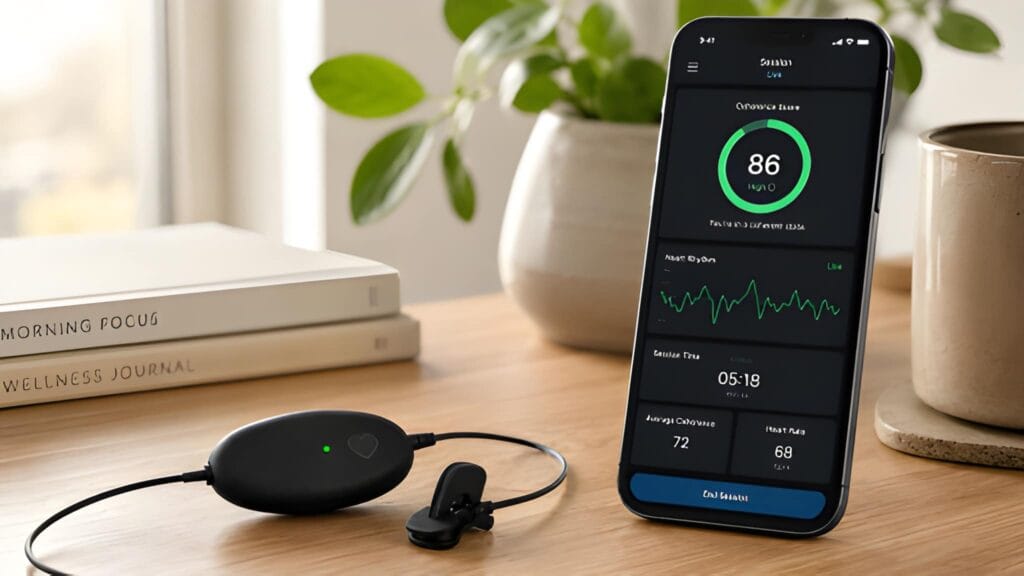
HeartMath Inner Balance Coherence Plus is a compact HRV biofeedback device built for people who want to make breathing, meditation, and emotional self-regulation more measurable. Instead of guessing whether your nervous system is settling down, the Inner Balance sensor and HeartMath app show your heart rhythm pattern, coherence score, and progress in real time.
This HeartMath Inner Balance review looks at what the device actually does, how the Inner Balance Coherence Plus sensor works, who it fits best, and where its limits are. If you are interested in heart-brain coherence, nervous system reset routines, meditation training, or stress resilience, this guide will help you decide whether this tool deserves a place in your daily practice.
Quick Verdict: Is HeartMath Inner Balance Coherence Plus the Right HRV Device for You?
HeartMath Inner Balance Coherence Plus is worth considering if you want a simple, structured way to practice heart coherence and HRV coherence without turning your routine into a complicated data project. It is not a smartwatch, not a medical device, and not a passive tracker you wear all day. It is a focused training tool.
The strongest reason to buy it is feedback. Most people breathe, meditate, or try to calm down without knowing what is happening inside the body. Inner Balance gives you a real-time coherence score, so you can see whether your breathing rhythm, emotional focus, and attention are moving you toward a more balanced state.
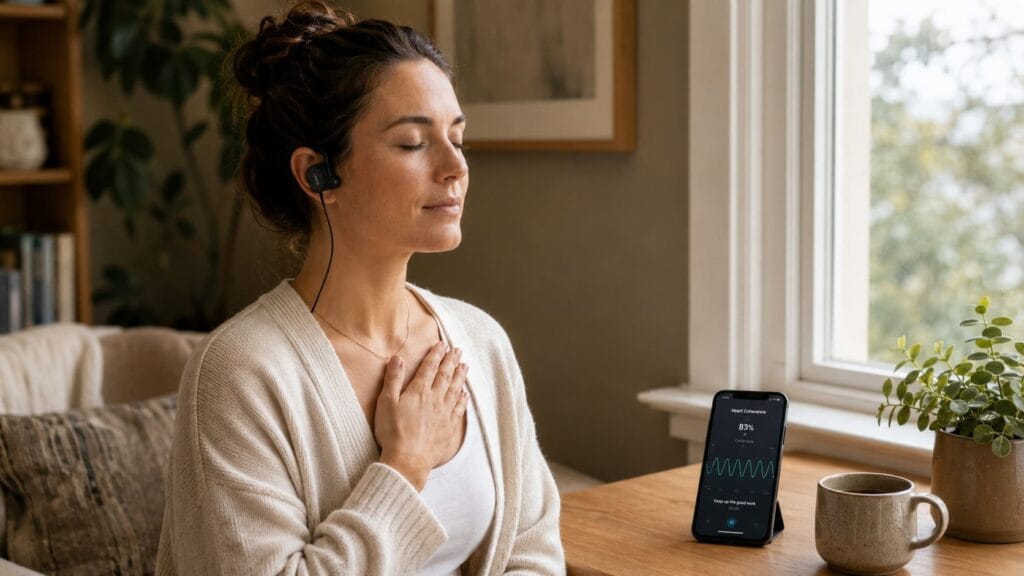
For beginners, this is where the device shines. It turns a vague idea like “relax your nervous system” into something visible. You clip the ear sensor on, open the HeartMath app, follow the session, and watch your coherence change. That makes it useful for daily practice, not just occasional curiosity.
How Does the Inner Balance Coherence Plus Sensor Work?
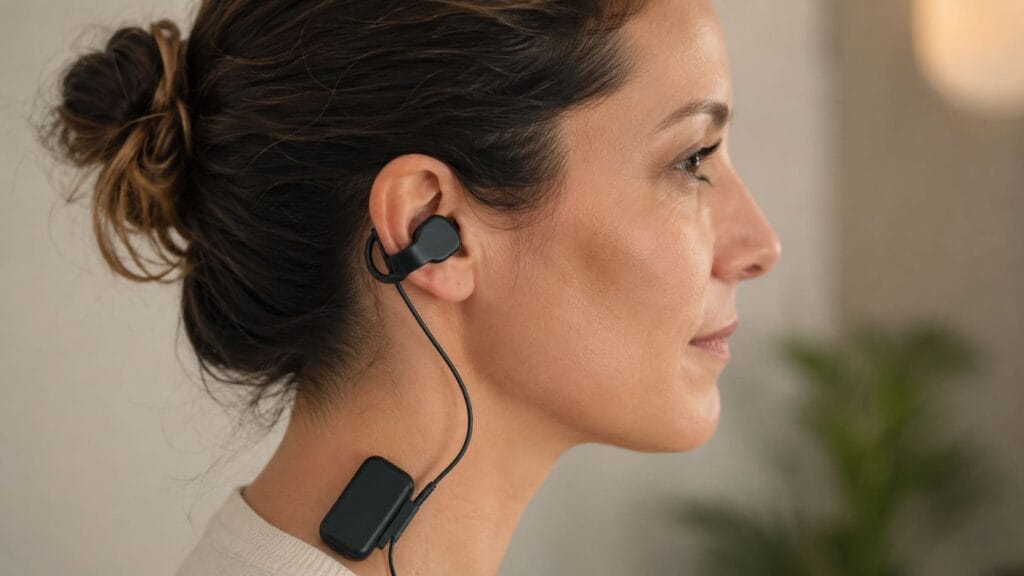
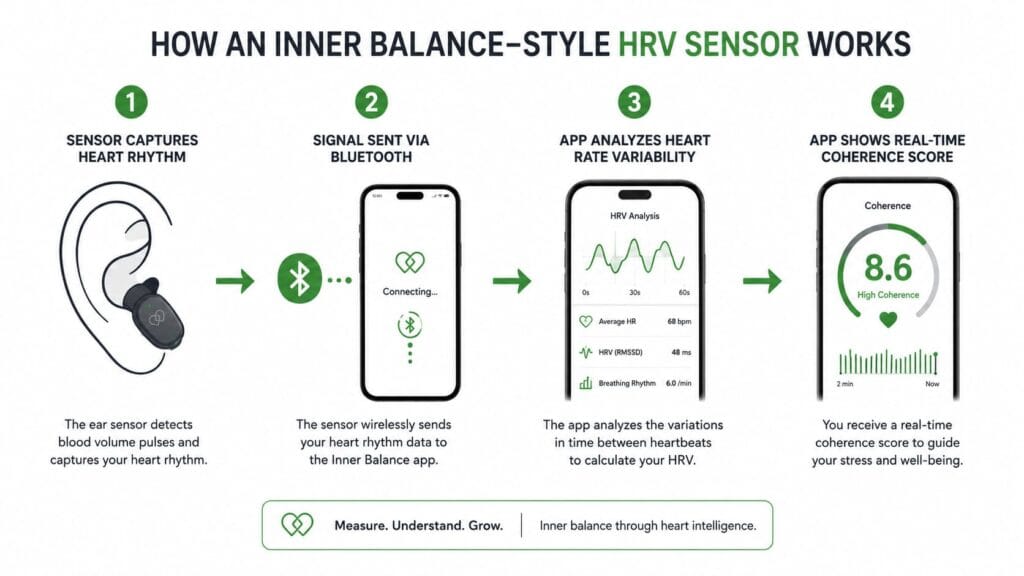
HeartMath Inner Balance Coherence Plus is a Bluetooth HRV sensor that works with the HeartMath app. The device is designed to capture your heart rate variability through an ear sensor and translate your heart rhythm patterns into coherence feedback.
In simple terms, HRV shows small changes in time between heartbeats. HeartMath uses those rhythm patterns to estimate coherence, which is presented in the app as low, medium, or high coherence. The goal is not to chase perfect numbers. The goal is to build a coherence skill set through regular practice.
The Inner Balance Coherence Plus sensor is the newer version of the Inner Balance system. It is built around mobile use, which makes it more practical for home routines, meditation breaks, breathing sessions, and short reset practices during the day.
The Inner Balance Coherence Plus sensor works by clipping to your ear and detecting pulse data. The ear is used because it can provide a clear signal for heart rate and heart rate variability during a live session. The sensor then sends that information to the HeartMath app.
Inside the app, your heart rhythm is translated into a real-time coherence score. When your breathing becomes more steady and your emotional state becomes more settled, the pattern may become smoother. The app then shows whether you are moving into low, medium, or high coherence.
This is the core value of the tool. You are not just reading about heart coherence. You are seeing feedback while you practice. That can make breathing and meditation feel less abstract and more like a trainable skill.
What Does the HeartMath App Actually Show You?
The HeartMath app is where most of the user experience happens. The Inner Balance sensor collects the signal, but the app gives you the training environment. It shows your session, coherence level, score, rhythm pattern, and progress over time.
For someone new to HRV biofeedback, the app makes the process easier. You do not need to understand every technical detail of heart rate variability. You follow the session, breathe steadily, focus your attention around the heart area, and watch how your coherence changes.
The app also helps create consistency. A meditation habit can collapse quickly when there is no structure. Inner Balance gives you sessions, feedback, and a reason to return. That is important because the benefits of heart-brain coherence practice usually come from repetition, not from one impressive session.
What Is Heart-Brain Coherence?
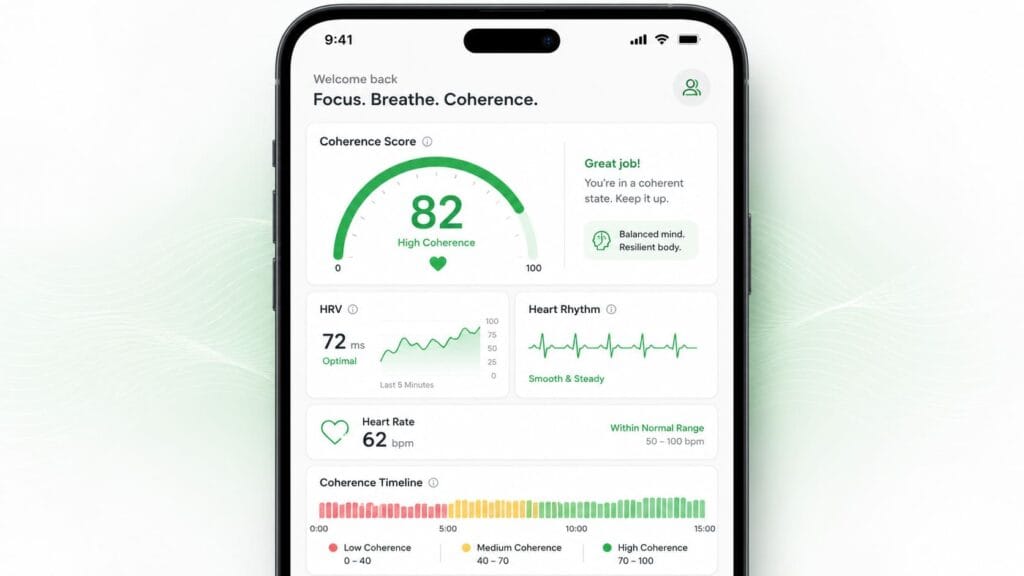
“Heart-brain coherence” is HeartMath’s term for a smoother and more regular heart-rhythm pattern that may appear during paced breathing, focused attention, and emotionally steady practice. The Inner Balance sensor measures pulse and HRV; it does not directly measure brain activity.
The app uses HeartMath’s proprietary algorithm to convert heart-rate and HRV patterns into a coherence score. That score is useful as training feedback, but it should not be confused with a medical assessment, a general recovery score, or proof that every system in the body has entered an optimal state.
Independent research supports the wider rationale behind slow breathing and HRV biofeedback. A systematic review and meta-analysis indexed by the U.S. National Library of Medicine found that voluntary slow breathing can produce measurable changes in HRV. A separate review of how HRV biofeedback works explains how paced breathing and feedback may influence baroreflex and autonomic activity.
These findings support HRV biofeedback as a trainable self-regulation method. They do not independently validate every HeartMath marketing claim or prove that Inner Balance will produce identical emotional, sleep, cognitive, or health outcomes for every user.
How Can Inner Balance Help With Stress and Emotional Self-Regulation?
Stress is not only a thought. It shows up in breathing, heart rhythm, muscle tension, attention, and emotional reactivity. Inner Balance helps because it gives feedback during the moment when you are trying to shift state.
For example, you may start a session with uneven breathing and a scattered mind. The app may show low coherence. Then you slow your breathing, focus on the heart area, and bring in a calmer emotional tone. If your heart rhythm pattern becomes smoother, the app reflects that change.
That loop is powerful because it trains awareness. You start to notice what actually works for you. Some people respond well to slower breathing. Others need a more emotional focus, such as appreciation or calm attention. The device does not do the work for you, but it can make the work clearer. If you want a more direct nervous-system wearable instead of HRV feedback training, compare it with our Pulsetto review.
Is Inner Balance Good for Meditation Training?
Yes, Inner Balance can be useful for meditation training, especially for people who struggle with silent practice. Traditional meditation can feel vague: you sit, breathe, wander, return, and hope something is happening. With Inner Balance, you get feedback.
That does not mean the device should replace meditation. It is better to see it as meditation training wheels. It helps you understand how your breathing and attention affect your internal state. Over time, you may need the sensor less because the skill becomes more familiar.
For MindReset-style use, the best approach is simple: use Inner Balance before meditation, after work, before sleep, or during a short midday reset. Five to ten minutes can be enough to build the habit. Longer sessions may help, but consistency matters more than heroic effort.
What Are the Main Benefits of Inner Balance Coherence Plus?
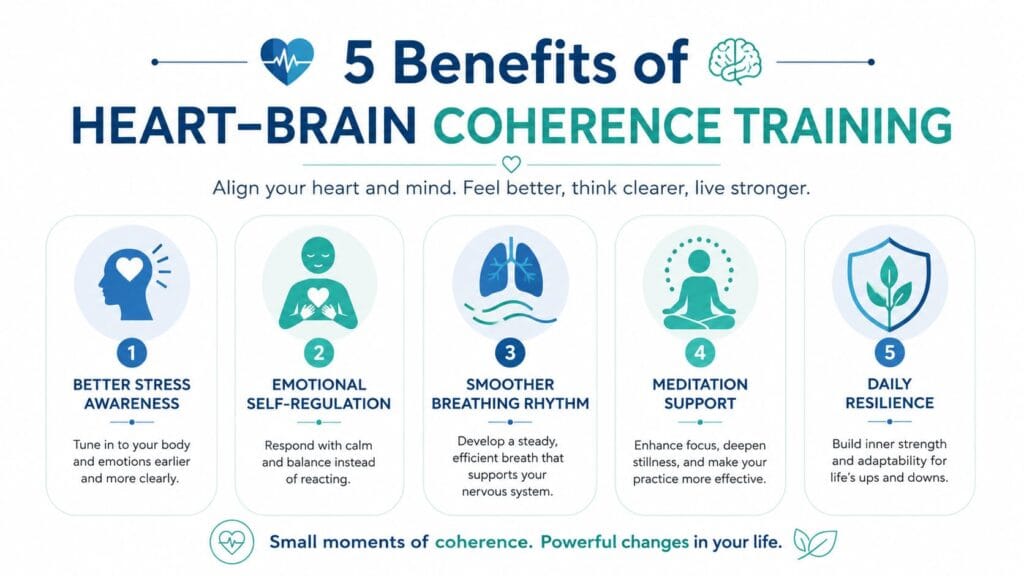
The first benefit is real-time feedback. Most wellness tools give advice. Inner Balance gives you a signal. You can see your coherence in real time and adjust your breathing or focus during the session.
The second benefit is structure. The HeartMath app gives the practice a container. You are not just randomly trying to relax. You are training a specific skill: moving your heart rhythm into a more coherent pattern through breathing, attention, and emotional regulation.
The third benefit is simplicity. The Inner Balance Coherence Plus sensor is small, mobile, and easier to use than professional HRV systems. For a normal person who wants a nervous system reset tool, that matters. If a device is too complicated, it ends up in a drawer.
What Could Be Better?
The biggest limitation is that Inner Balance is focused on coherence, not full HRV analytics. If you want detailed recovery metrics, advanced HRV dashboards, athlete-level readiness scores, or long-term passive tracking, this may not satisfy you.
Another limitation is that you need to use the ear sensor during a live session. This is not a device you wear all day like a ring or smartwatch. It is built for active, intentional practice. That is good for training, but not ideal for people who want passive data collection.
Finally, the concept of coherence can feel too branded for some users. If you are skeptical, that is fair. The practical question is not whether you like every word HeartMath uses. The practical question is whether real-time breathing and HRV feedback helps you build a calmer, more repeatable self-regulation routine.
Who Should Buy HeartMath Inner Balance?
HeartMath Inner Balance is a good fit for people who want a guided HRV biofeedback device for daily practice. It is especially useful if you already do breathing, meditation, prayer, journaling, yoga, or nervous system reset routines but want more feedback.
It also fits people who are sensitive to stress and want to understand their patterns better. If you prefer brain-training feedback instead of heart rhythm feedback, read our Mendi neurofeedback review as a useful comparison. The device can help you see how quickly your system shifts when you slow your breathing and change emotional focus. That makes it useful for people who like practical neuroscience rather than vague wellness advice.
It is also a strong choice for beginners in heart coherence training. You do not need to be a biohacker. You do not need to understand every HRV metric. You only need to show up, connect the sensor, open the HeartMath app, and practice.
Who Should Skip It?
Skip Inner Balance if you want a passive wearable that tracks your recovery all day and night. This is not an Oura Ring, WHOOP, Garmin, or Apple Watch replacement. It is not built for sleep tracking, workout recovery, or constant background measurement.
You may also want to skip it if you dislike app-based practice. The sensor and HeartMath app work together, so the app is central to the experience. If you want a completely screen-free tool, emWave2 may be a better product to research later.
You should also skip it if you expect instant transformation. Inner Balance is a feedback tool. It can support training, but it does not remove stress from your life. The real value comes from using the device repeatedly until heart coherence becomes a familiar state you can access more easily.
Inner Balance vs emWave2: Which One Makes More Sense?
Inner Balance makes more sense for most modern users because it works with a mobile app and gives a clean entry point into HeartMath tools. It is the more natural choice for personal use, meditation support, breathing practice, and quick reset sessions.
emWave2 is more of a standalone handheld device. Some people may prefer that because it feels less dependent on a phone. But for a first HeartMath device, Inner Balance Coherence Plus is easier to recommend because the app experience, real-time feedback, and guided content make the practice more approachable.
The better question is not “which device is more advanced?” The better question is “which device will I actually use?” For most people, the answer will be Inner Balance.
If you want a desktop HeartMath workflow instead, see our emWave Pro review; for category context, compare the neurotechnology devices guide.
How to Use Inner Balance in a Daily Reset Routine
The best way to use Inner Balance is to keep the routine short and repeatable. Start with five minutes. Clip the ear sensor on, open the HeartMath app, begin a session, and breathe slowly enough that your body can settle.
Do not force high coherence. That usually creates tension. Instead, aim for a smooth breathing rhythm, relaxed attention, and a steady emotional tone. If the score rises, good. If it does not, observe what is happening. That observation is part of the training.
A useful routine is simple: one session in the morning, one short reset after work, or one session before bed. You can also combine it with somatic recovery tools if your stress shows up more in the body than in thoughts. You can also use it before difficult tasks, creative work, or meditation. The point is to train your system before stress controls the day.
What Is Included With Inner Balance™ Coherence Plus and the New HeartMath App?
The Inner Balance™ Coherence Plus package is built around the sensor and HeartMath app experience. The sensor captures your heart rhythm data during a live session, while the app provides coherence measurement, guided training, and progress feedback.
For many users, the app content is just as important as the sensor itself. It helps you build a coherence skill set through courses, sessions, and real-time feedback instead of leaving you to figure out the practice alone.
What we could verify
We could verify the current listed price, lifetime HeartMath app access, stated $79 annual subscription saving, Bluetooth and USB-C connection options, ear-sensor design, 500Hz pulse-wave sampling claim, real-time coherence scoring, approximately eight hours of battery life, automatic shutoff, supported HeartMath apps, third-party standard-HRV-profile compatibility, US shipping offer, 60-day return period, and one-year technology warranty.
Price, Lifetime App Access, Returns, and Warranty
At the time of our latest check, Inner Balance Coherence Plus was listed at a promotional price of $186.75, reduced from a stated MSRP of $249. Prices and promotions may change, so confirm the final checkout amount before ordering.
| Purchase detail | Current published information | Buyer consideration |
|---|---|---|
| Current promotional price | $186.75 at latest check | Confirm the final price before ordering |
| Stated MSRP | $249 | Do not judge value only by the displayed discount |
| HeartMath app access | Lifetime access included with a new Coherence Plus sensor | This avoids the standard $79 annual app subscription |
| US shipping | Free ground shipping on most orders | Confirm eligibility at checkout |
| Return period | 60-day money-back guarantee | Read the full return conditions before ordering |
| Technology warranty | 1 year | Keep proof of purchase and review exclusions |
| Battery | Approximately 8 hours | Includes an auto-shutoff feature |
What we could not verify
We could not independently verify sensor accuracy across every user, the proprietary coherence algorithm, long-term ear-clip comfort, Bluetooth reliability, app stability, battery degradation, customer support quality, durability over months of daily use, or product-specific effects on anxiety, depression, sleep, cognition, cardiovascular health, stress disorders, emotional resilience, or nervous-system regulation.
Final Verdict: Is HeartMath Inner Balance Coherence Plus Worth It?
HeartMath Inner Balance Coherence Plus is a strong choice if you want a practical HRV biofeedback tool for heart coherence training, breathing, meditation, and emotional self-regulation. It is beginner-friendly, focused, and more useful than another vague wellness app that only tells you to relax.
Its main value is not that it gives you a score. Its real value is that it helps you build awareness. You learn how your heart rhythm changes when you breathe differently, focus differently, and shift your emotional state. That can turn nervous system reset from a nice idea into a repeatable practice.
If you want deep HRV analytics or passive recovery tracking, this is not the right device. But if you want a simple, focused way to train coherence in real time, HeartMath Inner Balance Coherence Plus is one of the most practical devices in the HeartMath ecosystem.
FAQ
Does Inner Balance Coherence Plus measure HRV?
Yes. Inner Balance Coherence Plus measures heart rhythm data through the ear sensor and uses that signal for HRV-based coherence measurement inside the HeartMath app. In simple terms, Inner Balance Coherence Plus translates your heart rhythm patterns into a real-time coherence score, so you can see how your breathing and attention change your state during a session.
How does the Balance Coherence Plus sensor work with the HeartMath app?
The Balance Coherence Plus sensor works by using a sensor to capture your heart rhythm during a live session. The Coherence Plus sensor and HeartMath app then bring that signal into a guided training experience where you can watch coherence in real time instead of guessing whether your practice is working.
What is included with Inner Balance™ Coherence Plus and the new HeartMath app?
The Inner Balance™ Coherence Plus experience is built around the sensor, the new HeartMath app, real-time feedback, and training content included in the HeartMath system. For many users, the value is much more than coherence measurement because the app helps you build a coherence skill set through courses, sessions, and progress tracking.
Does the Coherence Plus sensor and HeartMath app require a subscription?
A new Inner Balance Coherence Plus sensor currently includes a complimentary lifetime subscription to the HeartMath app, unlocking the app’s available features without the standard $79 annual subscription. The lifetime access must be activated through the HeartMath account associated with the sensor purchase.
Can the Inner Balance app help you get into high coherence?
The Inner Balance app incorporates feedback that can show low, medium and high coherence during practice. The goal is not to force high coherence every time. A better goal is creating a new coherence baseline through repeated breathing, attention, and heart-focusing techniques.
Is heart coherence only for meditation?
No. Heart coherence can be applied to many areas of daily life: work preparation, emotional reset, breathing practice, meditation, sleep wind-down, and focused recovery breaks. The app can help you apply heart coherence to many everyday moments where you want a steadier internal state.
Where do you get the HeartMath app?
Before purchasing, go to the Apple App Store or Google Play and check the current HeartMath app details for your device. This is especially important because app compatibility, updates, and availability can change.
Does the Plus sensor have a battery?
Yes. HeartMath states that the Coherence Plus sensor provides approximately eight hours of battery life and includes an automatic shutoff feature to conserve power. Real-world runtime and long-term battery degradation may vary.
Does the sensor work with any HRV app?
Yes. HeartMath states that the Coherence Plus sensor provides approximately eight hours of battery life and includes an automatic shutoff feature to conserve power. Real-world runtime and long-term battery degradation may vary.
Is HeartMath Inner Balance Coherence Plus only about numbers?
No. HeartMath Inner Balance Coherence Plus is about feedback, training, and practice. The score matters, but the deeper value is the sense of inner regulation you build over time. Coherence is a state you learn to recognize, repeat, and use more deliberately.
Should you check out the Inner Balance device if you are new to HRV?
Yes, if you want a simple introduction to HRV coherence and heart coherence training. Check out the Inner Balance device if you want guided practice, visual feedback, and a beginner-friendly way to build your heart coherence without jumping into advanced HRV dashboards.
Key Things to Remember
- HeartMath Inner Balance Coherence Plus is a mobile HRV biofeedback device for coherence training.
- The ear sensor captures heart rate variability during live sessions.
- The HeartMath app translates heart rhythm patterns into a real-time coherence score.
- It is best for breathing practice, meditation support, stress resilience, and emotional self-regulation routines.
- It is not a passive wearable, sleep tracker, or advanced recovery analytics tool.
- The device works best when used consistently in short, repeatable sessions.
- For most beginners, Inner Balance Coherence Plus is the most practical first HeartMath device.