
Table of Contents
Analytical mind meditation is a structured approach for people who struggle to switch off during silent practice. Instead of trying to empty the mind, it uses clear anchors, counting, labels, walking, guided instructions, or feedback to give analytical thinking a simple job.
You may sit down to meditate and immediately start planning, analyzing, replaying conversations, solving work problems, reviewing mental lists, or criticizing yourself for “doing meditation wrong.”
That does not mean you are broken or unable to meditate. It usually means that vague instructions such as “empty your mind” or “just let go” do not provide enough structure.
You may simply have an analytical mind that does not respond well to vague instructions like “empty your mind,” “just let go,” or “sit with your breath” without structure.
This guide is not about forcing traditional meditation to work. It is about building a practical meditation approach for analytical thinkers: people who like clarity, structure, feedback, logic, and visible progress.
Quick verdict: If silent meditation frustrates you, do not treat that as failure. Use structured attention practices instead: guided sessions, breath counting, body scans, walking meditation, brain dumps, HRV breathing, or focus-based tools.
Affiliate disclosure: MindReset.org may earn a commission if you buy through our links. This does not increase your price and does not affect our editorial judgment.
Research note: We have not personally tested every device or supplement mentioned in this guide. The core recommendations are based on established meditation formats, public product documentation, practical use cases, and comparison of structured options for people who dislike unstructured silent practice.
What we assessed: clarity, required setup, cost, app dependence, feedback, buyer fit, and whether each option adds useful structure without making medical promises.
What we could not independently verify: that any meditation method, wearable, neurofeedback device, HRV tool, or supplement will reliably improve anxiety, sleep, focus, burnout, trauma symptoms, or nervous-system regulation for every user.

What Is Analytical Mind Meditation?
Analytical mind meditation is not a special spiritual category.
It is a practical way to adapt meditation for people who think in systems, patterns, risks, data, plans, and problems.
Instead of asking the mind to become empty, it gives the mind a simple job.
That job might be:
- count the breath;
- follow a guided voice;
- scan the body from head to toe;
- label thoughts as “planning,” “worrying,” or “remembering”;
- walk slowly and notice each step;
- use a timer and one clear instruction;
- track breathing with an HRV biofeedback tool;
- train focus with a structured neurofeedback device.
The point is not to fight your analytical mind.
The point is to give it a safe, simple structure so it stops turning the meditation session into another work meeting.
Why Traditional Meditation Can Feel Hard for Analytical Thinkers
A lot of meditation advice is too vague for analytical people.
Instructions like “clear your mind” or “just be present” may sound simple, but they can create pressure. If your mind is used to solving problems, predicting outcomes, managing risk, or optimizing work, then silence may feel like an empty space that immediately fills with unfinished tasks.
You may notice thoughts like:
- “Am I doing this correctly?”
- “Why am I still thinking?”
- “This is wasting time.”
- “I should be better at this.”
- “I need to reply to that message.”
- “What if I forget that task?”
- “I cannot switch off.”
This does not mean meditation is impossible for you.
It means your practice needs more structure.

The Main Mistake: Trying to Force the Mind to Go Blank
The biggest mistake is trying to dominate your own thoughts.
When a thought appears, many analytical people react by trying to crush it:
“Stop thinking.”
“Focus harder.”
“Do it properly.”
“This is stupid.”
That response usually makes the session worse.
A better approach is to treat thoughts as data, not enemies.
If your mind keeps planning, label it: planning.
If your mind keeps replaying a conversation, label it: replaying.
If your mind worries about tomorrow, label it: worrying.
Then return to the anchor.
The anchor can be breath, sound, body sensation, walking, or a guided instruction.
You are not trying to delete thoughts.
You are practicing returning.
Who This Guide Is For
This guide may help if you:
- struggle with silent meditation;
- overthink during rest;
- prefer structure over vague mindfulness;
- like practical routines;
- get frustrated when your mind wanders;
- use work, analysis, or planning to feel in control;
- want a calmer routine without pretending to be a different person.
It may also help if you are good at focused work but bad at stopping.
That is common. The same mind that can solve complex problems can also keep running long after the problem is finished.

Who Should Be Careful
Meditation is not always the right tool for every situation.
For a broader evidence and safety overview, see the NCCIH guide to meditation and mindfulness. It notes that meditation is generally considered low risk, while also acknowledging that safety research remains limited and some people report negative experiences.
If sitting quietly brings up intense distress, panic, traumatic memories, severe anxiety, depression, or overwhelming emotions, do not force yourself through it alone.
Use gentler grounding practices, movement, breathing, or professional support instead.
Meditation should not feel like self-punishment.
It should support your life, not become another thing you fail at.
The MindReset Method for Analytical Meditation
Use this simple method when ordinary meditation feels too vague.
If breath counting feels useful, you may also like these breathing techniques for calm.
Step 1: Choose a Clear Anchor
Do not start with “I will clear my mind.”
Choose one anchor:
- breath count;
- body scan;
- walking steps;
- sound;
- guided audio;
- hand on chest;
- visual point;
- HRV breathing;
- simple phrase.
A clear anchor gives your mind somewhere to return.
Step 2: Set a Short Time
Start with 3–5 minutes.
Not 30.
Not 60.
Analytical people often turn meditation into a performance goal. That backfires.
A short session completed consistently is better than a long session you avoid.
Step 3: Use a Label
When a thought appears, label it gently.
Examples:
- planning;
- remembering;
- judging;
- solving;
- worrying;
- rehearsing;
- comparing;
- future;
- past.
Then return to the anchor.
This gives your analytical mind something useful to do without letting it take over the whole session.
Step 4: End With One Practical Note
After the session, write one sentence:
“What did I notice?”
Examples:
- “My mind kept planning work.”
- “I felt calmer with counting than with silence.”
- “Walking worked better than sitting.”
- “I need to do a brain dump before meditation.”
- “Evening is harder than morning.”
This turns meditation into feedback, not judgment.
If your mind is full before practice, use the brain dump technique before you sit down.
A 5-Minute Analytical Mind Meditation
Try this:
Minute 1: Sit comfortably. Keep your eyes open or closed. Choose one anchor: breathing, sound, or body sensation.
Minute 2: Count each exhale from 1 to 10. When you reach 10, restart at 1.
Minute 3: When thoughts appear, label them: planning, remembering, judging, or worrying.
Minute 4: Return to counting. Do not argue with the thoughts.
Minute 5: Stop. Write one line: “What did my mind keep doing?”
That is enough.
The goal is not to become calm on command.
The goal is to notice the pattern and practice returning.
Why Counting Works Better Than “Empty Your Mind”
Counting gives the mind a small task.
That matters.
For analytical thinkers, a light structure can be easier than open silence. Breath counting, body scanning, walking meditation, and guided sessions all work for the same reason: they reduce ambiguity.
You know what to do.
You know where to return.
You know when the session ends.
This makes the practice less frustrating and more repeatable.
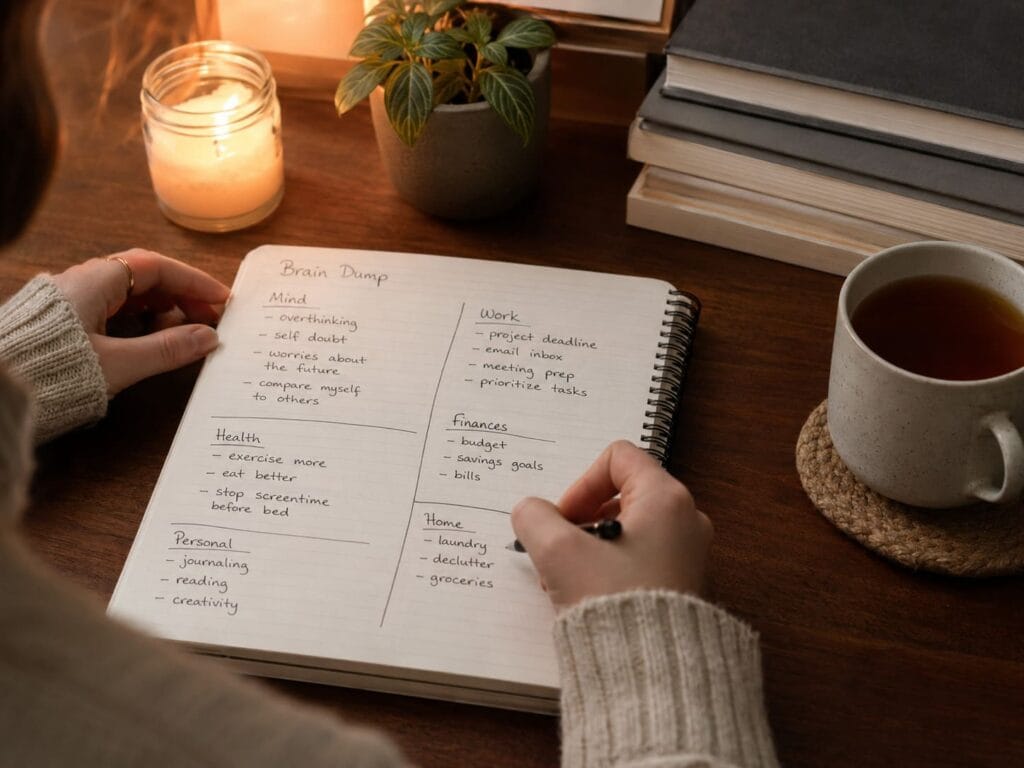
Try a Brain Dump Before Meditation
If your mind is full of tasks, do not meditate first.
Write first.
A brain dump helps remove obvious mental clutter before you sit down.
Use this quick format:
- tasks I need to remember;
- messages I need to send;
- worries on my mind;
- things I cannot solve tonight;
- top three actions for tomorrow.
Then meditate for five minutes.
This works because your mind is less likely to panic about forgetting something important. The tasks are already captured.
Walking Meditation for Restless Analytical Minds
Sitting still is not the only way to meditate.
Walking meditation can be better if your mind gets louder when your body is still.
Try this:
- walk slowly;
- notice the feeling of each step;
- keep your phone away;
- breathe naturally;
- when thoughts appear, label them and return to the step.
You can do this indoors, in a garden, or outside.
The movement gives the mind a physical rhythm. For some people, that is much easier than sitting in silence.

Guided Meditation Is Not “Cheating”
Some people think guided meditation is less serious than silent meditation.
That is nonsense.
If a guided voice helps you stay with the practice, use it.
For analytical people, guided meditation can be useful because it removes the need to decide what to do next. You follow the structure. The session holds the frame for you.
Good guided sessions are usually:
- short;
- specific;
- calm;
- practical;
- not overly mystical;
- not full of big healing promises.
Look for guided practices focused on breathing, body scan, focus, sleep wind-down, or stress awareness.
Avoid anything that promises to cure anxiety, heal trauma, unlock your brain, or reset your nervous system in one session.
HRV Breathing and Biofeedback Tools
Some analytical people do better when they can see feedback.
That is where HRV breathing and biofeedback tools may help.
These tools do not need to be treated as magic. Their value is simple: they give you a measurable routine. You breathe, follow the pacing, and watch feedback over time.
This can make practice feel more concrete.
Useful for:
- people who like data;
- people who need external structure;
- people who get bored with silent sitting;
- people who want a repeatable breathing routine.
Skip if:
- you obsess over scores;
- the data makes you more anxious;
- you want a device to do the whole job for you;
- you already feel overloaded by apps and wearables.
Neurofeedback Tools Like Mendi or Muse
Neurofeedback devices can be useful for people who want a more active form of focus training.
Instead of sitting silently and wondering whether anything is happening, you get a session with feedback. Some devices use EEG. Others use fNIRS. The details vary by product.
The buyer-safe way to think about these devices:
They may help structure focus or meditation practice.
They should not be presented as guaranteed brain rewiring, anxiety treatment, burnout recovery, emotional control, or nervous system repair.
Best for:
- data-driven users;
- people who like training sessions;
- people who want feedback;
- people who struggle with unstructured meditation.
Skip if:
- you dislike headsets;
- you want a passive solution;
- you will not use the app consistently;
- you expect medical results.

The Best Meditation Types for Analytical Minds
| Problem | Better practice | Why it helps |
|---|---|---|
| Mind races in silence | Guided meditation | Gives structure |
| Too many tasks in your head | Brain dump first | Captures open loops |
| Sitting still feels impossible | Walking meditation | Adds movement |
| You need measurable feedback | HRV breathing | Makes practice concrete |
| You overthink the technique | Breath counting | Gives a simple task |
| You get bored quickly | Short 3–5 minute sessions | Lowers friction |
| You like training systems | Neurofeedback | Turns practice into feedback |
| You judge yourself harshly | Thought labeling | Reduces self-criticism |
Common Mistakes
Mistake 1: Starting Too Long
If you hate meditation, do not start with 30 minutes.
Start with 3 minutes.
Mistake 2: Trying to Stop Thoughts
Thoughts are not the enemy.
The practice is noticing and returning.
Mistake 3: Choosing the Wrong Style
Silent sitting is not the only option.
Try guided, walking, breath counting, body scan, or HRV breathing.
Mistake 4: Turning Meditation Into Performance
If you chase a perfect score, perfect calm, or perfect focus, you turn meditation into another pressure system.
Keep it simple.
Mistake 5: Ignoring Real-Life Stressors
Meditation can support awareness, but it cannot fix every external problem.
If your workload, sleep, finances, relationships, or screen habits are the real issue, address those too.
A Simple Weekly Plan
Try this for one week:
Monday: 5-minute breath counting.
Tuesday: 10-minute walking meditation.
Wednesday: 5-minute guided body scan.
Thursday: Brain dump, then 5-minute breathing.
Friday: HRV breathing or simple paced breathing.
Saturday: 10-minute screen-free walk.
Sunday: Review what worked and choose one practice to repeat.
Do not try to master everything.
Find the method your mind resists least.
What This Practice Can and Cannot Do
Analytical meditation can help you:
- build a repeatable pause;
- notice thinking patterns;
- reduce mental clutter;
- create a calmer evening routine;
- improve focus transitions;
- stop treating meditation as failure;
- build a practical alternative to scrolling.
It cannot:
- cure anxiety;
- treat depression;
- heal trauma;
- replace therapy;
- fix burnout by itself;
- replace sleep, movement, boundaries, or medical care;
- guarantee calm every time.
That distinction matters.
Useful practices should be honest.
Final Verdict: Give the Mind a Better Job
If traditional meditation does not work for you, the answer is not more shame.
The answer is better design.
Analytical minds often need structure, feedback, labels, movement, or a clear task. That does not make the practice weaker. It makes it more realistic.
Do not force yourself to sit in silence and fight your own thoughts.
Start with five minutes. Count the breath. Label the thoughts. Use a brain dump. Walk if needed. Try guided practice. Use feedback tools only if they genuinely help.
Your mind does not need to be empty.
Your mind does not need to be empty.
It needs a better place to return.