Table of Contents
The willpower discipline trap begins when every difficult habit is treated as a test of character. You intend to stop scrolling, begin work earlier, read before bed, or turn off the television—but the plan depends on making the same correct decision again and again.
When the plan fails, the usual conclusion is that you need stronger discipline. A better question is whether the environment keeps making the unwanted action easier than the action you actually want.
This guide explains how routines, phone settings, physical distance, timers, lighting schedules, smart plugs, and dedicated products can reduce repeated decisions. The goal is not to eliminate personal responsibility. It is to stop wasting effort on a choice that could have been simplified in advance.
Research note: The popular claim that willpower is one fixed biological resource that becomes completely depleted is not settled science. Research on “ego depletion” has produced mixed findings and replication concerns. This guide therefore focuses on observable behaviour: cues, convenience, fatigue, timing, friction, habits, and environmental design.
What we assessed: digital boundaries, device placement, focus settings, router schedules, smart plugs, lighting automation, sound routines, electrical safety, recurring costs, and when buying another product is unnecessary.
What we could not independently verify: that automation restores neuroplasticity, regenerates neurons, performs a dopamine detox, removes the need for self-control, or guarantees improved sleep, focus, productivity, calm, or mental health.
Wellbeing and safety note: Habit tools may make a routine easier, but they do not treat burnout, depression, anxiety, ADHD, insomnia, compulsive behaviour, or another health condition. Follow manufacturer load limits and safety instructions for all electrical products. Never automate the shutdown of equipment that must remain available for health, safety, communication, security, refrigeration, or household access.
Quick Verdict
Do not begin by buying a smart home system. Begin by making the unwanted behaviour slightly harder and the preferred behaviour slightly easier.
For phone distraction: disable non-essential notifications, remove social apps from the home screen, charge the phone outside the bedroom, and use scheduled Focus or Downtime settings.
For late television or gaming: use a visible shutdown time, place the remote away from the sofa, disable autoplay, and consider a smart plug only when the connected equipment can be safely power-cycled.
For an inconsistent evening routine: automate one simple cue such as dimmer lighting or closing blackout shades. Do not build a complicated sequence that requires several apps and constant maintenance.
For recurring work avoidance: prepare the first task in advance, close unrelated tabs, leave the phone elsewhere, and use a dedicated timer or distraction-free device when software limits are too easy to ignore.
Skip automation when a free setting already solves the problem, another household member needs unrestricted access, the device controls safety-critical equipment, or maintaining the system creates more friction than the habit itself.
What Is the Willpower Discipline Trap?
The discipline trap has a predictable pattern:
- You set a broad rule such as “I will use my phone less.”
- The environment remains unchanged.
- The unwanted action stays convenient, visible, and immediately rewarding.
- You must repeatedly interrupt the behaviour after it has already started.
- One difficult evening is interpreted as a character failure.
- You respond with a stricter promise rather than a more practical system.
A useful habit plan is more specific. It defines the behaviour, time, location, trigger, stopping point, and alternative action.
| Weak intention | Stronger system |
|---|---|
| “I will stop scrolling at night.” | Social apps lock at 10 p.m., the phone charges outside the bedroom, and a paper book is already beside the bed. |
| “I will work with more discipline.” | The first document is open, notifications are disabled, and the phone remains in another room for one 30-minute block. |
| “I will watch less television.” | Autoplay is disabled, one episode is selected in advance, and the remote is stored away after the episode. |
| “I will go to bed earlier.” | Lighting dims at a set time, the next morning is prepared before the routine begins, and optional tasks stop at a clear boundary. |
The system does not guarantee success. It simply removes several unnecessary opportunities to make the opposite choice.
Why Do Good Intentions Often Fail in the Evening?
Evening behaviour may be affected by several ordinary factors:
- physical tiredness;
- insufficient or inconsistent sleep;
- unfinished work and emotional tension;
- hunger, alcohol, caffeine, or late meals;
- a phone that remains visible and within reach;
- autoplay and endless recommendations;
- lack of a clear stopping cue;
- no prepared low-effort alternative;
- a routine that asks for too many decisions at once.
None of these factors proves that the prefrontal cortex is “completely exhausted.” They simply make the easier and more familiar behaviour more likely.
Platforms also use features such as notifications, autoplay, recommendations, variable content, and low-friction reopening. You do not need to describe those systems as unbeatable neurological weapons to recognise that they make continued use convenient.
For a broader practical plan, read our digital mindfulness guide. It covers notification control, intentional checking, device placement, and a seven-day reset without unsupported dopamine claims.
Habit Friction Decision Table
| Your problem | Best first step | Possible product path | Skip if |
|---|---|---|---|
| Automatic phone checking | Remove notifications and move the phone out of reach | Phone lock box, app blocker, minimalist phone, or physical timer | Built-in Focus settings already work |
| Late television or gaming | Disable autoplay and create a fixed shutdown point | Smart plug for compatible non-critical equipment | The device should not be power-cycled |
| Bright evening room | Dim existing lamps and reduce overhead lighting | Smart bulb, dimmer, or motorized blackout shade | Automation requires rewiring or unwanted apps |
| Noise encourages phone-based audio | Test a fan or offline audio track | Dedicated sound machine | The room is already quiet |
| Reading is repeatedly interrupted | Use airplane mode and leave the phone elsewhere | Dedicated e-reader or paper book | You rarely read regardless of format |
| Work tabs and notifications fragment attention | Prepare one task and close unrelated apps | Visual timer or distraction-free writing device | The real problem is excessive workload |
Start With Free Changes Before Buying Anything
1. Move the cue
A visible phone, remote, game controller, or open browser tab is a repeated invitation. Put the item outside immediate reach or remove it from the room where the unwanted habit normally starts.
2. Prepare the alternative first
A screen-free evening will not feel easier when the alternative requires searching for a book, charging a device, clearing a table, or deciding what to do.
Prepare one low-effort option:
- a paper book already open at the next chapter;
- a downloaded audiobook with a timer;
- a simple puzzle or notebook;
- comfortable clothing ready for a short walk;
- one familiar offline playlist;
- tomorrow’s first task written on paper.
3. Remove the endless option
Choose one episode, one chapter, one article, or one playlist before starting. The stopping point should exist before attention becomes tired.
4. Use built-in device controls
Modern phones and computers already provide Focus modes, app limits, notification schedules, grayscale options, bedtime modes, and website blocking. Test these before buying hardware.
5. Reduce the number of rules
Do not begin with a perfect two-hour routine involving ten products. Choose one clear rule, such as:
“At 10 p.m., the phone charges outside the bedroom.”
A small rule that survives an ordinary week is more useful than a complete lifestyle system maintained for two nights.
When Can Home Automation Help?
Automation is most useful when it removes a predictable, repeated action that has one clear time or trigger.
Device-specific digital curfews
Use app schedules, parental controls, device profiles, operating-system settings, or router-level controls to limit selected entertainment devices rather than shutting down the complete household internet connection.
A complete router shutdown may also disconnect:
- security cameras and smart locks;
- smoke, water-leak, or household alerts;
- work or emergency communication;
- another household member’s device;
- accessibility or health-related equipment;
- scheduled backups and software updates.
When the phone is the problem, limit the phone. Do not disable the infrastructure of the entire home unless every user and connected system has been considered.
Lighting schedules
A scheduled reduction in brightness can create a visible boundary between active evening tasks and the final part of the night. Use existing lamps or dimmers first.
Warmer, dimmer lighting may feel more comfortable than bright overhead light. It should not be marketed as an automatic switch that forces melatonin release or guarantees sleep.
The CDC recommends turning off electronic devices at least 30 minutes before bedtime as one general sleep habit. The practical goal is reducing light and stimulating activity—not creating a perfect biological protocol.
Automated blackout shades
Motorized shades can close at a predictable time and open in the morning. This is most useful when outside light is a real bedroom problem, the windows are difficult to reach, or the user already values smart-home automation.
Automation does not compensate for thin or poorly fitted fabric. Compare motor type, power source, controls, fabric, side gaps, installation, compatibility, warranty, and manual override.
Sound routines
A smart speaker or sound machine can begin a familiar low-volume track at a set time. This may reduce the need to browse for audio, but it is optional.
Brown noise, forest sounds, rain, music, and other audio should not be described as reducing anxiety automatically or placing the nervous system into deep recovery. Some users prefer steady sound; others prefer silence.
Smart Plugs: Useful Friction With Important Limits

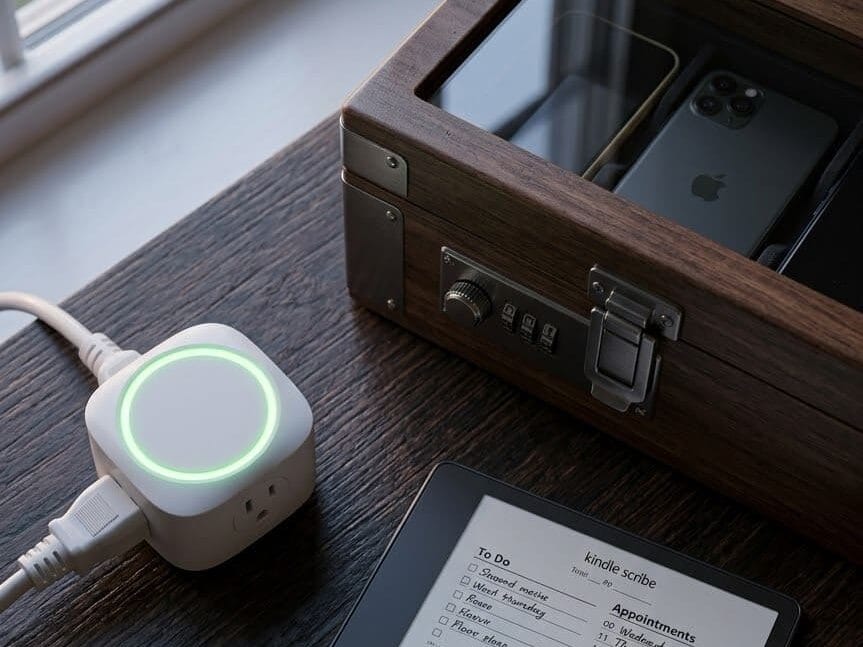
A smart plug can create a scheduled boundary for selected lamps, decorative lighting, or compatible entertainment equipment. It may also track energy use on supported models.
Its behavioural value comes from adding a small pause. When the television or lamp has already switched off, restarting the activity requires a deliberate action rather than one automatic press of the remote.
That pause may help some users reconsider the next step. It does not restore consciousness, regenerate the brain, or guarantee that the person will choose differently.
Better smart plug uses
- a low-power evening lamp;
- decorative lighting;
- a compatible television or entertainment setup that safely tolerates power disconnection;
- non-critical office equipment within the rated load;
- energy monitoring for suitable household electronics.
Do not use a smart plug casually for:
- medical or accessibility equipment;
- smoke alarms, fire systems, security systems, or smart locks;
- refrigerators, freezers, or equipment protecting food or medication;
- routers needed for emergency communication or connected safety devices;
- space heaters, cooking devices, or another high-load appliance unless the manufacturer explicitly permits that use;
- equipment that may be damaged by sudden power loss;
- anything exceeding the plug’s voltage, current, or wattage rating.
Choose a product certified for your market, inspect it for damage, keep it dry, and follow both the smart plug instructions and the instructions for the connected appliance.
Product Guides From MindReset
The right product depends on the exact source of friction. These MindReset guides compare the relevant options, costs, limitations, and who should skip them.
| Problem | MindReset guide | What it compares |
|---|---|---|
| Phone and app distraction | Digital Detox Tools for Focus | Physical blockers, minimalist phones, timers, lock boxes, and distraction-free devices |
| Reading on a distracting phone | Kindle vs Phone vs Paper Books | Dedicated e-readers, smartphones, tablets, paper books, and subscription costs |
| Outside light and scheduled window control | Motorized Blackout Shades for Sleep | Motor types, fabric, smart controls, installation, gaps, and hidden costs |
| Bedroom or office background noise | Sound Oasis S-680 Review | A dedicated sound machine, sound selection, portability, controls, and limitations |
| Soft bedtime audio | Musicozy Sleep Headphones Review | Budget sleep headband, comfort, battery, audio use, and alternatives |
| Workstation distraction | Desk Gadgets for Focus and Work Stress | Timers, lighting, organisation, focus tools, and products worth skipping |
| Complete bedroom setup | Sleep-Friendly Bedroom Setup | Lighting, blackout products, noise tools, bedding, and buying priorities |
Who Should Use Environmental Friction?
- You repeatedly make the same decision at the same time and place.
- The unwanted action begins automatically before you consciously choose it.
- Built-in phone or computer limits are easy to override.
- You want a repeatable evening or work routine with fewer steps.
- You are willing to test one adjustment before buying an entire system.
- Other household members agree with the automation.
- The products are compatible, safely rated, and easy to override when genuinely necessary.
Who Should Avoid Rigid Automation?
- Your work, caring responsibilities, or health needs require unpredictable access.
- Another household member needs the internet, lighting, or device at a different time.
- The system controls medical, security, refrigeration, heating, or emergency equipment.
- Missing one routine step causes disproportionate guilt or anxiety.
- You spend more time configuring automations than using the routine.
- The real problem is excessive workload, caregiving, pain, sleep loss, or another unmet need.
- You are replacing professional help with increasingly complicated self-control systems.
A Seven-Day Willpower-Free Habit Test
Test the idea before buying new hardware.
| Day | Action | What to observe |
|---|---|---|
| 1 | Choose one repeated problem and define the exact time and place | What cue starts the behaviour? |
| 2 | Remove the cue from immediate reach | Does the behaviour begin less automatically? |
| 3 | Prepare one easy alternative in advance | Do you use it without searching for something else? |
| 4 | Enable one built-in schedule or Focus setting | Do you accept the boundary or override it immediately? |
| 5 | Add one visible cue such as dimming a lamp or moving the remote | Does the transition become easier to notice? |
| 6 | Repeat the simplest version without adding anything | Which step creates the most value? |
| 7 | Review the week | Would hardware solve a remaining specific problem? |
Track behaviour rather than vague feelings. Useful measures include:
- time the unwanted behaviour started;
- how long it continued;
- number of overrides;
- whether the alternative was used;
- whether the system disturbed another person;
- whether maintaining it created additional work.
Buy a tool only when the test identifies a remaining obstacle that the tool can realistically remove.
Hidden Costs and Limitations
Apps and account dependence
Smart plugs, bulbs, speakers, and shades may require manufacturer accounts, cloud access, permissions, firmware updates, and continued app support.
Wi-Fi and platform compatibility
A product may depend on a specific Wi-Fi band, Matter controller, Apple Home, Alexa, Google Home, hub, or operating system. Confirm the complete setup before purchase.
Privacy and cybersecurity
Connected devices may collect account, usage, diagnostic, network, and automation information. Use unique passwords, enable available security updates, and remove products that no longer receive support.
Manual override
An evening system should have a straightforward manual override for emergencies, guests, schedule changes, and household needs.
Automation failure
Internet outages, app errors, firmware changes, depleted batteries, clock changes, and account problems may interrupt routines. Avoid making one cloud-connected product the only way to control an essential light or household function.
Electrical load and heat
Check the maximum voltage, current, wattage, operating temperature, and permitted appliance type. A plug that can schedule a lamp is not automatically suitable for a heater or kitchen appliance.
Automation can become avoidance
Turning off devices may help with one predictable habit. It cannot solve an impossible workload, household conflict, chronic sleep loss, physical illness, financial stress, or another underlying problem.
What We Could Verify
- Research does not support presenting willpower as one simple, universally proven biological tank that always becomes empty.
- Environmental cues, convenience, routines, and repeated context can affect whether a behaviour is easier to begin.
- Modern phones, routers, computers, plugs, bulbs, and shades can automate selected schedules and limits.
- The CDC recommends turning off electronic devices at least 30 minutes before bedtime as one general sleep habit.
- Smart plugs must be used within their manufacturer-rated electrical limits.
- Connected home devices introduce compatibility, privacy, security, maintenance, and reliability considerations.
- A free change in placement or settings can be tested before buying dedicated hardware.
What We Could Not Verify
- That willpower is a fixed resource that becomes completely exhausted each evening.
- That the prefrontal cortex shuts down because of ordinary daily decisions.
- That every decision not to open social media creates neurological micro-stress.
- That shutting off Wi-Fi performs dopamine detoxification.
- That a quiet room causes neurons to regenerate.
- That smart lighting automatically follows or corrects an individual’s biorhythm.
- That brown noise reduces anxiety without conscious effort.
- That home automation restores neuroplasticity or places the nervous system into deep recovery.
- That environmental design removes the need for choice, motivation, flexibility, or professional support.
Frequently Asked Questions
Is willpower really a limited resource?
The simple “battery” model is disputed. Some studies report small self-control effects after demanding tasks, while major replications and reviews have raised questions about size, consistency, and interpretation. It is safer to focus on fatigue, motivation, habits, cues, convenience, and context.
Can I improve discipline without more motivation?
You can reduce how often motivation is needed by preparing the environment: remove cues, create a clear stopping point, prepare the alternative, and automate one predictable transition.
Should I turn off my Wi-Fi every night?
Not automatically. A full shutdown may interrupt cameras, alerts, backups, smart locks, work communication, accessibility tools, and other household users. Device-specific limits are usually more precise.
Can a smart plug turn off my television automatically?
Possibly, but confirm that the television, console, external drive, receiver, and other connected equipment can safely tolerate scheduled power disconnection. Use the product within its rated load and instructions.
Can I use a smart plug with a space heater?
Do not assume that a general smart plug is suitable. Heating equipment can draw substantial current. Follow the heater and plug manufacturers’ instructions and use only a properly rated product explicitly intended for that application.
Does warm lighting make the body release melatonin?
Evening light level and timing can influence alertness and circadian signals, but one warm bulb does not guarantee a particular hormonal response or improved sleep. Use dimmer lighting as a practical environmental cue.
What is the cheapest tool for phone distraction?
Move the phone to another room and use built-in Focus or Downtime settings. A kitchen timer, paper checklist, or ordinary box may be sufficient before buying a specialised product.
What if I keep overriding every limit?
Increase friction gradually: remove the app, log out, change where the device is stored, use a separate alarm clock, ask another person to hold the override code, or consider a physical blocker. Also examine what the behaviour is helping you avoid or manage.
Can environmental design replace treatment for compulsive behaviour?
No. Environmental friction may support a plan, but persistent loss of control that harms sleep, work, finances, relationships, or safety may justify professional assessment and support.
Final Verdict
The willpower discipline trap is not solved by declaring that discipline is useless. It is solved by reserving deliberate effort for decisions that genuinely require it.
Start with the free layer: remove the cue, prepare the alternative, define the stopping point, use built-in limits, and change the physical location of the device.
Add a product only when a specific obstacle remains. A lock box may help when the phone stays within reach. A dedicated e-reader may help when reading repeatedly becomes scrolling. A motorized shade may help when outside light is the real problem. A sound machine may help when phone-based audio keeps reopening the screen.
Use smart plugs and other electrical automation conservatively. They can schedule compatible non-critical equipment, but they should never be treated as universal habit devices or placed on essential equipment without checking safety and household consequences.
MindReset recommendation: build one small boundary that works on an ordinary tired evening. A simple repeatable system is more valuable than an impressive smart home that requires constant attention.
Continue with our buyer guide to digital detox tools to compare physical blockers, minimalist devices, timers, and distraction-free alternatives.
Sources and Further Reading
- U.S. National Library of Medicine: A Multilab Replication of the Ego Depletion Effect
- U.S. National Library of Medicine: Updated Meta-Analysis of Ego Depletion
- U.S. National Library of Medicine: Willpower Mindset and Replication Evidence
- U.S. Centers for Disease Control and Prevention: Better Sleep Habits
- National Institute of Standards and Technology: Privacy and Security for Connected Devices
- Electrical Safety Foundation International: Appliance Safety Tips
- Electrical Safety Foundation International: Safe Home Automation and Energy Use