Table of Contents
Affiliate disclosure: MindReset.org may earn a commission if you buy through our links. This does not increase your price and does not affect our editorial judgment. We evaluate products based on buyer fit, verifiable specifications, limitations, ownership costs, and realistic alternatives—not commission size.
Research note: We have not personally installed or long-term tested the Joydeco motorized blackout Roman shade. This research-based buyer guide uses current manufacturer specifications, installation and care information, published shipping and return terms, available customer feedback, and comparison with other blackout window-treatment formats.
We could assess the listed fabric, motor type, power requirements, included remote, mounting guidance, cleaning instructions, and current ordering policies. We could not independently verify long-term motor reliability, operating noise, app compatibility, edge-light performance in different window frames, customer support quality, or durability after months of daily use. Prices, discounts, specifications, availability, shipping terms, and return policies may change, so confirm the current details before ordering.
Quick Verdict: Are Motorized Blackout Shades Worth It for Sleep?
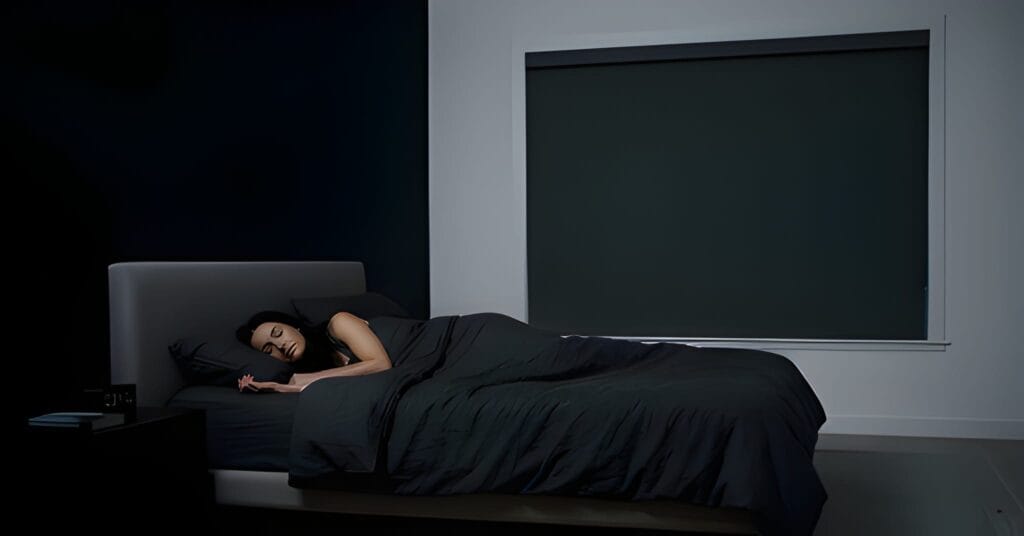
Quick verdict: Motorized blackout shades can be worth the cost when outside light regularly enters the bedroom and the buyer values scheduled or remote-controlled operation. Their realistic advantage is convenience and more consistent light control—not guaranteed deeper sleep, medical recovery, or improved cognitive performance.
The linked Joydeco product is a plug-in motorized Roman shade made with blackout polyester fabric. The current listing includes a remote control, cordless operation, removable fabric, inside- or outside-mount guidance, and a requirement for a nearby permanent power outlet.
Best for: bedrooms facing streetlights or early sunrise, difficult-to-reach windows, shift workers, media rooms, and buyers who want to open or close shades without operating each window manually.
Skip it if: you rent and cannot install permanent brackets, do not have a suitable outlet near the window, need verified app control without buying additional hardware, or are uncomfortable ordering a custom-sized product with restrictive return terms.
Main buyer risk: “Motorized” does not automatically mean “smart.” The linked shade currently lists remote operation and plug-in power, so buyers should confirm app, voice-assistant, scheduling, and hub compatibility before placing a custom order.
The Neurobiology of Light Intrusion: Why a Standard Window Covering Destroys Deep Rest
To grasp the necessity of an engineered void, one must first understand the devastating physiological impact of minor environmental disruptions. The human circadian rhythm is a master biological clock, governed by a cluster of neurons in the hypothalamus known as the suprachiasmatic nucleus. This delicate neuro-mechanism relies on strict environmental cues to orchestrate the transition between states of high-alertness and cellular repair. The primary antagonist to this restorative process is Light at Night (LAN).
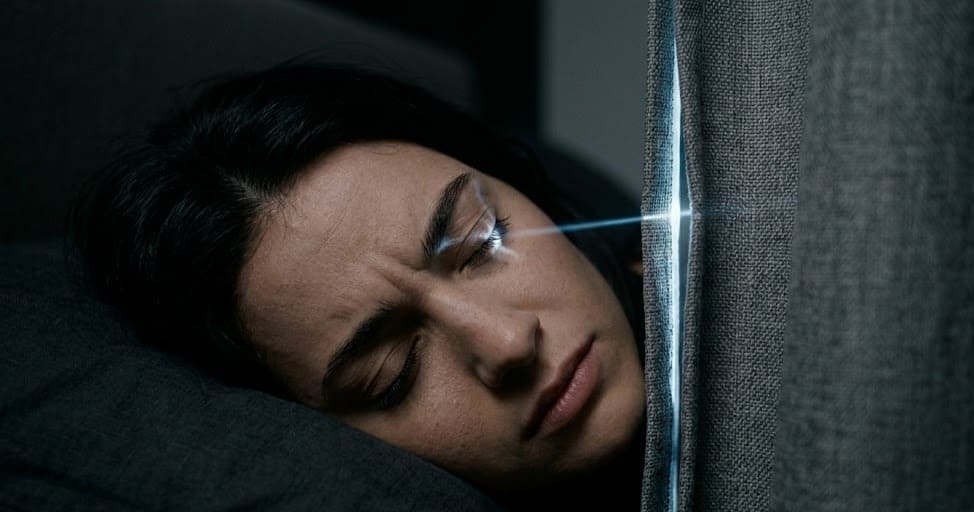
The physiological architecture of the human eye presents a unique vulnerability during periods of rest. The dermis of the eyelid is exceptionally thin, designed to protect the cornea while remaining highly permeable to ambient photons. Consequently, even a microscopic sliver of illumination—whether from a distant streetlamp, the sweeping headlights of a passing car, or a neighbor’s porch fixture—is sufficient to pierce the closed eyelids. When these photons strike the retina, they trigger a rapid neural cascade that travels directly to the suprachiasmatic nucleus.
Light exposure during the evening and night can influence circadian timing and make it harder for some people to maintain a consistent sleep routine. The actual effect depends on brightness, timing, duration, light spectrum, individual sensitivity, and whether the light reaches the eyes. A blackout shade may reduce one source of environmental light, but it should not be presented as a way to control hormones or guarantee deeper sleep.
Unwanted bedroom light may contribute to awakenings or make the room feel less suitable for sleep, especially when the source is bright, intermittent, or directed toward the bed. Vehicle headlights and changing outdoor illumination can be more noticeable than a stable low-level light source.
A well-fitted blackout shade is one practical way to reduce this disruption. It is not a treatment for metabolic, cardiovascular, hormonal, neurological, or persistent sleep problems, and individual results will vary.
The body remains in a state of superficial, fragmented rest. Moreover, Northwestern University researchers have documented that even a single night of moderate photonic exposure during rest significantly increases heart rate and triggers measurable insulin resistance the following day. Thus, the failure to secure a true void is directly correlated with metabolic dysfunction and cardiovascular strain.
The Common Limitation of Smart Curtains and Venetian Blinds
Understanding the severe neurological cost of photonic intrusion exposes the inherent, fatal flaw of standard residential window treatments. The vast majority of consumers, and indeed many builders, rely on archaic and fundamentally compromised designs. When evaluating the efficacy of traditional drapery, sheer shades, venetian blinds, or basic cellular shades, it becomes glaringly obvious that they are entirely incapable of providing the strict environmental control required by high-performers.
The primary failure of standard curtain panels lies in their structural deployment. They typically hang loosely on decorative tension rods, creating massive, unsealed gaps at the top, bottom, and lateral edges. While the textile itself may possess room-darkening properties, this perimeter leakage creates a devastating “halo effect.” The illumination simply bypasses the fabric, reflecting off the adjacent drywall and flooding the room with diffuse, ambient rays.
Traditional blackout curtains may block a large amount of light through the fabric, but gaps around the top, bottom, and sides can still allow visible light into the room. Performance depends on the curtain width, lining, rod position, wall overlap, and distance from the window.
Other common solutions fare even worse. Venetian blinds and traditional wood blinds suffer from continuous, unavoidable structural bleeding. The inherent design necessitates spaces between individual slats and routing holes for operational cords, rendering them completely useless for establishing a sensory deprivation environment. Even when tightly closed, they allow hundreds of micro-beams of harsh glare to enter the space.
Similarly, standard inside the window frame installations of typical shades or blinds inevitably leave functional clearances on the left and right sides. These micro-gaps act as localized pollution sources, acting as persistent biological disruptors.
For the individual demanding peak cognitive recovery, attempting to utilize standard shades and blinds is akin to attempting to pressurize a cabin with an open window. It is a critical point of failure in their domestic infrastructure.
Structural Efficacy and Biological Impact Analysis
| Window Treatment Category | Typical Light Control | Edge-Sealing Approach | Main Buyer Limitation |
| Traditional Drapery Panels | High through blackout fabric, but variable around the perimeter | Depends on panel width, rod placement, and wall overlap | Top and side gaps may remain visible |
| Venetian Blinds / Wood Blinds | Low to moderate | No complete seal because of slats and cord openings | Better for daytime control than full blackout |
| Standard Cellular Shades | Moderate to high | Close fit inside the frame, usually with narrow side gaps | Inside mounts may allow lateral light leakage |
| Outside-Mounted Motorized Roman Shade | Potentially high with blackout fabric and sufficient overlap | Fabric can extend beyond the window opening | Results depend on measuring, mounting, trim, and installation accuracy |
Why Joydeco May Be a Strong Smart and Motorized Blackout Option
Custom motorized blackout shades combine three buyer priorities: window-specific sizing, light-blocking fabric, and easier daily operation. The Joydeco Custom Plug-in Motorized Blackout Roman Shades are designed for buyers who want these features in a decorative Roman shade format.
The manufacturer describes the multi-layered polyester fabric as providing a room-darkening or blackout effect. However, fabric opacity does not automatically guarantee that the entire room will be completely dark, because light can still enter around the edges of the installed shade.
An outside mount that extends beyond the window opening may reduce lateral light leakage more effectively than a narrow inside mount. The final result will depend on the measurements, window trim, wall surface, selected overlap, and installation accuracy.
For the elite performer, outfitting multiple windows within the primary suite with these custom smart blackout blinds represents the best combination of minimalist architectural design and aggressive biohacking. The Joydeco shades come equipped with a sophisticated motorized mechanism that operates with near-silent efficiency, entirely replacing outdated, manual chain systems with precision automation.
The cordless design ensures a pristine visual aesthetic while providing a functionally flawless barrier. When fully deployed, the Joydeco custom blackout Roman shades do not merely filter the outside world; they act as a physical firewall, actively defending the user’s neurological recovery.
The Pathology of the Modern Alarm: Why You Need to Motorize Your Blackout Blinds
Achieving an impenetrable void is the critical prerequisite for initiating deep, restorative slumber. However, the methodology by which an individual terminates this state and returns to wakefulness is equally vital to their subsequent diurnal performance. The modern, near-universal reliance on aggressive, auditory smartphone alarms represents a catastrophic, daily physiological insult that severely undermines health optimization.
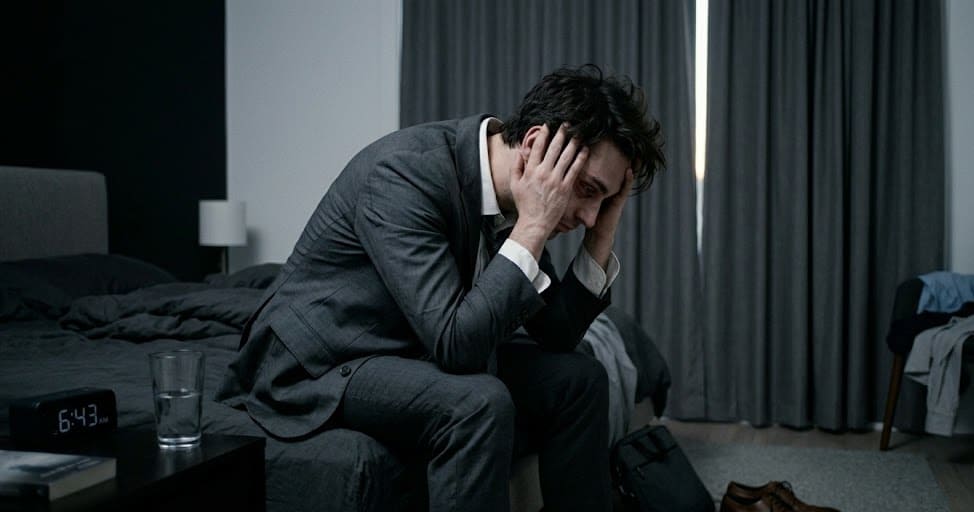
A loud alarm can feel unpleasant or abrupt, particularly when it wakes someone from deeper sleep. This does not mean that ordinary alarms are inherently dangerous or that motorized shades are a medical alternative.
Motorized blackout blinds may support a gentler morning routine by allowing the shade to open remotely or, when compatible controls are available, on a schedule. An alarm should still be used when waking at a specific time is important.
This abrupt awakening stimulates an immediate, stressful surge in catecholamines and cortisol. While a natural rise in cortisol is necessary for morning alertness, the explosive spike induced by an alarm is inherently traumatic. Repeated exposure to these loud, sudden wake-ups elevates baseline stress hormones over time, a physiological state intrinsically linked to chronic anxiety, persistent systemic inflammation, and long-term cardiovascular disease.
Grogginess after waking is commonly described as sleep inertia. Its intensity varies with sleep duration, sleep stage, schedule, accumulated sleep loss, and individual factors. A scheduled shade opening may feel more pleasant to some users, but it cannot guarantee immediate alertness or eliminate morning fatigue.
The practical reason to motorize blackout blinds is convenience—not control over blood pressure, cortisol, metabolism, body weight, inflammation, or the autonomic nervous system.
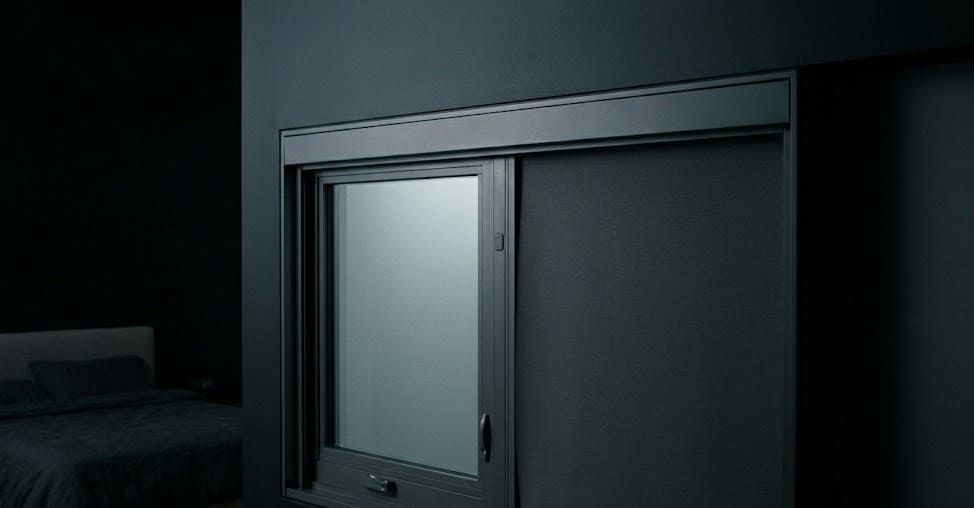
Automated Awakening: The Ultimate Biohack Using Smart Blinds and a Smart Shade
One useful feature of compatible smart blinds is the ability to open them at a scheduled time. This can allow available morning light into the room and may create a more gradual-feeling transition than immediately switching on bright indoor lighting.
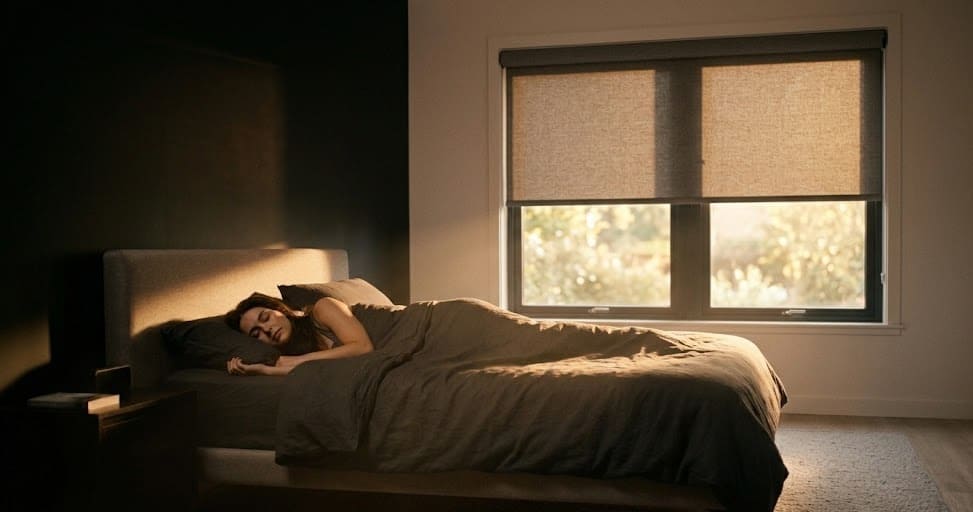
By installing the best smart blinds, the user can completely abandon the pathology of the smartphone alarm. The Joydeco smart shade allows for exact, programmatic environmental control. The individual schedules the motorized blackout Roman shades to quietly and gradually roll up at the exact desired wake time.
As the motorized blackout shades open, available outdoor light can gradually enter the bedroom. The amount of useful light will depend on sunrise time, weather, season, window direction, surrounding buildings, and the selected opening schedule.
Some users may prefer this routine to waking in a fully dark room, but scheduled shades cannot guarantee improved mood, sharper focus, faster reaction time, better hormone balance, or the elimination of sleep inertia.
For reliability, buyers who must wake at a specific time should keep a separate alarm and treat scheduled shade opening as a supportive environmental feature rather than a replacement.
This automated routine reduces the need to open and close shades manually. Its value comes from convenience, consistency, and easier control of the bedroom environment—not from directly controlling the body’s neurochemical state.
Comparative Physiological Impact of Awakening Modalities
| Awakening Method | Main Advantage | Main Limitation | Best Use Case |
| Auditory Alarm | Reliable when waking at an exact time matters | Can feel abrupt or unpleasant | Workdays, travel, appointments, and fixed schedules |
| Natural Dawn | Requires no device or automation | Varies by season, weather, and window direction | Flexible schedules and naturally bright bedrooms |
| Scheduled Smart Shades | Allows available outdoor light into the room automatically | Requires compatible controls and does not replace a reliable alarm | Smart-home users who prefer automated morning routines |
Technological Synergy: Integrating Your Blackout Roller Shade into the Smart Home Ecosystem
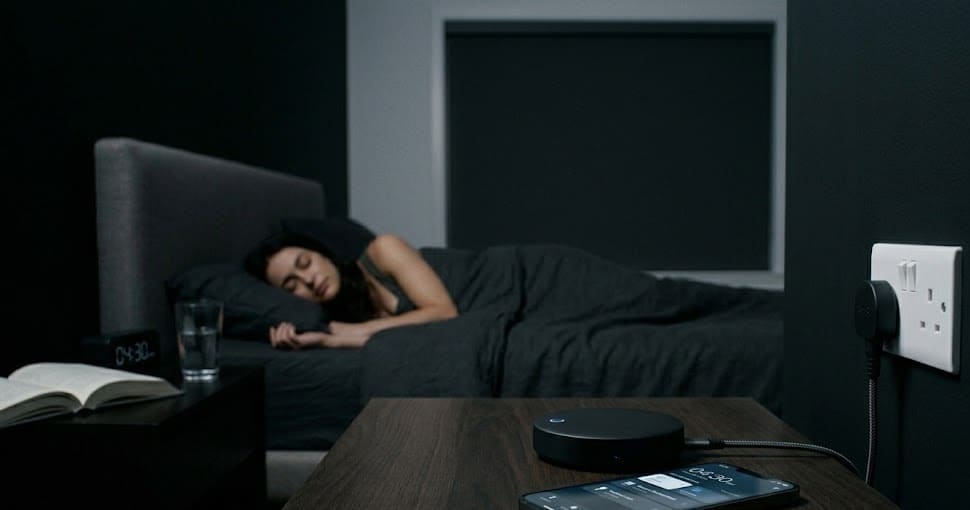
To flawlessly execute this biological synchronization, the window shades must integrate perfectly into the modern, interconnected smart home ecosystem. The title of the “best motorized blackout shades for sleep” must be reserved for hardware that requires absolute zero manual intervention upon deployment.
Joydeco offers different motor and control configurations, but buyers should not assume that every motorized shade includes full smart-home compatibility. Remote control, app control, voice control, scheduling, and hub support are separate features that should be confirmed for the exact selected model.
Some Joydeco motor configurations may require a compatible hub or gateway for app control, scheduling, or voice-assistant integration. Confirm whether a hub is required, whether it is included, and whether the exact motor works with Tuya, Alexa, Google Home, Siri, or another platform before ordering.
The protocol to add smart functionality to the recovery chamber is flawlessly logical:
- Confirm the Motor Type: Check whether the selected shade includes remote control only or also supports app control and scheduling.
- Check Hub Requirements: Confirm whether a separate Tuya or other compatible gateway is required and whether it is included in the order.
- Verify Platform Compatibility: Ask the manufacturer which Alexa, Google Home, Siri, or other smart-home features work with the exact motor configuration.
- Test Routines Carefully: After installation, test opening limits, closing limits, schedules, grouped controls, and behaviour after power or internet interruptions.
This level of automation allows for convenient voice commands, but true optimization relies entirely on passive, automated scheduling. The user never needs to manually interact with the unit. Whether one utilizes battery-powered units for pristine cordless aesthetic purity or plug-in wired motors for permanent, maintenance-free operation, the integration remains universally seamless.
It is necessary to contextualize this capability within the broader market. While competitors like smartwings motorized units, serena shades, or even the newly introduced switchbot roller shades come into the marketplace with varying degrees of smart roller capabilities, the essential functional requirement remains unchanged—a robust, silent motor, flawless smart home compatibility, and absolute, full blackout fabric.
Other solutions like eve blinds or automated wood blinds often compromise on the completeness of the light seal. Joydeco accomplishes this synthesis through high-torque, rechargeable power supplies that guarantee the shade stops at the exact same millimeter height during every operation, maintaining strict visual uniformity and unmatched mechanical reliability.
Material Science and Environmental Purity: Beyond the Visual Void
Fabric composition, cleaning requirements, colour accuracy, texture, and certification claims can also matter when choosing a bedroom window covering. Buyers who are sensitive to new-product odours should allow the shade to air out after delivery and follow the manufacturer’s care instructions.
Joydeco states that selected fabrics carry OEKO-TEX® STANDARD 100 certification. This can provide useful information about material testing, but buyers should confirm that the certification applies to the exact selected fabric and, where possible, check the certificate or label number.
Certification should not be interpreted as proof that a window shade will improve respiratory health, prevent allergies, protect the nervous system, or improve sleep quality.
Polyester Roman shades can collect household dust over time, particularly around folds and upper surfaces. Regular light cleaning may help preserve the appearance of the fabric and reduce visible dust buildup.
Follow the current manufacturer instructions for dusting, spot cleaning, steaming, or removing the fabric. Do not assume that removable fabric is automatically machine washable unless the care label specifically permits it.
The Economics of High-End Recovery: The D2C Advantage
Historically, fully outfitting a premium residence with custom smart window coverings was an exceptionally capital-intensive endeavor, often aggressively gated behind luxury interior design firms, bespoke architectural consultants, and massively inflated retail markups. This exclusionary paradigm forced many otherwise health-conscious consumers to compromise, settling for inferior, off-the-shelf blackout blinds that fundamentally failed to provide the necessary edge-sealing or sophisticated smart automation.
Joydeco radically disrupts this financial barrier through a highly efficient Direct-to-Consumer (D2C) business model. By aggressively bypassing traditional retail intermediaries, wholesale distributors, and expensive boutique showrooms, the brand assumes total, end-to-end control over the supply chain—from initial raw material sourcing to final doorstep delivery.
This streamlined operational efficiency allows Joydeco to offer made-to-measure, premium craftsmanship at shockingly aggressive price points. For instance, the Joydeco Custom Blackout Roman Shades frequently retail with significant direct-to-consumer discounts, drastically reducing the financial friction typically associated with acquiring custom sizing.
For the high-performing professional, this economic structure fundamentally alters the cost-benefit analysis of domestic optimization. Rather than viewing a single motorized shade as an exorbitant luxury upgrade, the D2C model empowers the user to order a blackout system for every single window in the primary suite without exceeding standard, reasonable home improvement budgets. Outfitting multiple windows ensures the absolute, complete eradication of ambient leaks.
The value of Joydeco shades depends on custom size, motor configuration, installation requirements, number of windows, expected usage, and how strongly the buyer values remote operation. A manual blackout shade may offer better value when the window is easy to reach and automation will rarely be used.
Comparisons with traditional retail models clearly highlight the gross inefficiency of the past. Traditional B2C brands deliberately limit consumer data access and artificially inflate prices to cover multi-tier logistics and excessive overhead. The direct-to-consumer framework not only ensures far more competitive pricing but also facilitates incredibly rapid product iteration based on direct consumer feedback. This ensures that the motor systems, fabric selections, and smart integrations remain permanently at the absolute cutting edge of technological capability.
Motor Specifications: Ensuring Your Blackout Roller and Roller Shade Operate Flawlessly
The mechanical integrity and reliability of a smart home system absolutely dictate its long-term viability. The title of “best motorized blackout shades for sleep” demands hardware that functions flawlessly, day after day, operating silently to avoid any auditory disruption during the crucial, delicate morning transition.
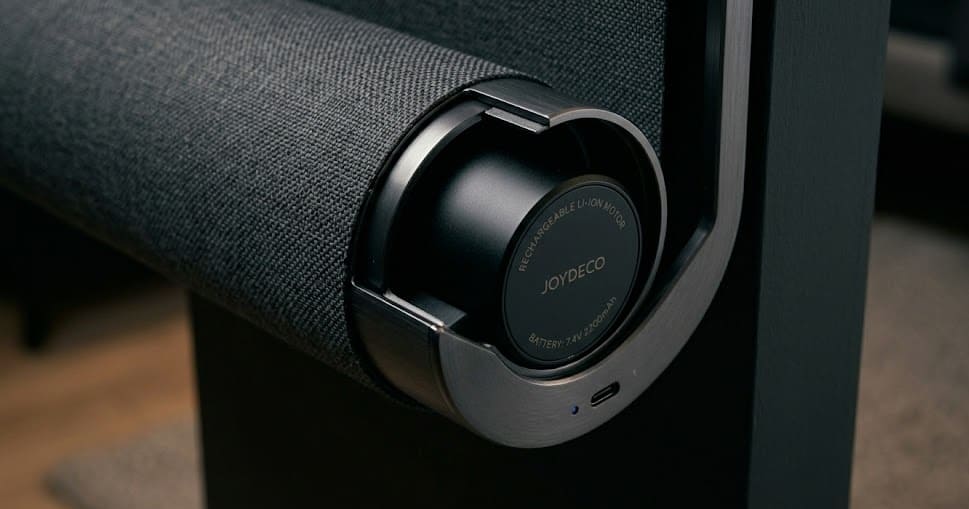
Joydeco offers specific, highly engineered power architectures tailored to diverse residential needs. The battery-powered motorization variant utilizes advanced, high-capacity, rechargeable lithium-ion power cells. This completely cordless installation eliminates the need for complex, invasive electrical hardwiring, making it accessible for immediate deployment without the necessity of contracting an expensive electrician.
The motor must be strong enough to lift the selected fabric and shade dimensions consistently. However, published cycle testing does not guarantee how long an individual motor will last in a specific home, and we could not independently verify long-term noise, speed, stopping accuracy, or durability.
Maintenance requirements depend on the exact hardware and fabric configuration. Keep the brackets, moving components, cable, plug, and motor area free from heavy dust, and avoid allowing moisture to reach the electrical parts.
Use a soft brush, feather duster, or other manufacturer-approved method for routine cleaning. Follow the supplied instructions before spot cleaning, steaming, or removing the fabric.
Should the user prefer, and if the architecture allows, selecting the plug-in/wired variant requires connection to a permanent outlet. This guarantees a continuous, endlessly reliable power source that completely eliminates the need for even infrequent battery recharging protocols. This is frequently the ideal, ultimate solution for newly constructed chambers where forward-thinking electrical planning accommodates window-adjacent power delivery.
Expanding the Sensory Control Protocol Beyond the Bedroom
While the primary suite represents the absolute apex of necessary environmental control, the advanced principles of illumination management extend to other critical residential areas. Elite performers recognize that daytime exposure dictates nocturnal quality. Therefore, aggressively controlling the ambient environment in home offices, executive living rooms, and evening decompression spaces is a necessary, logical extension of the comprehensive circadian protocol.
In spaces where absolute total darkness is not strictly required, individuals may opt for light filtering cellular shades or standard elegant Roman shades. These sophisticated units utilize specialized trapped air pockets to provide superior thermal insulation—keeping the environment aggressively cool in the summer and efficiently warm in the winter—while elegantly softening the harsh, fatiguing glare of natural sunlight.
This prevents severe ocular fatigue during intense, sustained work sessions without plunging the active room into premature darkness. However, for any space designated for deep rest, recovery, or actual unconsciousness, the strict, uncompromising application of 100% motorized blackout fabrics remains an absolute imperative.
The flawless integration of these various shade types into a single, cohesive, unified smart home platform allows the user to masterfully manipulate the entire residence’s lighting profile seamlessly. As the evening approaches, the centralized system can automatically lower blackout cellular shades or Roman shades across the entire house.

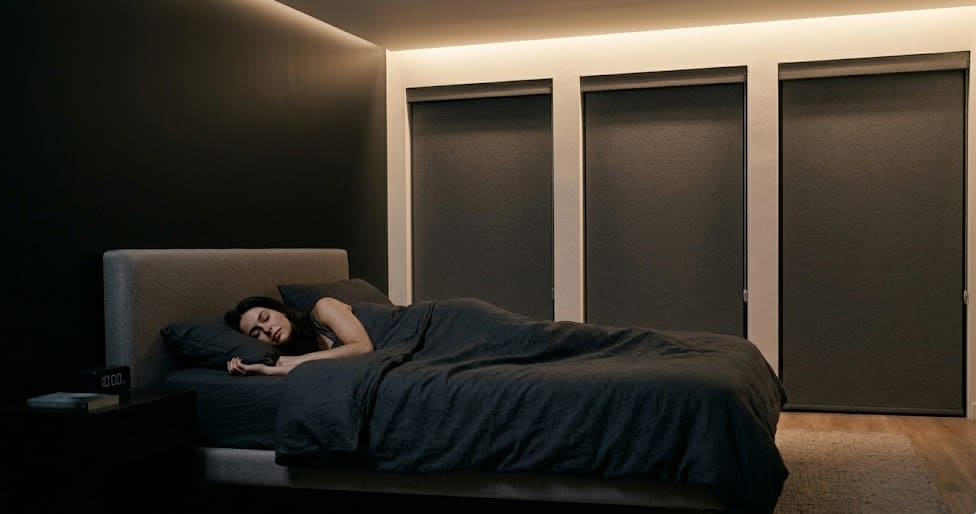
Automated evening closing can become part of a consistent pre-sleep routine, helping reduce visible outdoor light without requiring the user to close every shade manually.
When evaluating the market to pick what works best, one must look past simple manual blackout cellular shades. The sheer convenience and biological optimization offered by the Joydeco system places it in a category of its own. Unlike standard smart curtains that still leave gaps, or venetian blinds that bleed ambient rays, the custom fit guarantees a perfect seal.
Based on available specifications and public documentation, the Joydeco model combines direct-to-consumer pricing, Tuya smart hub compatibility, and OEKO-TEX-certified fabrics, making it a strong option to compare with leading luxury brands. It may be a strong fit for buyers who want automated blackout control, smart-home compatibility, and fabric certification in a direct-to-consumer shade.
We could verify
The published product positioning, motorized operation, listed blackout fabric, available mounting options, stated power configuration, remote-control features, installation guidance, care information, and the manufacturer’s current claims about smart-home and material features.
What we could not verify
We could not independently verify long-term motor reliability, operating noise, total darkness after installation, exact smart-home compatibility for every motor option, app stability, battery or power-component degradation, colour accuracy, customer support quality, return handling, delivery condition, or real-world durability over months of daily use.