
Table of Contents
Noise cancelling vs open ear headphones is not simply a choice between silence and sound. The real decision is how much outside noise you need to block, how much awareness you must preserve, and whether you want to switch between those two states throughout the day.
This guide compares noise-cancelling vs open-ear headphones, along with transparency and ambient-sound modes. It explains which design is better for focused work, commuting, walking, home use, travel, and situations where environmental awareness matters.
For a broader look at how background sound, silence, music, and environmental noise affect a workspace, read our acoustic ecology guide.
Affiliate disclosure: MindReset.org may earn a commission if you buy through our links. This does not increase your price and does not affect our editorial judgment.
Amazon disclosure: As an Amazon Associate, we earn from qualifying purchases.
Research note: We have not personally tested every headphone in this comparison. This guide is based on official product specifications, public documentation, available hearing-safety guidance, product design, and comparison with similar headphones.
What we assessed: listening design, environmental awareness, noise cancellation, ambient-sound controls, battery life, comfort considerations, app dependence, portability, water resistance, and fit for specific use cases.
What we could not independently verify: long-term comfort, microphone quality in every environment, real-world battery degradation, app stability, customer support, durability over several years, or how effective noise cancellation will feel to every listener.
Health and safety note: Headphones are not treatments for anxiety, sensory disorders, burnout, insomnia, ADHD, or another medical condition. Listening comfort varies. Persistent ear pain, dizziness, tinnitus, pressure, or hearing changes should not be ignored.
Availability note: Models, specifications, software features, prices, colors, warranties, and availability may change. Confirm the current offer before purchasing.
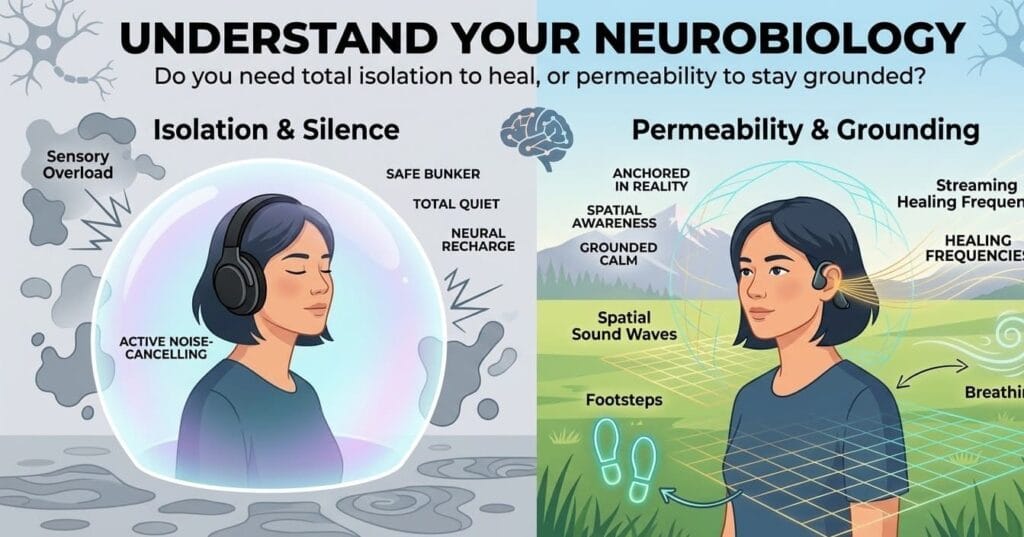
Quick Verdict: Noise-Cancelling or Open-Ear Headphones?
Choose noise-cancelling headphones when your main problem is steady background noise from aircraft, trains, air conditioning, office conversations, appliances, or nearby traffic.
Choose open-ear headphones when you need to hear children, colleagues, announcements, approaching vehicles, doorbells, or changes in your surroundings while listening.
Choose headphones with a strong transparency or ambient-sound mode when you need both isolation and awareness at different points of the day.
For maximum noise reduction, our main pick is the Bose QuietComfort Ultra Headphones (2nd Gen). For continuous environmental awareness, choose the Shokz OpenRun Pro 2. For buyers who want advanced noise cancellation with flexible ambient controls, the Sony WH-1000XM6 is the strongest hybrid option.
Noise-Cancelling vs Open-Ear Headphones: Decision Table
| Listening need | Best type | Recommended option | Why | Skip if |
|---|---|---|---|---|
| Maximum isolation | Over-ear ANC | Bose QuietComfort Ultra 2nd Gen | Designed for strong noise cancellation with Quiet and Aware modes | You dislike sealed ear cups or need constant awareness |
| Walking, running, and awareness | Open-ear | Shokz OpenRun Pro 2 | Leaves the ear canal open while providing wireless audio | You need strong bass isolation or quiet listening in loud places |
| Work, travel, and flexible modes | Hybrid ANC with ambient mode | Sony WH-1000XM6 | Combines advanced ANC, Ambient Sound, and Quick Attention controls | You want a simple device without app settings |
| Air travel | Over-ear ANC | Bose or Sony | Reduces steady low-frequency cabin noise | Over-ear clamping or heat bothers you |
| Shared home office | ANC or ambient mode | Sony WH-1000XM6 | Lets you switch between focus and conversation | You need to hear the room continuously |
| Outdoor awareness | Open-ear | Shokz OpenRun Pro 2 | Keeps the ear canal uncovered | Your environment is too loud to hear audio comfortably |
What Is the Difference Between ANC, Open-Ear, and Transparency Mode?
Active noise cancellation
Active noise cancellation uses microphones to detect environmental sound and generates an opposing audio signal intended to reduce part of that noise.
ANC is generally most useful against steady, repeating sounds such as aircraft engines, train noise, ventilation systems, and low background hum. Performance against sudden voices, sharp sounds, and rapidly changing noise varies by model and fit.
Over-ear ANC headphones also provide passive isolation because their ear cups physically surround the ears.
Open-ear headphones
Open-ear headphones leave the ear canal uncovered. Depending on the model, sound may be delivered through bone conduction, air-conduction speakers positioned near the ear, or a combination of both.
The main benefit is awareness. You can listen to speech, music, or navigation while still hearing more of the surrounding environment.
The trade-off is isolation. Loud traffic, machinery, wind, conversations, and public transport may overpower the audio and tempt you to raise the volume.
Transparency and ambient-sound modes
Transparency or ambient-sound modes use external microphones to feed environmental sound through sealed headphones.
This creates a middle option. You can use ANC while concentrating, then switch to ambient sound when speaking to a colleague, listening for an announcement, or moving through a public space.
Ambient sound is electronically processed and may not sound identical to listening without headphones. Wind, microphone quality, processing delay, and app settings can affect the result.
Which Headphone Type Is Best for Focused Work?
Noise-cancelling headphones are usually the better option when external sound repeatedly interrupts concentration. They are especially useful in open offices, shared homes, cafés, airports, and rooms with ventilation or appliance noise.
Open-ear headphones may be better when your work requires awareness. Parents, reception workers, people waiting for deliveries, and anyone who needs to respond quickly to colleagues may find full isolation impractical.
The best setup may be a headphone with both strong ANC and a usable ambient mode. That allows a focused block without removing the headphones whenever someone speaks.
Headphones cannot repair unclear priorities, excessive notifications, poor sleep, an overloaded schedule, or constant task switching. Treat them as one layer of a focus setup rather than a complete productivity solution.
Which Headphone Type Is Better for Walking and Commuting?
Open-ear headphones preserve more direct access to environmental sound, making them the more practical choice when awareness matters.
However, an open design does not guarantee safety. Music, calls, wind, traffic volume, and divided attention can still prevent you from noticing something important. Pause audio at crossings, follow local rules, and never rely on headphones as your only source of environmental awareness.
For trains, buses, and aircraft, ANC is usually more useful because it reduces steady background noise. Transparency mode can then be enabled for announcements or conversations.
1. Bose QuietComfort Ultra Headphones (2nd Gen): Best for Maximum Isolation

The Bose QuietComfort Ultra Headphones (2nd Gen) are the strongest option in this guide for buyers who prioritise isolation, travel comfort, and straightforward control over how much outside sound enters.
Quiet Mode provides full noise cancellation, while Aware Mode allows more environmental sound through. Bose also offers ActiveSense, which can automatically apply some noise cancellation when sudden loud sounds interrupt Aware Mode.
Bose states that the second-generation model can provide up to 30 hours of playback with ANC active, up to 23 hours with Immersive Audio, and up to 45 hours with ANC turned off. Battery results depend on volume, settings, connection, and usage.
The main disadvantages are price, the sealed over-ear design, heat during long sessions, and the possibility that some users will dislike wearing large ear cups for several hours.
Best for: flights, trains, shared offices, low-frequency background noise, deep-work sessions, and buyers who want strong isolation.
Skip if: you need continuous awareness, dislike over-ear pressure, work in warm conditions, or want a lightweight outdoor headphone.
2. Shokz OpenRun Pro 2: Best for Environmental Awareness
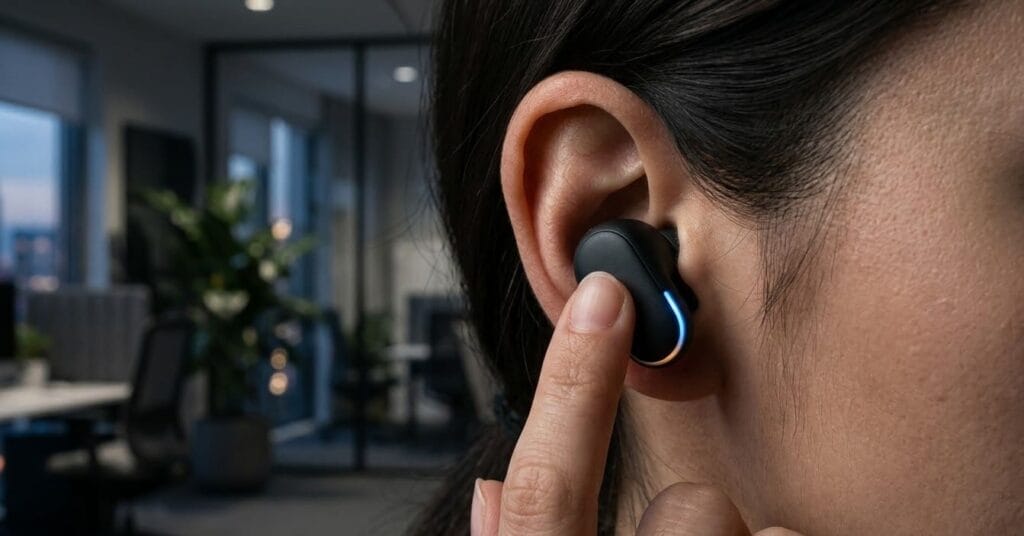
The Shokz OpenRun Pro 2 is designed for buyers who want audio without placing an earbud inside the ear canal or sealing the ears with over-ear cups.
Its DualPitch design combines bone conduction for mids and highs with a separate air-conduction component for bass. The ears remain open, allowing more direct awareness of conversation, traffic, announcements, and other environmental sounds.
Shokz lists up to 12 hours of battery life, USB-C charging, quick charging, standard and Mini sizes, and IP55 resistance against sweat and light rain. IP55 does not make the headphones suitable for swimming, showering, saunas, or prolonged water exposure.
The main limitation is performance in noisy places. Because the ears remain open, traffic, trains, aircraft, wind, and loud conversations can compete with your audio.
Best for: walking, running, working around children, household tasks, outdoor routines, and situations where awareness matters more than isolation.
Skip if: you want powerful isolation, frequently travel by air, work beside loud machinery, or expect the same bass and privacy as sealed headphones.
3. Sony WH-1000XM6: Best Hybrid Option for Work and Travel
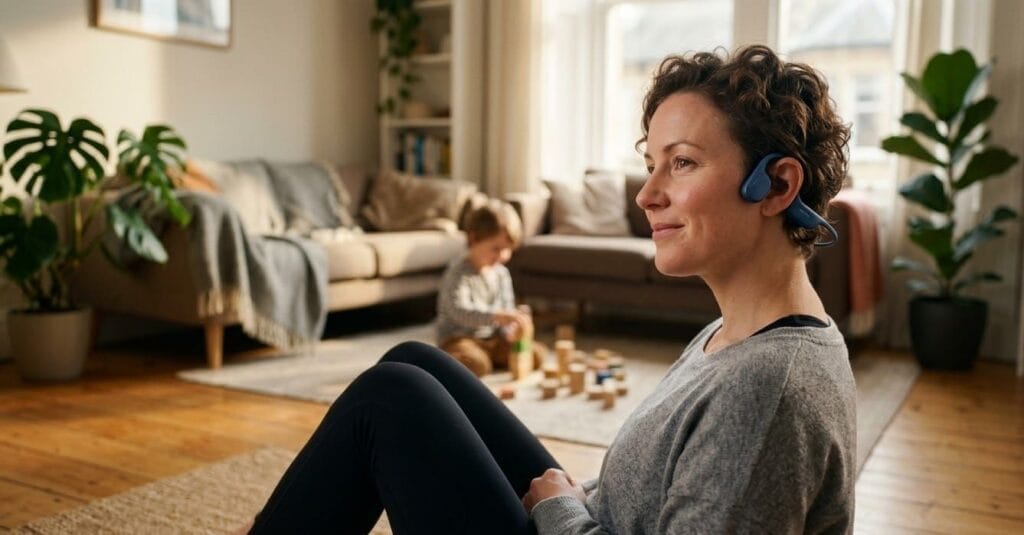
The Sony WH-1000XM6 is the most flexible choice for buyers who regularly switch between isolation and awareness.
Sony combines active noise cancellation with Ambient Sound Mode, Quick Attention, adaptive controls, multipoint connectivity, and app-based sound settings.
Quick Attention temporarily reduces playback and lets in ambient sound when the user covers the touch panel. Ambient Sound Mode can remain enabled for longer conversations or awareness during a shared workday.
Sony lists up to 30 hours of continuous music playback with noise cancellation active and up to 40 hours with it switched off. Results depend on the selected settings and use.
The trade-off is complexity. The Sony Sound Connect app contains many controls, and buyers who prefer a simple physical on/off experience may find the number of settings unnecessary.
Best for: hybrid work, commuting, flights, multipoint use, buyers who frequently switch between focus and conversation, and people who enjoy adjusting app settings.
Skip if: you dislike touch controls, want an open-ear design, prefer minimal software, or do not need advanced adaptive features.
Can Noise Cancellation Feel Uncomfortable?
Some listeners describe ANC as creating a pressure-like, enclosed, or unnatural sensation. That does not mean the headphones are physically changing air pressure in the same way as altitude changes.
Comfort may depend on ear-cup seal, clamping force, audio processing, personal sensitivity, fit, and how quickly the user switches from a noisy environment into strong cancellation.
Try a lower cancellation level, Aware Mode, Ambient Sound Mode, or a shorter session. Stop using the headphones if they produce persistent pain, dizziness, nausea, tinnitus, or hearing changes.
Are Open-Ear Headphones Automatically Safer?
No. Open-ear headphones can improve environmental awareness, but they do not automatically protect hearing.
In a noisy environment, an open design may force the listener to raise the volume to compete with traffic, wind, machinery, or public transport. Noise-cancelling headphones can sometimes make lower-volume listening easier because less background noise reaches the listener.
Safety depends on volume, listening duration, surrounding noise, fit, and attention—not only on whether the ear canal is open.
Hearing Safety: Volume Matters More Than Headphone Type
The World Health Organization states that both sound level and listening duration affect hearing risk. Its current safe-listening guidance gives an example of up to 40 hours per week at an average of 80 dB, compared with only four hours per week at 90 dB.
Read the current WHO safe-listening guidance.
- Use the lowest volume that keeps speech or music clear.
- Take regular breaks during long work or travel sessions.
- Use device volume warnings and listening-history tools.
- Do not increase volume simply to overpower traffic or machinery.
- Clean ear pads and contact surfaces regularly.
- Stop listening when you notice ringing, muffled hearing, pain, or unusual sensitivity.
Hidden Costs and Practical Checks
- Replacement ear pads: over-ear cushions compress, absorb sweat, and eventually wear.
- Battery degradation: maximum runtime usually declines with age and charging cycles.
- App dependence: EQ, firmware, adaptive controls, and custom modes may depend on a phone app.
- Fit risk: head size, glasses, hair, ear shape, and clamping preference affect comfort and ANC performance.
- Microphone limitations: wind and crowded environments can reduce call quality.
- Water resistance: sweat resistance does not mean swimming or shower use.
- Sound leakage: open-ear models may be audible to nearby people at higher volumes.
- Return conditions: check whether opened headphones can be returned in your region.
- Older listings: Amazon may show previous generations alongside current models.
Who Should Buy Noise-Cancelling Headphones?
- Frequent flyers and train passengers.
- People working around steady background noise.
- Remote workers sharing space with other household members.
- Buyers who prefer stronger bass and a sealed listening experience.
- People who want to reduce the need to overpower background noise with volume.
- Users who can switch to an ambient mode when awareness matters.
Who Should Buy Open-Ear Headphones?
- Walkers and runners who need more environmental awareness.
- Parents who need to hear children and household sounds.
- People who dislike objects inside the ear canal.
- Workers who must remain available to colleagues.
- Users who listen mainly in quieter environments.
- People who value light weight and airflow over isolation.
Who Should Avoid Both Types?
- Anyone experiencing unexplained ear pain, tinnitus, dizziness, or hearing changes.
- People expecting headphones to treat anxiety, burnout, or sensory conditions.
- Workers in environments where headphones are prohibited or unsafe.
- Anyone who routinely listens at excessive volume.
- People who need certified hearing protection against dangerous workplace noise.
- Buyers who cannot tolerate over-ear clamping or open-ear vibration.
What We Could Verify
- Bose QuietComfort Ultra Headphones (2nd Gen) provide Quiet and Aware modes, with ActiveSense available in Aware Mode.
- Bose states up to 30 hours of playback with ANC, 23 hours with Immersive Audio, and 45 hours with ANC switched off.
- Shokz OpenRun Pro 2 uses an open-ear DualPitch design combining bone and air conduction.
- Shokz lists up to 12 hours of battery life, quick charging, USB-C, and IP55 resistance.
- Sony WH-1000XM6 specifications list up to 30 hours with noise cancellation and 40 hours without it.
- Sony provides Ambient Sound Mode and Quick Attention features on the WH-1000XM6.
- The WHO advises considering both listening volume and duration when assessing hearing risk.
What We Could Not Verify
We could not verify that silence naturally signals predators to the human brain, that ANC triggers cortisol or panic, or that particular headphones regulate the nervous system.
We could not verify that 432 Hz audio, binaural beats, brown noise, or another specific sound frequency reliably treats anxiety, accelerates recovery, or produces a predictable physiological response.
We also could not verify which model will feel most comfortable for every head shape, glasses frame, hairstyle, ear shape, or sensitivity level without extended personal use.
FAQ
Are noise-cancelling headphones better than open-ear headphones?
Noise-cancelling headphones are better for reducing steady background noise. Open-ear headphones are better when environmental awareness and an uncovered ear canal matter more than isolation.
Which type is better for working from home?
Choose ANC when household sounds interrupt concentration. Choose open-ear headphones when you must hear children, deliveries, alarms, or other people in the home.
Are open-ear headphones good for an office?
They can work well in a relatively quiet office where awareness matters. They are less effective in loud open-plan spaces because environmental sound remains audible.
Can I use noise-cancelling headphones without music?
Many ANC headphones allow noise cancellation without active music playback, although operation and battery requirements vary by model.
Is transparency mode the same as open-ear listening?
No. Transparency mode electronically passes sound through microphones while the ears remain physically covered or sealed. Open-ear headphones leave the ear canal uncovered.
Are bone-conduction headphones silent to other people?
Not always. Open-ear headphones can leak sound, particularly at higher volumes. Leakage depends on the design, fit, volume, and distance from other people.
Which headphones are best for flights?
Over-ear ANC headphones such as Bose QuietComfort Ultra or Sony WH-1000XM6 are generally more suitable for reducing steady aircraft-cabin noise than open-ear headphones.
Final Verdict
Choose the Bose QuietComfort Ultra Headphones (2nd Gen) when strong isolation, travel, and straightforward ANC performance are the main priorities.
Choose the Shokz OpenRun Pro 2 when hearing the surrounding environment matters more than blocking it.
Choose the Sony WH-1000XM6 when you need a flexible work-and-travel headphone that can switch between advanced noise cancellation and environmental awareness.
There is no universal winner in the noise-cancelling vs open-ear headphones comparison. The correct choice depends on whether your current environment requires isolation, awareness, or frequent movement between both.
Buy for the environment you actually use—not for claims about therapy, brain frequencies, cortisol, or nervous-system recovery.
For additional workspace and attention tools, compare our smart gadgets for a quick mind reset.