Table of Contents
Premium brain training devices are no longer just meditation gadgets with nicer packaging.
MindReset.org may earn a commission if you buy through our links. This does not increase your price and does not affect our editorial judgment.
Research note: We have not personally tested Sens.ai, Neurosity Crown, or the other neurotechnology products discussed here yet. This guide is based on product specifications, public documentation, available research, user feedback, and comparison with similar tools.
This article is for general informational and buyer-guidance purposes only. It is not medical advice, diagnosis, or treatment. Wellness devices, cold exposure, heat, light therapy, PEMF, breathing practices, recovery tools, and nervous-system-related products may not be suitable for everyone. If you have a medical condition, take medication, are pregnant, have cardiovascular concerns, or are unsure whether a product or practice is appropriate for you, speak with a qualified healthcare professional before using it.
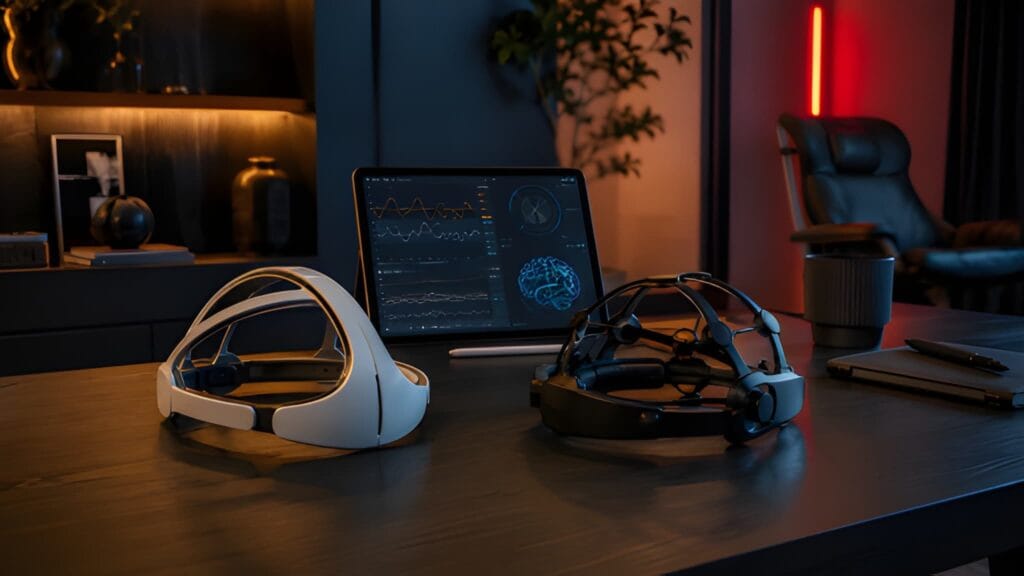
Sens.ai and Neurosity Crown both sit in the serious at-home neurofeedback category. Both use EEG. Both are designed for people who want more than a basic wellness app. Both appeal to biohackers, founders, high-performance professionals, developers, and people who want a deeper view of their brain activity.
But they are not built for the same person.
Sens.ai is closer to a structured home neurofeedback system. It gives you guided training, Missions, app-based protocols, PBM, light stimulation, and a more finished wellness experience.
Neurosity Crown is closer to a brain-computer interface. It is made for users who want access to signal-level acces, AI integration, developer tools, and real-time brain signals they can actually build with.
So the real question is not simply: “Which is the best neurofeedback device?”
The better question is:
Do you want a guided brain training system, or do you want an open EEG headset for experimentation, focus tracking, and AI-connected brain signals?
That difference changes everything.
User Reviews: What Matters Before Choosing a Home Neurofeedback Device
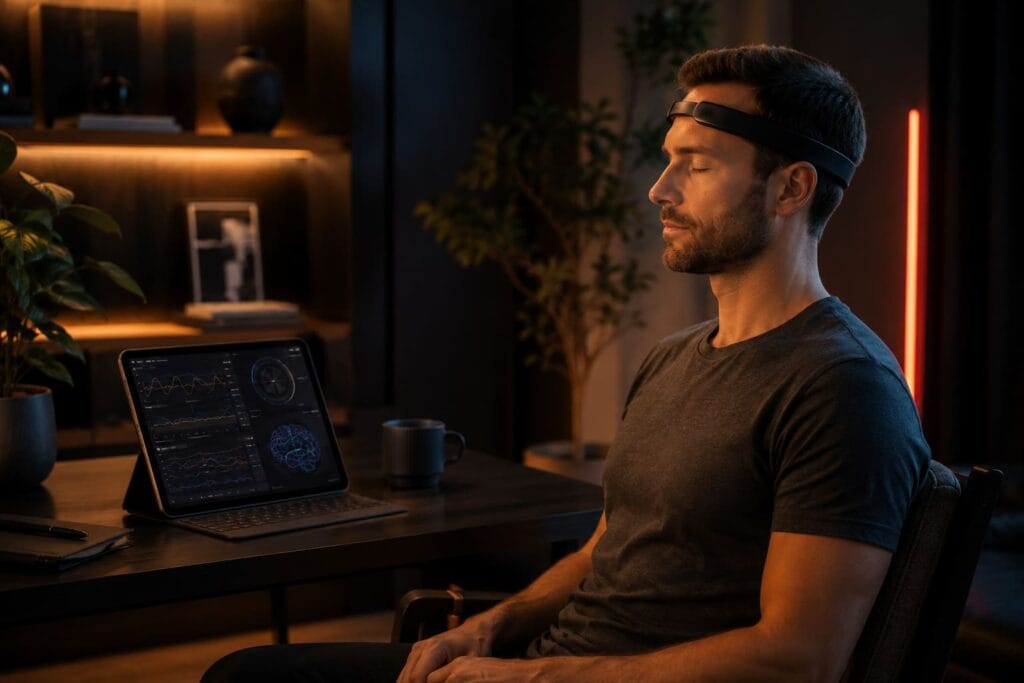
Before comparing EEG channels, PBM, AI integration, and sensor placement, it is worth starting with the part buyers actually care about after the first week: daily use.
Most people do not abandon a brain training device because they read a technical paper and changed their mind. They abandon it because setup feels annoying, the app is unclear, the sensors are inconsistent, the training exercises feel repetitive, or the device does not fit their routine.
That is why user reviews around premium neurofeedback devices usually circle around the same practical questions:
Is the headset comfortable enough to use regularly?
Is the signal quality stable?
Does the app explain what to do next?
Can a beginner use it without becoming an EEG technician?
Does the device provide meaningful feedback, or just attractive charts?
Is the training program structured enough to keep the user engaged?
Can advanced users access raw EEG data?
Does the device feel like a serious cognitive performance tool, or just an expensive headband?
This is where Sens.ai and Neurosity Crown start to separate.
Sens.ai is built for the person who wants direction. You put on the Sens.ai headset, follow the app, choose a training program, and work through guided neurofeedback sessions. The value is in structure. You are not expected to design your own neurofeedback protocols or understand every detail of raw EEG.
Neurosity Crown is built for the person who wants access. You are not just using a brain training device; you are working with a brain-computer interface. The value is in control, raw EEG data, software integration, and the possibility of building your own AI-connected workflows.
That makes Sens.ai easier to understand for a wellness buyer. It also makes Neurosity Crown more exciting for a technical user.
Neither approach is automatically better. They solve different problems.
Quick Verdict: Best Home Neurofeedback Device for Your Use Case
Choose Sens.ai if you want guided at-home neurofeedback, structured brain training, PBM, light-based sessions, app-led Missions, and a premium wellness experience.
Choose Neurosity Crown if you want signal-level acces, developer tools, AI integration, BCI experiments, real-time brain activity tracking, and more control over your own signal feedback.
Choose Muse S Athena or Muse if your main goal is meditation, guided meditation, sleep tracking, calm training, and a softer entry point into EEG-based brain wearables.
Choose Mendi if you want a simpler consumer brain training device with a lower-friction routine and less technical complexity.
For a category-level view of measurement methods and ongoing costs, use our neurotechnology devices buyer guide.
Choose Apollo Neuro, Ultrahuman Ring, or Manta Sleep if your real goal is recovery, nervous system support, sleep optimization, or wearable tracking rather than EEG neurofeedback.
That is the simple version.
Now let’s go deeper.
Sens.ai Review: Guided At-Home Neurofeedback, PBM, and Training Missions
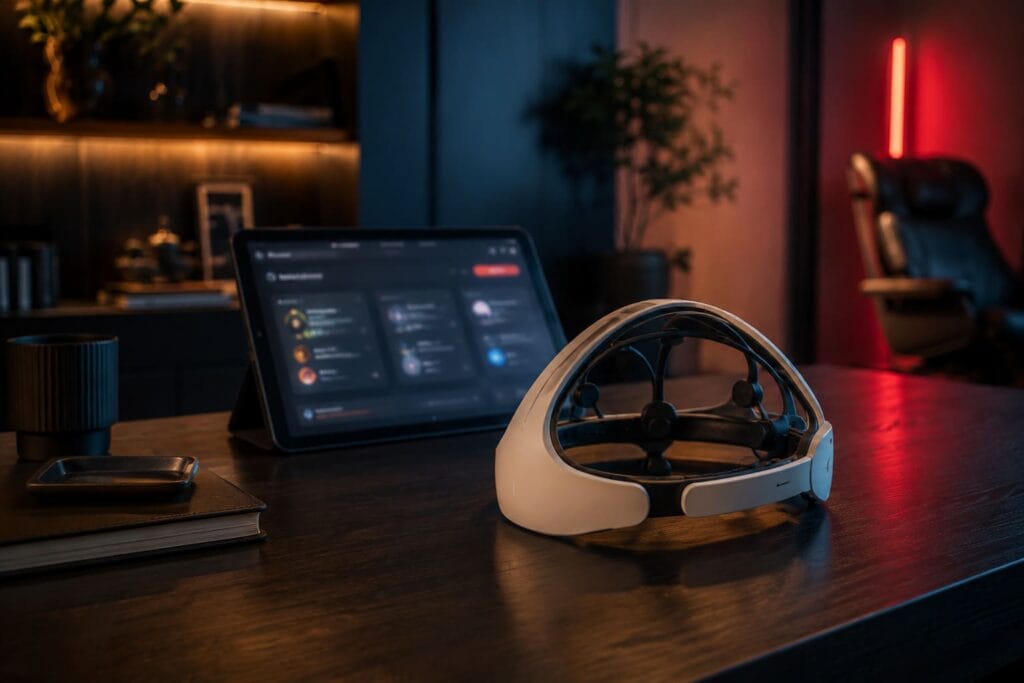
Sens.ai is designed as an at-home neurofeedback system for people who want a complete training environment rather than a raw EEG playground.
The core idea is simple: assess your brain activity, choose a Mission, train consistently, and reassess over time.
This makes Sens.ai feel less like a gadget and more like a training system. The device is not only trying to show your brain data. It is trying to guide you through a structured process.
The Sens.ai headset combines EEG neurofeedback with PBM, also known as photobiomodulation. In practical terms, this means the device uses EEG sensors to measure electrical brain activity and adds a light-based training layer through near-infrared light stimulation.
For a buyer, the important point is not to get lost in the science vocabulary. The important point is that Sens.ai is trying to do more than basic brain tracking.
This makes Sens.ai feel closer to a structured neurofeedback protocol for home use than a simple meditation headband.
It is built around:
- EEG neurofeedback
- guided training sessions
- structured Missions
- PBM / photobiomodulation
- app-based progress tracking
- meditation and cognitive training
- a premium home neurofeedback experience
This is why Sens.ai will appeal to people who want brain training at home but do not want to manually build protocols, write code, or interpret developer signal access themselves.
The strongest part of Sens.ai is its structure.
You are not left alone with charts and brain wave data. The app gives you a training program. That matters because most people do better with a clear path than with unlimited options.
A serious user may appreciate the Missions because they create a reason to keep using the device for several weeks. That is important. Neurofeedback training is not a one-session product category. The value comes from repetition, consistency, and feedback over time.
Sens.ai is best understood as a premium brain training device for guided use.
Not a medical clinic at home.
Not a miracle headset.
Not a replacement for professional care.
A structured neurofeedback and light-based training system for people who want to train attention, recovery, cognitive performance, meditation quality, or mental state awareness in a more guided way.
Neurosity Crown Review: EEG Headset for AI, Focus Training, and Brain Activity Tracking
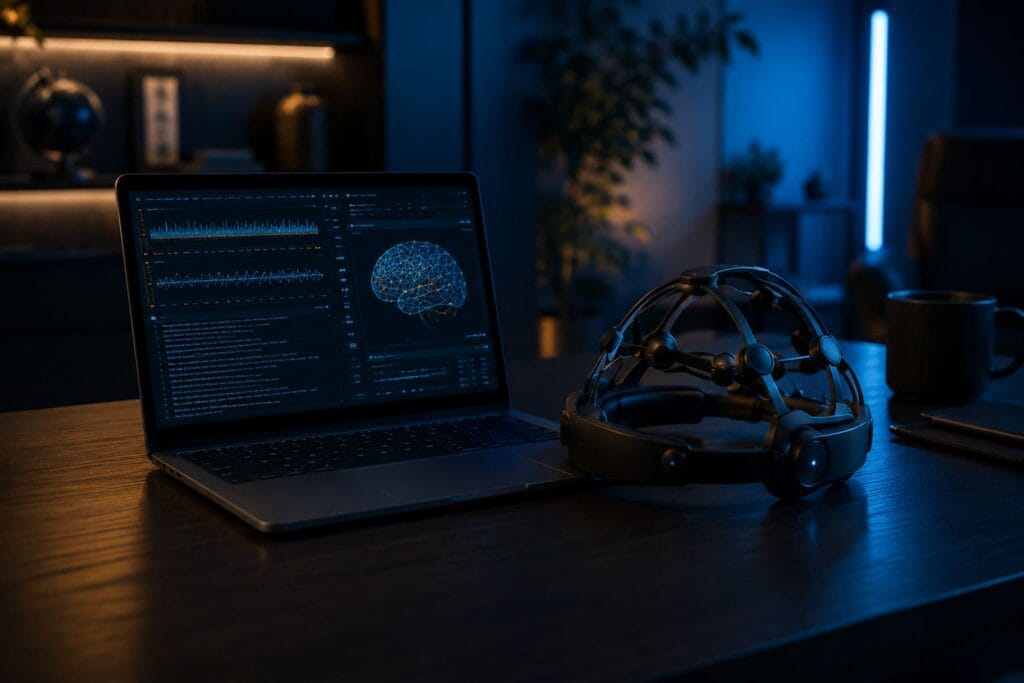
Neurosity Crown is a very different type of device.
It is not trying to be a polished wellness coach first. It is trying to be a brain-computer interface.
That means the Crown is more interesting if you care about raw EEG, real-time brain activity, AI integration, software workflows, and building things with brain signals.
For a casual wellness buyer, that can sound like too much work.
For a developer, researcher, quantified-self user, or AI builder, that is exactly the point.
Neurosity Crown uses EEG sensors to track electrical brain activity and provides access to brain data in a way that is much more open than most consumer neurofeedback devices. The device is designed around the idea that your brain activity can become an input layer for software.
That is the real reason Crown feels more future-facing.
It is not just about focus training. It is about using EEG as an interface.
The Crown is strongest for:
- raw EEG data
- real-time brain activity tracking
- AI workflows
- brain-computer interface experiments
- developer projects
- custom dashboards
- focus and cognitive performance tracking
- software integration
- brain data ownership and control
This is a different buyer profile.
If you want a simple app telling you what session to do next, Neurosity Crown may feel too open.
If you want to connect brain signals to software, AI, productivity tools, custom experiments, or BCI projects, Sens.ai may feel too closed.
That is the central difference in this comparison.
Sens.ai trains you inside its system.
Neurosity Crown gives you more room to build your own system.
Neurosity Crown uses EEG to turn brain activity into real-time signals that can support focus training, software experiments, and AI-connected workflows.
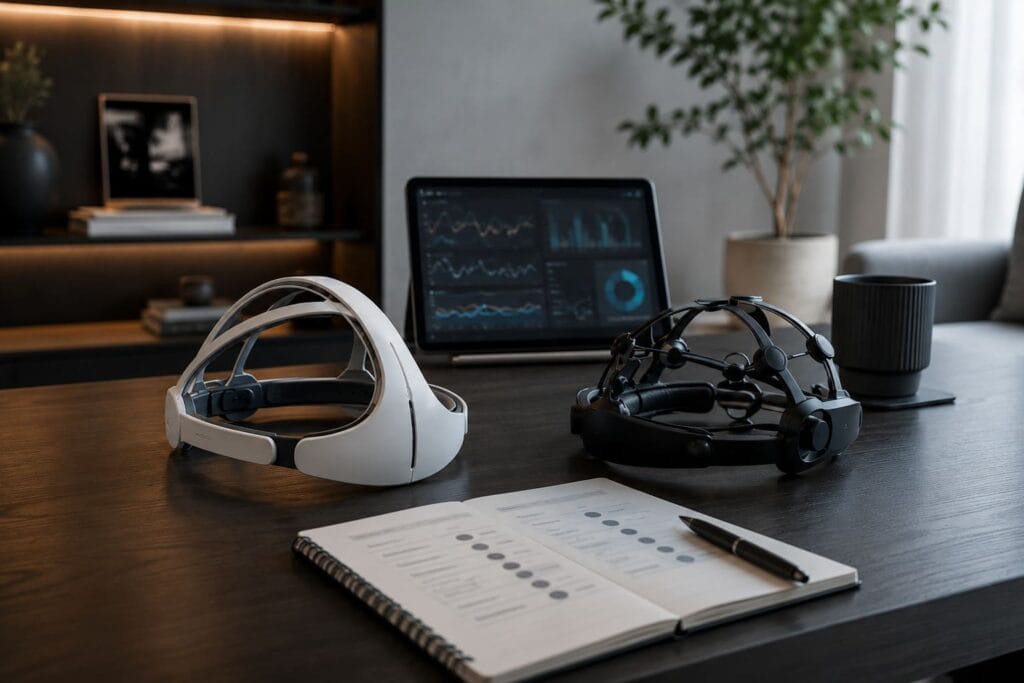
Sens.ai vs Neurosity Crown: Key Differences for Home Neurofeedback Devices
| Feature | Sens.ai | Neurosity Crown | Why it matters |
|---|---|---|---|
| Best for | Guided neurofeedback training | Open EEG / BCI development | Different user types |
| Main experience | App-led Missions and training protocols | Raw EEG, SDK, AI, brain signals access | Structure vs control |
| EEG focus | Neurofeedback and training feedback | Real-time EEG data and software integration | Different use cases |
| PBM / photobiomodulation | Yes, light-based training layer | No | Sens.ai’s unique advantage |
| AI integration | Limited compared with Crown | Stronger developer / AI angle | Crown is more future-facing |
| signal-level acces | More closed ecosystem | Stronger raw EEG access | Important for advanced users |
| Ease of use | Better for non-technical users | Better for technical users | Depends on comfort with data |
| Training program | Structured Missions | More self-directed | Sens.ai gives more guidance |
| Meditation | Built into training context | Possible, but less wellness-led | Muse may still be easier here |
| Home use | Strong guided home neurofeedback | Strong technical home EEG platform | Both work at home, differently |
| Buyer profile | Biohacker who wants structure | Builder who wants access | The real buying decision |
The key point is simple:
Sens.ai is the better home neurofeedback device for guided training. Neurosity Crown is the better EEG device for people who want open brain data, AI experiments, and BCI potential.
EEG Channels and Sensors: How Each Brain Training Device Tracks Brain Activity
EEG is the foundation of both devices.
EEG sensors measure electrical brain activity from the scalp. This is what allows a neurofeedback device to respond to your brain state in real time.
But more EEG channels do not automatically make a device better for every person.
What matters is how the sensor layout supports the use case.
A meditation headband does not need the same EEG setup as a developer-focused BCI headset. A guided neurofeedback system does not need to expose data in the same way as a raw EEG platform. A sleep-focused wearable does not need to compete with a device built for software experiments.
This is where buyers often make the wrong comparison.
They look for the best neurofeedback device on paper. More sensors. More features. More technical language. More advanced claims.
But the best home neurofeedback device is not always the most complex one.
It is the one that matches your actual behavior.
If you want to train regularly with clear instructions, a structured neurofeedback system is more useful than a technical device you never use.
If you want to build your own brain-computer interface, access raw EEG data, and experiment with AI workflows, a closed wellness system will feel limiting.
Sens.ai and Neurosity Crown both use EEG, but they turn EEG into different experiences.
Sens.ai turns EEG into guided training.
Neurosity Crown turns EEG into an interface.
That difference is more important than a single spec line.
Photobiomodulation, PBM, and Light: Sens.ai’s Main Advantage
PBM is one of the main reasons Sens.ai stands apart from most home neurofeedback devices.
Photobiomodulation uses light, often near-infrared light, as part of a wellness or performance training approach. In the Sens.ai context, PBM adds a light-based layer to EEG neurofeedback and guided brain training.
This makes the Sens.ai headset more ambitious than a simple EEG headband.
It is not only measuring brain activity. It is also trying to combine measurement, feedback, and light-based stimulation in one training experience.
That can be attractive if you are interested in premium biohacking, cognitive performance, brain health habits, and at-home brain training.
But it needs to be framed correctly.
PBM should not be sold as a guaranteed fix for anxiety, ADHD, depression, sleep problems, or cognitive decline. That would push the article into risky medical territory and create expectations the product may not support for every user.
A more realistic way to describe PBM in Sens.ai is this:
It is a light-based training layer that makes the system more advanced and differentiated than most consumer neurofeedback devices.
That is enough.
The sales angle does not need fake medical promises. The value is already clear: Sens.ai combines guided neurofeedback, PBM, functional assessment, and structured Missions in a premium home training system.
For many buyers, that is exactly what makes it interesting.
AI Workflows: Where Neurosity Crown Feels More Future-Facing
If Sens.ai is built around structured neurofeedback training, Neurosity Crown is built around access.
Access to EEG data.
Access to brain-state signals.
Access to software workflows.
Access to experiments that connect brain activity with AI systems.
This is why Crown feels more future-facing.
The most interesting part of Neurosity Crown is not that it tracks focus. Many devices claim to support focus training.
The more interesting part is that Crown treats signal feedback as something you can build with.
For developers, that changes the category.
A brain training device gives you feedback.
A brain-computer interface can become part of a system.
That system might be a focus dashboard, a productivity tool, a meditation experiment, a research prototype, a custom neurofeedback app, or an AI assistant that responds to your cognitive state.
This does not mean Crown is the best device for everyone.
It means Crown is more powerful for the right person.
If you want a calm, polished, guided meditation experience, Muse S Athena may be easier.
If you want structured neurofeedback training with PBM, Sens.ai is more direct.
If you want a simpler consumer brain training device, Mendi may feel more approachable.
But if you want raw EEG data, AI integration, and a real BCI headset for experimentation, Neurosity Crown is the more serious choice.
Where Muse S Athena, Mendi, and Other Brain Training Devices Fit In
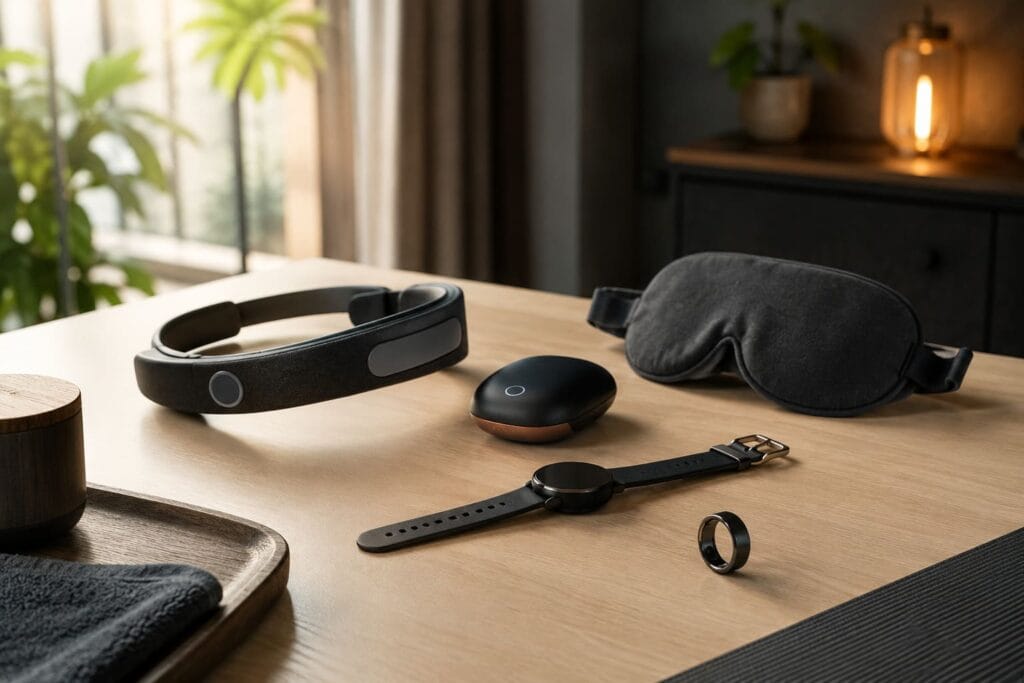
Sens.ai and Neurosity Crown are not the only serious brain training devices on the market.
They sit at the premium end of the category, but they do not replace every other wearable. In some cases, a simpler device may be the smarter buy.
That is why it helps to compare them with other devices we have already covered on MindReset.
Muse S Athena / Muse
Muse is not trying to be an open BCI platform like Neurosity Crown. It is also not trying to combine EEG neurofeedback with PBM like Sens.ai.
Its strength is ease of use.
For many people, that matters more than technical depth.
If you are new to EEG wearables and your main problem is inconsistent meditation or poor sleep habits, Muse may be the better first step before jumping into a premium device.
Mendi
Mendi fits a different buyer, especially someone looking for a simpler at-home brain training device without the technical depth of Sens.ai or Neurosity Crown.
It is more accessible, more focused, and easier to understand than Sens.ai or Neurosity Crown. It is not the same type of raw EEG device as Crown, and it is not the same type of premium multi-layer training system as Sens.ai.
But for someone who wants simple at-home brain training without diving into complex EEG data, Mendi can make more sense.
Apollo Neuro
Apollo Neuro is not a neurofeedback device, but it can still be useful for readers comparing nervous system wearables for stress, recovery, and daily regulation.
That is important.
It does not use EEG to track brain activity, and it is not designed as a brain-computer interface. It belongs more in the nervous system recovery and wearable relaxation category.
Still, it can be relevant for the same reader because many people searching for neurofeedback devices are really trying to improve stress resilience, recovery, sleep quality, and daily regulation.
If that is your actual goal, Apollo Neuro may be worth comparing before spending premium money on EEG.
Ultrahuman Ring
Ultrahuman Ring is also not a brain training device; it is better positioned as a recovery, sleep, and performance tracking wearable.
It is better understood as a recovery, sleep, movement, and metabolic tracking wearable.
It does not compete directly with Sens.ai or Neurosity Crown. But it can support the same broader goal: better self-awareness and better daily performance.
If you want passive tracking rather than active neurofeedback training, a ring may fit your life better than a headset.
Manta Sleep
Manta Sleep is not EEG neurofeedback either.
It belongs in the sleep optimization category. But that does not make it irrelevant.
Choosing the Right Neurofeedback Device for Home Use
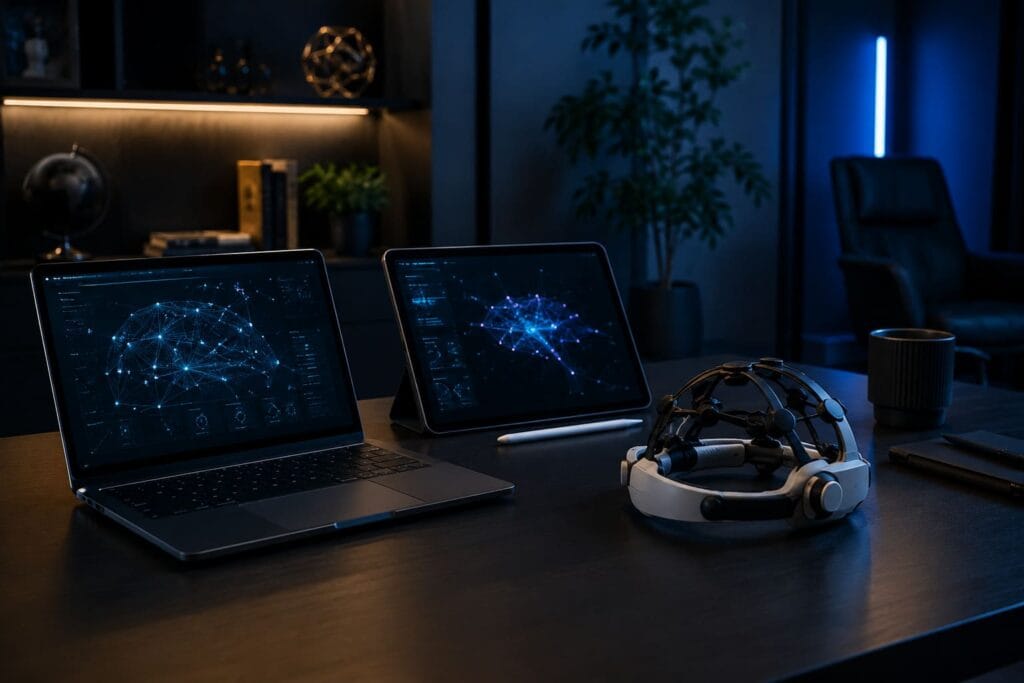
Choosing the right neurofeedback device is not about buying the most advanced headset.
It is about matching the device to the use case.
Choose Sens.ai if…
Choose Sens.ai if you want guided at-home neurofeedback and a clear training path.
It is the stronger option if you like the idea of structured Missions, app-led sessions, PBM, light stimulation, and a premium brain training system that does not require you to become a developer.
Sens.ai is also the better fit if you want the device to tell you what to do next.
Best for:
- guided neurofeedback training
- premium home use
- structured Missions
- PBM and light-based training
- cognitive performance routines
- meditation and training protocols
- users who want less technical friction
Choose Neurosity Crown if…
Choose Neurosity Crown if you want access to brain data, not just guided sessions.
It is the stronger option if you care about raw EEG, AI, BCI, real-time brain activity, software integration, and building custom workflows.
Neurosity Crown is not the easiest choice for a casual wellness buyer. But for technical users, that openness is the reason to buy it.
Best for:
- developer signal access
- AI brain interface experiments
- developer projects
- BCI workflows
- custom neurofeedback
- focus training
- signal feedback ownership
- users who want control, not just guidance
Choose Muse S Athena if…
Choose Muse S Athena if meditation, sleep, and calm training are more important than advanced neurotechnology.
It is not trying to beat Sens.ai or Crown on technical depth. It wins on simplicity and habit formation.
Best for:
- meditation
- guided meditation
- sleep routines
- calm feedback
- beginner-friendly EEG
- lower-friction daily use
Choose Mendi if…
Choose Mendi if you want a simpler brain training device and do not need a premium EEG headset or developer tools.
It is a better match for users who want a focused training routine without the complexity of raw EEG data or PBM.
Best for:
- simple brain training
- approachable home use
- lower technical complexity
- people who want a narrow training habit
Best Neurofeedback Device: The Real Buyer Decision
The best neurofeedback device depends on what you are actually trying to change.
If you want a premium guided system, Sens.ai is more logical.
If you want an open EEG platform, Neurosity Crown is more logical.
If you want meditation and sleep support, Muse S Athena may be more logical.
If you want simple training without entering the deep end of neurotechnology, Mendi may be more logical.
This is why “best” can be misleading.
A device can be technically impressive and still wrong for your daily life.
A simpler headband can produce more value if you actually use it.
The best home neurofeedback device is not the one with the loudest marketing.
It is the one that fits your use case.
FAQ: Sens.ai, Neurosity Crown, and At-Home Neurofeedback Devices
Is neurofeedback a form of brain training?
Neurofeedback is a form of brain training where a device measures brain activity and gives feedback that helps the user notice and adjust certain mental states. In consumer devices, this is usually framed around focus, meditation, relaxation, cognitive performance, or training consistency rather than medical treatment.
How is at-home neurofeedback different from in-clinic neurofeedback?
Traditional neurofeedback and in-clinic neurofeedback usually involve professional setup, supervised protocols, and more controlled conditions. At-home neurofeedback devices are built for convenience, repeat use, and personal training routines. They can be useful for self-tracking and practice, but they are not the same thing as clinical care.
Does Sens.ai use infrared light?
Sens.ai uses a light-based layer as part of its PBM / photobiomodulation approach. In simple terms, this means the Sens.ai headset combines EEG neurofeedback with infrared-style light stimulation as part of its guided training experience. The practical buyer takeaway is that Sens.ai is more than a basic EEG headband.
Is the Muse S Athena headband comparable to Sens.ai and Neurosity Crown?
The Muse S Athena headband sits in a nearby category, but it is easier to understand as a meditation and sleep-focused EEG wearable. Sens.ai is more focused on structured neurofeedback training and PBM, while Neurosity Crown is more focused on EEG access, AI workflows, and developer-level experimentation.
Where do Myndlift and FocusCalm fit in?
Myndlift is a neurofeedback platform that is usually discussed in the broader neurofeedback market, while FocusCalm is a neurofeedback device focused more on calm and focus training. They are useful comparison points, but Sens.ai and Neurosity Crown sit in a more premium and specialized part of the market.
What is the market for at-home neurofeedback devices really about?
The market for at-home neurofeedback devices is not only about who has the most advanced hardware. It is about matching the device to the user: guided training, meditation, focus training, sleep support, cognitive tracking, developer access, or AI-connected brain activity experiments.
Limitations Before You Buy
There are a few realistic limits to keep in mind.
First, consumer neurofeedback devices are not medical treatment devices. They can support training, awareness, meditation, focus routines, and performance habits, but they should not be treated as a replacement for clinical care.
Second, EEG at home is sensitive to setup quality. Hair, skin contact, sensor placement, movement, and user consistency can all affect signal quality.
Third, more data does not automatically mean better outcomes. Raw EEG data is powerful if you know what to do with it. It is overwhelming if you do not.
Fourth, structured training is only useful if you follow it. Sens.ai can offer a guided training program, but the user still has to show up.
Fifth, premium price does not guarantee premium results for every person. These are tools. They work best when they match a clear goal and a consistent routine.
That is the adult way to look at this category.
No panic. No hype. No fake promises.
Just a serious comparison of serious devices.
Who should avoid it:
- Buyers who want a simple, low-cost, or no-subscription meditation tool.
- Users who do not want app dependence, charging, firmware updates, sensor setup, or data-sharing considerations.
- Anyone expecting diagnosis, treatment, guaranteed cognitive improvement, or verified mental-health outcomes.
- People who are unsure whether EEG, light-based features, or neurofeedback-style training is appropriate for them.
- Buyers who need hands-on testing or verified long-term reliability before purchase.
What we could verify:
- Public product positioning and available product-page information.
- Visible buyer-facing specifications, pricing structure, warranty information, and setup requirements where available.
- The article’s comparison logic against similar tools in the same category.
- The presence and placement of affiliate links used on this page.
What we could not verify:
- Long-term headset comfort, sensor reliability, battery wear, app stability, firmware reliability, or customer-support quality.
- The accuracy or usefulness of brain-signal feedback for every user or use case.
- Product-specific effects on attention, stress, sleep, cognition, mental health, or other physiological outcomes.
- Whether research on EEG, neurofeedback, or photobiomodulation applies to these specific consumer systems.
Final Verdict: Sens.ai vs Neurosity Crown
Sens.ai and Neurosity Crown are both premium neurotechnology devices, but they are built around different philosophies.
Sens.ai is the better choice if you want guided at-home neurofeedback, structured training Missions, PBM, app-led protocols, and a premium wellness-style brain training experience.
Neurosity Crown is the better choice if you want developer signal access, AI integration, developer freedom, real-time brain activity access, and a true brain-computer interface.
For most non-technical wellness buyers, Sens.ai will feel more complete.
For developers, AI builders, quantified-self users, and serious experimenters, Neurosity Crown will feel more powerful.
For beginners, Muse S Athena or Mendi may be a more realistic first step.
The best choice depends on the job you want the device to do.
If you want to follow a guided training system, choose Sens.ai.
If you want to build with your brain data, choose Neurosity Crown.
If you want meditation, sleep, or recovery support, look at Muse, Mendi, Apollo Neuro, Ultrahuman Ring, or Manta Sleep before spending premium money on a device that may be more advanced than you actually need.
In the end, the smartest brain training device is not always the most futuristic one.
It is the one you will use consistently.