Table of Contents
NeoRhythm review
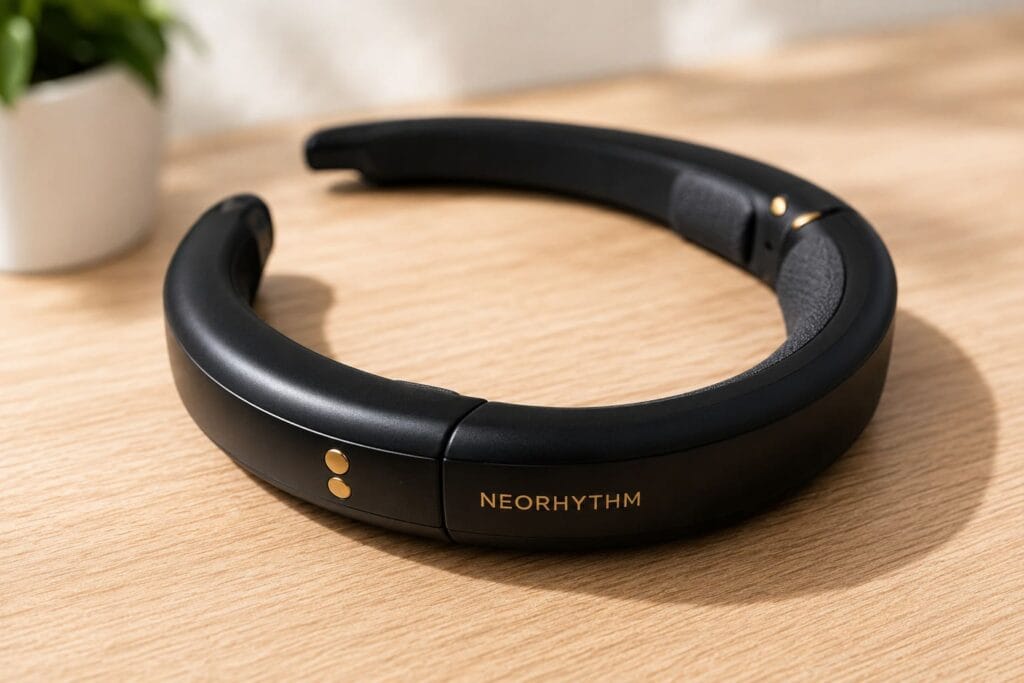
The OmniPEMF NeoRhythm is a wearable pulsed electromagnetic field device positioned as a tool for relaxation, sleep preparation, meditation, mental focus, physical comfort, and general wellness.
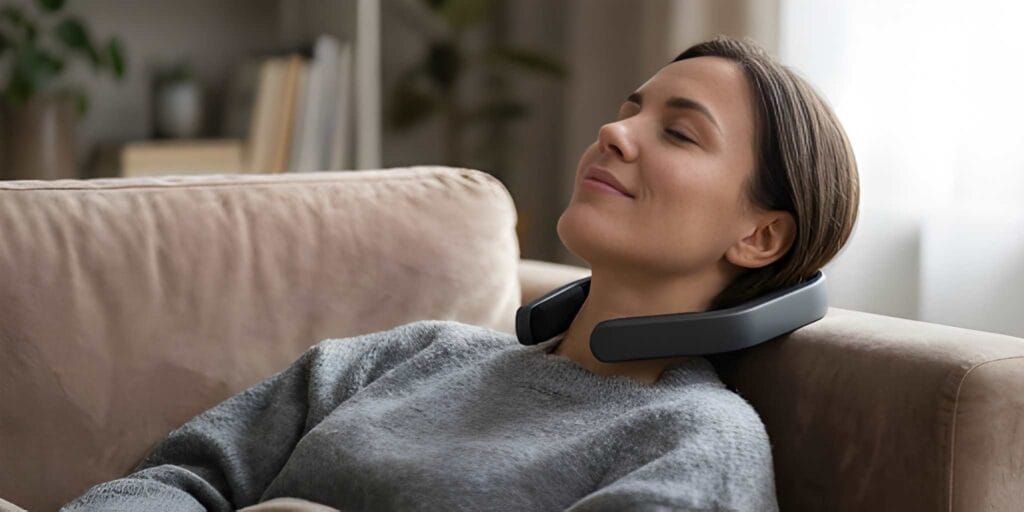
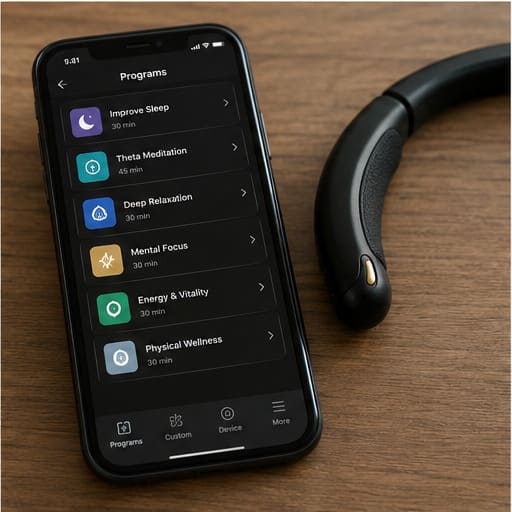
Its unusual U-shaped design can be worn on the head, around the neck, placed under a pillow, or positioned near other parts of the body. A mobile app controls the stimulation program, frequency, duration, and intended use.
This NeoRhythm review separates the verified product specifications from broader claims about PEMF therapy, brainwave entrainment, vagus nerve stimulation, pain relief, sleep quality, energy and vitality, and nervous system regulation.
Affiliate disclosure: MindReset.org may earn a commission if you buy through our links. This does not increase your price and does not affect our editorial judgment.
Research note: We have not personally tested the NeoRhythm PEMF wearable yet. This research-based review uses current product documentation, the user manual, available scientific studies, independent reports, public user feedback, and comparison with other consumer neurostimulation and relaxation devices.
Safety note: NeoRhythm is sold as a general wellness device. It is not intended to diagnose, treat, cure, or prevent insomnia, anxiety, depression, epilepsy, chronic pain, sleep disorders, or another medical condition. Certain implants and health conditions are listed as contraindications later in this guide.
Quick Verdict: Is the NeoRhythm PEMF Wearable Worth It?
NeoRhythm may be worth considering for buyers who are curious about PEMF technology, prefer a passive wearable device, and are comfortable paying a premium to experiment with frequency-based relaxation or sleep and relaxation programs.
The strongest parts of the product are its lightweight design, multiple wearing positions, wide frequency range, app-based customization, gesture control, rechargeable battery, 60-day return period, and two-year warranty.
The biggest limitation is evidence. There is one notable double-blind placebo-controlled study involving a NeoRhythm U-band worn around the neck, but this does not validate every stimulation program, every placement, or claims involving brainwave entrainment, pain control, cellular energy, REM sleep, deep relaxation, or mental performance.
Best for: tech-comfortable buyers who understand that this is an experimental wellness purchase rather than proven medical treatment.
Skip if: you want measurable neurofeedback, need a clinically approved treatment, dislike app-dependent hardware, have a contraindication, or expect guaranteed results.
MindReset verdict: an unusual and versatile PEMF wearable with better product documentation than many wellness devices, but still a high-risk purchase for buyers expecting reliable sleep, stress, or pain outcomes.
NeoRhythm Specifications, Price, and Package Contents
| Specification | Current information |
|---|---|
| Product | OmniPEMF NeoRhythm wearable PEMF device |
| Current listed price | Approximately $359–$404, depending on configuration |
| Frequency range | 1–303.41 Hz |
| Maximum magnetic field | 25 Gauss / 2.5 mT |
| Waveform | Trapezoidal |
| Weight | 105 g |
| Dimensions | 160 × 170 × 28 mm |
| Coil design | Five internal coils |
| Power | Internal rechargeable battery |
| Charging | Charging dock and Micro USB cable |
| Control | Companion app, Bluetooth, and gesture control |
| Programs | 12 programs plus custom options in the current user manual |
| Program duration | Approximately 30 minutes to 8 hours, selected duration, or continuous depending on mode |
| Return period | 60-day money-back guarantee for eligible returns |
| Warranty | Two years |
| Shipping | Free worldwide shipping currently advertised |
The listed price, promotions, shipping offer, available colors, app features, and warranty conditions can change. Check the current official NeoRhythm product page before purchasing.
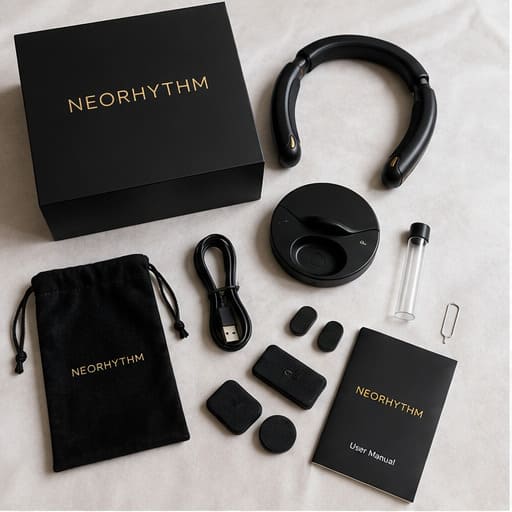
The current user manual lists the following items in the box:
- NeoRhythm device;
- charging dock;
- Micro USB cable;
- adjustment kit;
- user manual;
- magnetic test tube;
- NeoRhythm storage bag;
- hard reset tool.
Who Should Consider NeoRhythm?
- People interested in consumer PEMF wellness technology.
- Buyers who prefer a passive device rather than guided meditation or active breathing exercises.
- Users who want several frequency and placement options in one wearable.
- People comfortable using a mobile app and Bluetooth for setup.
- Buyers who value a 60-day trial period and two-year warranty.
- Users willing to track subjective changes without treating them as proof of medical improvement.
- People comparing PEMF wearables with vibration-based or meditation devices.
- Buyers who understand that the device may produce no noticeable effect.
The strongest buyer fit is someone who already understands PEMF therapy, accepts the uncertainty, and can afford to experiment without needing the device to solve a serious health or sleep problem.
Who Should Avoid the NeoRhythm Device?
- Anyone with a pacemaker or another active electronic implant.
- People with a cochlear implant or mechanical heart valve.
- People with a non-MRI-safe IUD.
- People with epilepsy.
- People who are pregnant.
- People with active bleeding.
- Organ transplant recipients or people receiving immunosuppressive therapy.
- Anyone expecting NeoRhythm to replace medical care or prescribed treatment.
- Buyers who want real-time brain measurements or neurofeedback.
- People who dislike Bluetooth, app pairing, charging, and device troubleshooting.
- Buyers who expect guaranteed improvements in insomnia, anxiety, focus, or pain relief.
The manufacturer also advises discussing the product with a healthcare professional when combining it with conventional medical treatment.
How Does NeoRhythm PEMF Therapy Work?
PEMF stands for pulsed electromagnetic field. A PEMF device uses coils to create a magnetic field that turns on and off in controlled pulses.
NeoRhythm contains five internal coils. The selected stimulation program determines which coils operate, the frequency used, the program duration, and the intended placement of the wearable.
The manufacturer positions the product as a combination of two ideas:
- General PEMF technology: low-frequency magnetic stimulation intended to interact with natural electrical activity in the body.
- Brainwave-inspired frequency protocols: programs using frequency ranges associated with Delta, Theta, Alpha, Beta, or Gamma brain wave activity.
The device can emit pulses ranging from 1 to 303.41 Hz with a maximum listed flux density of 25 Gauss, or 2.5 mT.
The important distinction is that using a frequency associated with a brainwave state does not prove that the brain enters that state. A setting labelled Theta Meditation may use a theta-range pulse, but the device does not measure EEG activity to confirm theta meditation or brainwave entrainment in the individual user.
If you prefer a full-body PEMF setup with infrared heat rather than a wearable headband, compare our HigherDOSE Infrared PEMF Mat review. The mat is designed for lying-down relaxation, while NeoRhythm focuses on portable, targeted stimulation and multiple wearing positions.
Is NeoRhythm the Same as TMS or Neurofeedback?
No. NeoRhythm should not be confused with clinical repetitive transcranial magnetic stimulation, commonly called rTMS.
Clinical rTMS uses much stronger, precisely targeted magnetic stimulation administered under professional supervision for specific approved medical indications. NeoRhythm is classified by its manufacturer as a household wellness device.
NeoRhythm is also not a neurofeedback headband. It does not read EEG signals, measure brainwave activity, or show whether the user is producing Alpha, Beta, Theta, Delta, or Gamma patterns.
A Muse-style headband measures electrical activity and provides feedback. The NeoRhythm PEMF device delivers a preset pulsed electromagnetic signal without measuring the brain’s response.
If you want a headband that measures brain activity instead of only delivering preset stimulation, read our Muse meditation headband review. Muse uses EEG-based feedback, while NeoRhythm does not confirm whether its frequency programs produce a matching brainwave response.
NeoRhythm Programs and Intended Use Cases
The companion app organizes programs around sleep, meditation, focus, relaxation, physical wellness, and recovery.
| Program category | Brand positioning | What remains uncertain |
|---|---|---|
| Improve Sleep | Lower frequency sleep program intended to help users relax and prepare for sleep | Whether it improves sleep quality, sleep phase, REM sleep, or insomnia for most users |
| Theta Meditation | Theta-range stimulation for meditation and deep relaxation | Whether the user’s EEG changes to a theta state |
| Alpha and calming programs | Relaxation, reduced mental noise, and calm awareness | Reliable effects on stress or nervous system function |
| Beta and focus programs | Mental focus, alertness, and productivity | Measurable improvement in attention or cognitive performance |
| Gamma programs | Higher-frequency cognitive or meditation support | Changes in memory, cognition, or gamma brainwave activity |
| Physical wellness programs | Muscle comfort, recovery, pain control, energy and vitality | Product-specific evidence for pain relief, tissue repair, circulation, or athletic recovery |
These are intended use categories, not verified medical outcomes. The app’s language should not be interpreted as evidence that a stimulation program treats a disorder or reliably changes brain activity.
For buyers more interested in active focus training and measurable session feedback, our Mendi neurofeedback review examines a different approach based on fNIRS rather than pulsed electromagnetic field stimulation.
How to Set Up and Use NeoRhythm
- Charge NeoRhythm for at least 2.5 hours before first use.
- Download the OmniPEMF mobile app for iOS or Android.
- Accept the terms and complete the first-time guide.
- Enable Bluetooth. Android users may also need Location Services enabled.
- Wake the device by tapping near the LED or Micro USB area.
- Connect through the companion app.
- Select Quick Start or Advanced Mode.
- Choose the required stimulation program and duration.
- Place the wearable headband in the position shown in the app.
- Press Select and double-tap the device to begin.
- Check for the short vibration and green indicator light.
- Double-tap again or use the app to stop the program.
After initial setup, the last-used program can be restarted with gesture control. A smartphone is still required when switching programs or changing settings.
App, Gesture Control, and Daily Usability
The app is required for initial pairing, selecting a new program, changing the duration, and accessing advanced options.
The gesture control reduces friction once a routine is established:
- double-tap to start the last-used program;
- double-tap to stop the current program;
- use the mobile app when switching programs;
- check the LED color for charging, connection, standby, and active stimulation.
The magnetic pulses are generally not felt. OmniPEMF therefore includes a small test tube with a magnet that reacts when the coils emit a pulsed electromagnetic field.
This app-plus-gesture system is convenient when it works. It also creates dependence on Bluetooth compatibility, mobile operating systems, firmware, and app stability.
Comfort, Fit, and Wearing Positions
At 105 grams, NeoRhythm is relatively lightweight, but the rigid U-shaped design will not fit every head, neck, pillow, or body area equally well.
The package includes an adjustment kit with additional pads of different thicknesses. These can reduce looseness and improve contact around the head or neck.
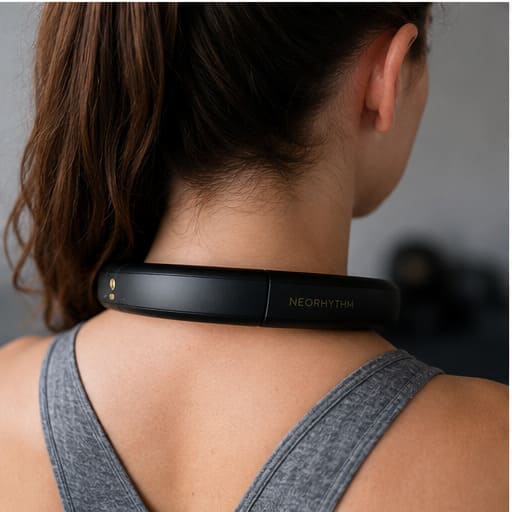
Common placements promoted by the manufacturer include:
- across the top or back of the head;
- around the neck;
- near the shoulders or back;
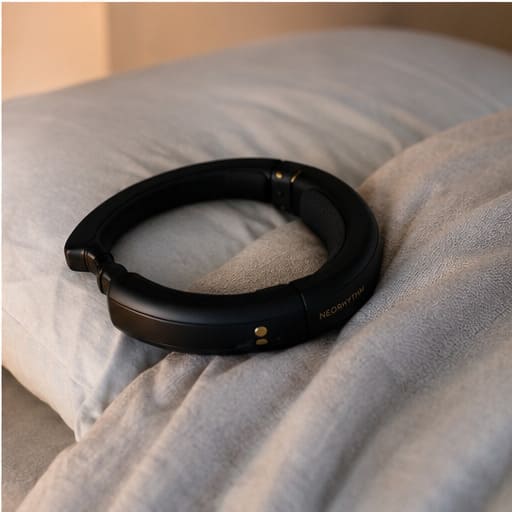
- under a pillow for the sleep program;
- around a limb or joint for physical wellness routines.
Comfort will depend on head shape, pillow firmness, sleeping position, sensitivity to pressure, and whether the device shifts during use.
Can NeoRhythm Support Relaxation?
Relaxation is one of the more plausible consumer use cases because the device requires little active effort and can become part of a quiet wind-down routine.
However, the subjective feeling of calm can come from several sources:
- the PEMF stimulation itself;
- expectation or placebo response;
- lying quietly for a set period;
- closing screens and reducing stimulation;
- repeating the same evening ritual;
- breathing more slowly while resting.
That does not make the experience meaningless. It means buyers should distinguish “I felt calmer during the session” from “the device changed my autonomic nervous system.”
Can NeoRhythm Improve Sleep?
OmniPEMF includes an Improve Sleep program and promotes use before bed or under a pillow during rest.
The brand links lower frequency stimulation with theta activity during light sleep and Delta activity during deeper sleep. It also discusses REM sleep and sleep preparation.
The missing step is objective confirmation. NeoRhythm does not measure EEG, sleep stages, awakenings, breathing, or sleep architecture. It cannot confirm that a low-frequency program causes a matching brainwave state.
A 2025 study involving neck application reported improvements in subjective sleep quality at certain frequencies, especially 16 Hz. This makes the sleep claim more credible than unsupported marketing alone, but it does not prove that every sleep program will help every user.
Buyers struggling with persistent insomnia should not use the device as a substitute for medical assessment, cognitive behavioral therapy for insomnia, or investigation of sleep apnea, medication effects, pain, anxiety, and other possible causes.
What Does the NeoRhythm Research Show?
The most relevant product-specific research was published in 2025 in Electromagnetic Biology and Medicine.
- 485 volunteers participated.
- The research used a double-blind, placebo-controlled design.
- A NeoRhythm U-band was positioned around the neck.
- The tested frequencies were 6 Hz, 16 Hz, and 32 Hz.
- Outcomes included self-reported sleep, anxiety, stress, and general wellbeing.
- The strongest reported sleep-related results appeared in the 16 Hz group.
- The placebo group also reported changes.
The study is relevant because it tested the actual NeoRhythm form factor rather than an unrelated hospital PEMF therapy device.
It is still only one study using specific neck placement, selected frequencies, volunteer questionnaires, and a defined protocol. It should be replicated independently before broad claims are made.
Read the paper abstract at PubMed.
What the Scientific Studies Do Not Prove
General studies on PEMF should not automatically be treated as proof for this exact wellness device.
The current research does not establish that NeoRhythm:
- treats insomnia, anxiety, depression, or another sleep or mood disorder;
- reliably entrains the brain into Alpha, Theta, Delta, Beta, or Gamma states;
- changes EEG brainwave activity in every user;
- works like clinical repetitive transcranial magnetic stimulation;
- improves REM sleep or deep sleep;
- provides dependable pain relief or pain control;
- repairs cells or “recharges” cellular energy;
- stimulates the vagus nerve in every placement;
- increases focus, memory, or cognitive performance;
- improves circulation, muscle recovery, or physical performance;
- produces stronger effects than a credible placebo routine.
NeoRhythm Safety and Contraindications
The user manual states that the product should not be used in several situations.
- pacemaker or other active electronic implant;
- cochlear implant;
- mechanical heart valve;
- non-MRI-safe IUD;
- epilepsy;
- pregnancy;
- active bleeding;
- organ transplant;
- immunosuppressive therapy.
NeoRhythm should not be used near water or while wet. The user manual states that it is not waterproof, although it can be wiped carefully with a damp cloth.
Do not expose it to extreme heat, fire, physical crushing, or severe bending. Do not attempt to replace the internal battery yourself.
The manufacturer’s statements have not been evaluated by the FDA, and the product is not intended to diagnose, treat, cure, or prevent disease.

Battery, Charging, Cleaning, and Maintenance
- Charge for at least 2.5 hours before first use.
- An orange LED indicates charging.
- No charging light indicates a full battery.
- A blinking red LED indicates low battery.
- Use the supplied charging equipment.
- Do not attempt to replace the internal battery.
- Keep the device away from water.
- Clean only with a lightly damp cloth.
- Do not stretch or aggressively bend the band.
- Use the lock function when carrying it in luggage.
The current documentation does not give a clear real-world battery-life estimate covering all program lengths, frequencies, Bluetooth use, and battery age.
Price, Hidden Costs, Returns, and Warranty
The current listed price is approximately $359–$404, depending on the selected option. Promotions can temporarily reduce the cost.
Potential costs and buyer friction include:
- return shipping paid by the customer;
- customs duties or taxes for some international returns;
- replacement pads or accessories;
- possible future phone or app compatibility issues;
- battery degradation outside the warranty period;
- time required to test multiple placements and programs.
The advertised 60-day return period begins when the device is delivered. Buyers must request an RMA, return all accessories, use suitable packaging, and ship the product within seven days after receiving return authorization.
The customer normally pays return postage. Certain hygiene accessories are non-returnable, and partial bundle returns may be calculated using the full retail value of retained products.
The two-year warranty covers verified physical or digital defects when the product was purchased through an official channel. Damage caused by misuse, contamination, modification, or inadequate protection may not be covered.
Read the current OmniPEMF returns policy before ordering.
NeoRhythm vs Other Wearable Wellness Devices
| Device type | What it provides | Best for | Main limitation |
|---|---|---|---|
| NeoRhythm PEMF wearable | Preset pulsed electromagnetic field stimulation | Passive experimentation with multiple frequency programs | No real-time measurement of the brain or body response |
| Muse EEG headband | EEG-based meditation feedback | Users who want measurable neurofeedback during meditation | Requires active participation and does not deliver PEMF therapy |
| Apollo Neuro | Vibrotactile patterns through a wrist or ankle wearable | Users who prefer noticeable vibration and simpler placement | Effects remain subjective and it does not measure nervous system change |
| Hapbee | Frequency-based magnetic signal programs | Buyers comparing similar app-controlled wellness wearables | Different signal system and similar evidence questions |
| Clinical rTMS | High-intensity targeted magnetic stimulation under supervision | Specific diagnosed conditions when prescribed | Not a consumer home wellness product |
NeoRhythm is most attractive when the buyer specifically wants versatile PEMF stimulation. Muse is more appropriate for measurable brainwave feedback, while Apollo provides a more tangible vibration-based experience.
If you prefer a smaller wearable with noticeable vibration rather than an electromagnetic field, see our Apollo Neuro review. Apollo uses tactile vibration patterns on the wrist or ankle, while NeoRhythm uses app-controlled PEMF programs and multiple placements.
NeoRhythm Pros and Cons
Pros
- Lightweight 105 g wearable
- Wide 1–303.41 Hz frequency range
- Five-coil design
- Multiple wearing positions
- App-based program selection
- Gesture control for repeated sessions
- Rechargeable battery
- Charging dock and accessories included
- 60-day eligible return period
- Two-year warranty
- One relevant double-blind placebo study
- No required active meditation during use
Cons
- Premium price
- No EEG or physiological measurement
- Many outcomes depend on subjective perception
- App and Bluetooth required for program changes
- Not waterproof
- Fit may vary by head and neck shape
- Unclear real-world battery duration
- Several medical contraindications
- Return shipping is normally paid by the buyer
- Research does not validate every program or placement
- Easy to confuse with stronger clinical neurostimulation technology
What We Could Verify
- NeoRhythm is sold by OmniPEMF as a wearable PEMF wellness device.
- The current listed price is approximately $359–$404.
- It contains five magnetic coils.
- The frequency range is listed as 1–303.41 Hz.
- Maximum intensity is listed as 25 Gauss / 2.5 mT.
- The device weighs 105 g.
- It has an internal rechargeable battery.
- A charging dock and Micro USB cable are included.
- Programs are selected through a companion app.
- The last program can be restarted using gesture control.
- The current manual lists 12 programs plus custom programs.
- The current return period is 60 days.
- The warranty lasts two years.
- A 2025 double-blind placebo-controlled study tested neck stimulation using a NeoRhythm U-band.
- The product is not intended to diagnose, treat, cure, or prevent disease.
What We Could Not Verify
- Long-term wearing comfort across different users.
- App stability across future iOS and Android versions.
- Battery degradation after months or years of use.
- Customer-support quality for every country.
- Real-world durability over extended daily use.
- Reliable brainwave entrainment in individual users.
- Product-specific effects on insomnia, REM sleep, deep sleep, anxiety, focus, pain, or recovery.
- That every program produces a different measurable physiological response.
- That head placement works the same way as the studied neck application.
- That NeoRhythm works better than a structured placebo or quiet relaxation routine.
Before spending several hundred dollars on a frequency-based device, use our biohacking wearables buyer guide to decide whether you actually need passive stimulation, neurofeedback, sleep tracking, HRV data, or a simpler relaxation tool.
Final Verdict: Should You Buy NeoRhythm?
NeoRhythm is one of the more unusual consumer PEMF wearables because it combines five coils, a wide frequency range, multiple positions, sleep and relaxation programs, app control, and gesture-based operation.
It also has more relevant research than many frequency-based wellness products. The 2025 neck-application study provides a legitimate reason for further investigation.
That evidence is not strong enough to confirm every claim on the product page. Buyers should not assume that frequency labels guarantee matching brainwave states, vagus nerve stimulation, better sleep, pain control, cellular recovery, or mental focus.
Buy it if: you specifically want a versatile PEMF therapy device, understand the uncertainty, have no listed contraindications, and can use the 60-day trial period responsibly.
Skip it if: you need objective measurements, proven medical treatment, dependable results, or a simpler and cheaper relaxation tool.
MindReset final verdict: a credible experimental wellness device for informed buyers, but not a proven solution for sleep, stress, pain, or nervous system recovery.
NeoRhythm FAQ
What is NeoRhythm?
NeoRhythm is an app-controlled wearable PEMF device that uses five internal coils to emit low-frequency pulsed electromagnetic stimulation.
Is NeoRhythm a medical device?
It is positioned as a household general wellness device. The manufacturer states that it is not intended to diagnose, treat, cure, or prevent disease.
Can NeoRhythm improve sleep?
A 2025 study reported subjective sleep improvements from specific neck-applied frequencies, especially 16 Hz. This does not prove that the standard sleep program will improve sleep for every user.
Does NeoRhythm measure brainwaves?
No. It delivers frequency-based stimulation but does not contain EEG sensors or verify the user’s brainwave response.
Is NeoRhythm the same as rTMS?
No. Clinical repetitive transcranial magnetic stimulation uses different equipment, intensity, targeting, protocols, and professional supervision.
Do I need the app every time?
The mobile app is needed to select or change programs and settings. The last stimulation program can be restarted or stopped using gesture control.
How long can a program run?
The current user manual lists program durations from approximately 30 minutes to eight hours, selected minutes, or continuous operation depending on the program.
Can people with epilepsy use NeoRhythm?
No. Epilepsy is listed among the contraindications in the current user manual.
Can NeoRhythm be used during pregnancy?
No. Pregnancy is listed as a contraindication by the manufacturer.
Is NeoRhythm waterproof?
No. The manual states that the device is not waterproof. It should be kept away from water and cleaned only with a lightly damp cloth.
What is the NeoRhythm return period?
Eligible purchases currently have a 60-day money-back period beginning on delivery. The buyer normally pays return shipping and must follow the RMA procedure.