
Table of Contents
Post-Vacation Fatigue: A Simple Re-Entry Reset for Work, Sleep, and Focus
But sometimes it does not.
You return from a holiday, long weekend, family visit, trip, or time away from work and feel strangely flat. Your inbox looks heavy. Your sleep schedule feels off. Normal tasks feel more irritating than they should. Even if the break was good, your body and attention may not be ready to jump straight back into full-speed life.
That is post-vacation fatigue.
It does not mean your trip failed. It does not mean you are lazy. It usually means your routine changed, your sleep timing shifted, your attention had a break from normal demands, and your work life restarted too fast.
This guide gives you a practical re-entry reset: simple steps to rebuild rhythm, reduce overload, and return to work without turning the first day back into a punishment.
Quick verdict: Post-vacation fatigue is best handled with a buffer day, light exposure, simple planning, short focus blocks, and a slower return to digital noise. Do not try to “catch up” on everything in one day.
Health note: This guide is for everyday re-entry fatigue after travel or time off. It is not medical advice. If tiredness is severe, lasts for more than a couple of weeks, or comes with persistent low mood, chest pain, shortness of breath, fainting, or other concerning symptoms, speak with a qualified clinician.

What Is Post-Vacation Fatigue?
Post-vacation fatigue is the tired, foggy, low-motivation feeling that can appear after time away from your normal routine.
It can happen after:
- a holiday;
- travel;
- a long weekend;
- a staycation;
- family events;
- Christmas or New Year breaks;
- time off after a stressful work period;
- a short mental reset that ends too suddenly.
Common signs include:
- low energy;
- messy sleep timing;
- inbox dread;
- difficulty focusing;
- irritability;
- feeling behind before you start;
- wanting to escape back into scrolling;
- trouble restarting normal routines.
This is not a medical diagnosis. It is a practical pattern: your routine was interrupted, and your re-entry needs structure.
Why You Feel Tired After a Break
There are a few normal reasons this happens.
First, your sleep rhythm may have shifted. During time off, people often sleep later, stay up later, eat later, use screens later, or travel across time zones. When the alarm suddenly returns, your body may feel behind the schedule.
Second, your attention had fewer normal demands. On holiday or during a break, your day may have been more flexible. Returning to meetings, email, deadlines, commute, household tasks, and notifications can feel like a sharp contrast.
Third, your first day back is often overloaded. Many people try to clear everything immediately: email, laundry, work tasks, admin, messages, unpacking, planning, and missed obligations. That is too much for one day.
The solution is not more pressure.
The solution is a controlled re-entry.

The Biggest Mistake: Returning Without a Buffer
The worst version of re-entry is this:
You travel home late, sleep badly, wake up early, open your inbox, see hundreds of messages, drink too much caffeine, skip movement, and try to act as if your system is already back to normal.
That is how post-vacation fatigue turns into a heavier re-entry crash.
A better rule:
Never make the first day back your hardest day.
If possible, create a buffer day between returning home and returning to full work mode. This does not need to be a luxury day. It is a transition day.
Use it for:
- unpacking;
- laundry;
- basic groceries;
- light movement;
- sorting calendar;
- checking urgent messages only;
- preparing meals;
- going to bed at a normal time;
- planning the next workday.
A buffer day protects the value of the break you just had.
The MindReset Re-Entry Plan
Use this simple plan for the first 24–48 hours after a break.
Step 1: Reset Your Morning Light
After time away, your sleep timing may be off. Morning light is one of the simplest ways to help rebuild a normal daily rhythm.
On your first morning back:
- open curtains early;
- step outside if possible;
- get daylight before heavy screen use;
- avoid staying in dim indoor light all morning;
- keep caffeine reasonable;
- avoid bright screens late at night.
You do not need a perfect biohacking routine. You just need a clear signal that the day has started.
If mornings are dark where you live, a sunrise alarm or light routine may help, but the main point is consistency.
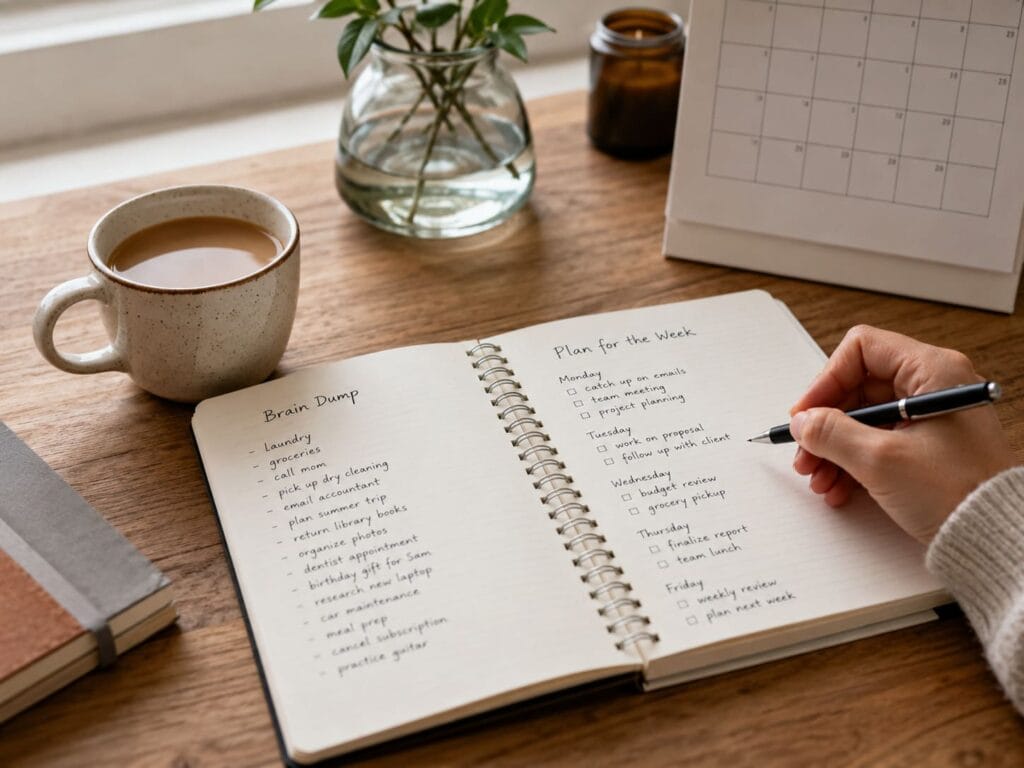
Step 2: Do a 10-Minute Brain Dump
Before opening every app and inbox, write down what is actually on your mind.
Use four simple categories:
Home: laundry, groceries, unpacking, bills.
Work: email, meetings, deadlines, projects.
People: replies, calls, family, appointments.
Recovery: sleep, food, walk, quiet time.
This stops the vague feeling of “everything is waiting for me” and turns it into a visible list.
Do not solve the whole list yet.
Just capture it.
If your mind feels overloaded, use the brain dump technique before opening every inbox.
Step 3: Choose Only Three Priorities
Your first day back should not have fifteen priorities.
Choose three.
Examples:
- clear urgent work messages;
- prepare tomorrow’s schedule;
- buy basic groceries;
- unpack suitcase;
- finish one work task;
- reply to two important people;
- go to bed on time.
Three priorities are enough.
You are not trying to win the whole week in one day. You are rebuilding traction.
Step 4: Use Short Focus Blocks
Your brain may not be ready for long deep work blocks immediately.
Start smaller.
Use a 25-minute block:
- Choose one task.
- Put your phone away.
- Open only what you need.
- Work for 25 minutes.
- Take a 5-minute reset.
- Write the next step before stopping.
This is especially useful for inbox recovery. Do not leave email open all day. Treat it as a batch task.
For a more structured return to focused work, read our single-tasking vs multitasking guide.
Step 5: Reduce Digital Noise
Post-vacation fatigue often turns into scrolling.
You feel behind, tired, or emotionally flat, so you reach for quick digital stimulation. Then the first evening back disappears into feeds, news, videos, and random browsing.
For the first night back, keep it simple:
- no doomscrolling in bed;
- no work email after a set time;
- no short-form video before sleep;
- charge your phone away from the bed;
- keep one offline activity ready.
The goal is not a dramatic digital detox. The goal is to protect your attention, sleep timing, and first evening back from being hit by every notification while you settle into normal routine again.
The First Workday Back: A Practical Schedule
Use this structure if your first day back feels heavy.
First 30 Minutes: Stabilize
Do not start with panic.
- Get water.
- Check your calendar.
- Open your task list.
- Identify urgent items.
- Ignore non-urgent noise.
Next 45 Minutes: Inbox Triage
Do not try to answer everything.
Sort messages into:
- urgent today;
- reply this week;
- archive;
- delegate;
- ignore.
Your goal is orientation, not perfection.
Midday: One Real Task
Choose one meaningful task that proves you are back in motion.
Not ten tasks.
One task.
Finish a section. Send one important email. Update one page. Review one document. Complete one admin item.
Afternoon: Low-Pressure Cleanup
Use the afternoon for easier tasks:
- scheduling;
- filing;
- planning;
- light admin;
- simple replies;
- updating lists.
Do not book your hardest creative work for the first afternoon back unless you truly have to.
Evening: Close the Loop
Before stopping work, write:
“Tomorrow’s first task is: ________.”
This prevents the second day from starting with the same fog.

What to Avoid After a Break
Avoid Opening Everything at Once
Email, Slack, WhatsApp, social media, calendar, news, banking, and project tools all at once will make re-entry feel worse.
Open one system at a time.
Avoid Overcorrecting With Caffeine
Caffeine can help, but using it to force yourself through exhaustion can backfire. Use it moderately and earlier in the day.
Avoid Punishing Yourself for Feeling Slow
Feeling slow on the first day back is normal. Do not turn it into a character judgment.
Avoid Planning a Full Reset That Is Too Big
You do not need a new life plan.
You need sleep timing, light, food, movement, one task list, and fewer notifications.
Avoid Staying Up Late to “Catch Up”
This is one of the fastest ways to make the second day worse.
The Afterglow Technique
A good break should not disappear the moment work returns.
Choose one habit from your time off and bring it into normal life.
Examples:
- a morning walk;
- reading before bed;
- eating breakfast slowly;
- fewer notifications;
- taking photos outdoors;
- stretching;
- drinking tea without a screen;
- a short evening walk;
- keeping one day each week less digitally noisy.
The point is not to live as if you are still on holiday.
The point is to keep one useful part of the break.
This helps reduce the emotional contrast between “holiday self” and “working self.”

Plan Something Small to Look Forward To
You do not need to book another expensive trip.
But it helps to put something pleasant on the calendar.
Examples:
- a local walk;
- a weekend hike;
- lunch with a friend;
- a screen-free evening;
- a museum visit;
- a coffee morning;
- a day trip;
- a quiet Sunday routine.
This gives your mind a forward anchor.
Instead of only looking back at the break, you create something next.
Simple Post-Vacation Fatigue Checklist
Use this after your next break:
- Create a buffer day if possible.
- Get morning light.
- Do a 10-minute brain dump.
- Choose only three priorities.
- Use short focus blocks.
- Batch your inbox.
- Avoid heavy digital noise at night.
- Go to bed at a normal time.
- Bring one good holiday habit into normal life.
- Plan one small thing to look forward to.
Keep the reset simple.
The goal is not to optimize everything. The goal is to return without crashing.
Final Verdict: Re-Entry Needs Structure
Post-vacation fatigue is not proof that rest does not work.
It is usually a sign that the transition back was too abrupt.
Your brain and body may need a day or two to rebuild rhythm, sort priorities, reduce digital noise, and reconnect with normal routines.
Use a buffer day. Get light in the morning. Write everything down. Pick three priorities. Work in short blocks. Keep your phone away from your bed.
You do not need to attack the whole week immediately.
You need a clean re-entry.