Table of Contents
This HigherDOSE Red Light Hat review examines whether the $449 FDA-cleared hair growth device offers enough credible evidence, convenience, and buyer protection to justify its premium price.
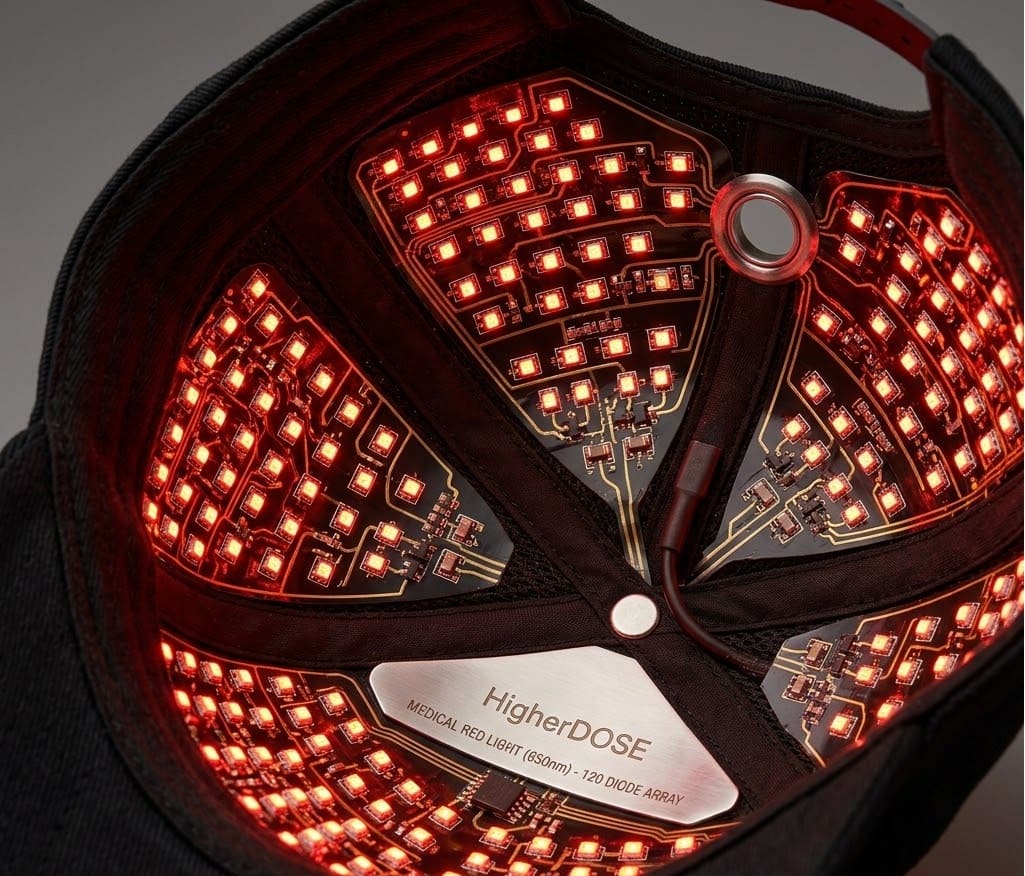
The hat uses 120 LED bulbs delivering 650nm red light to the scalp. HigherDOSE recommends one 10-minute session each day for 16 weeks, followed by maintenance use three or four times per week.
The strongest reason to consider it is not that it looks like a baseball cap or promises a luxurious wellness ritual. It is that the device has an identifiable FDA 510(k) clearance for specific forms of androgenetic alopecia and uses a treatment format that may be easier to follow than a handheld comb.
The most important limitation is equally clear: FDA clearance does not mean guaranteed hair regrowth, and it does not establish that the hat works for every cause of hair loss.
Affiliate disclosure: MindReset.org may earn a commission if you buy through our links. This does not increase your price and does not affect our editorial judgment.
Research note: We have not personally tested the HigherDOSE Red Light Hat. This guide is based on FDA documentation, current manufacturer specifications, published low-level light therapy research, brand return and warranty policies, safety guidance, and comparison with other hair-growth device formats.
What we assessed: FDA clearance, intended users, 650nm wavelength, LED count, daily treatment schedule, product-specific evidence, comfort, scalp coverage, cleaning, battery dependence, price, returns, warranty, hidden costs, and fit for different types of hair loss.
What we could not independently verify: real-world hair regrowth, average increase in hair count, long-term comfort, complete scalp coverage, irradiance consistency, battery degradation, LED durability, customer-support quality, return handling, or performance after months of daily use.
Price and availability note: The US product page listed the Red Light Hat at $449 during our research. Regional pricing, FSA/HSA eligibility, shipping, taxes, affiliate availability, and promotional discounts may change.
Medical note: Hair loss has many possible causes. Sudden shedding, patchy loss, scalp inflammation, pain, scarring, broken hairs, medication-related changes, or loss following illness, pregnancy, surgery, or major weight change should be evaluated appropriately rather than assumed to be ordinary pattern hair loss.

HigherDOSE Red Light Hat Review: Quick Verdict
The HigherDOSE Red Light Hat is worth considering for adults with diagnosed or strongly suspected androgenetic alopecia who want a cordless, hands-free LED hair growth device and can follow a long treatment schedule.
Its strongest points are FDA clearance for specific pattern hair loss indications, a short 10-minute session, 120 red-light LEDs, cordless operation, a 120-day return window, and a less clinical appearance than many rigid devices.
Its weaknesses are the $449 price, the need for daily use during the initial 16 weeks, limited product-specific independent evidence, only a one-year warranty, and uncertainty about fit, coverage, and results for individual users.
Buy it if: you understand your type of hair loss, still have active follicles in the thinning area, prefer a wearable cap over a handheld device, and will realistically use it consistently for several months.
Skip it if: your hair loss is sudden, patchy, scarring, unexplained, or associated with scalp symptoms; you have complete baldness in the target area; or you expect a guaranteed replacement for medical diagnosis or other established treatment options.
HigherDOSE Red Light Hat Buyer Decision Table
| Buyer question | Short answer | Why it matters |
|---|---|---|
| Is it FDA-cleared? | Yes, for defined androgenetic alopecia indications | Clearance is narrower than “all hair loss” |
| Is it a laser cap? | No. It uses 120 LEDs | Do not confuse LED count with laser-diode specifications |
| What wavelength does it use? | 650nm red light, with the FDA summary specifying 650nm ±10nm | Wavelength is only one part of effective light delivery |
| How long is each session? | 10 minutes | Short sessions may improve routine compliance |
| How often is it used? | Daily for 16 weeks, then 3–4 times weekly | This is a long-term routine, not a one-time treatment |
| Will it regrow hair? | Possibly for some users with pattern hair loss | Results vary by diagnosis, follicle activity, adherence, and other factors |
| Does it work for complete baldness? | Not expected where viable follicles are absent | Light cannot create new follicles in a fully bald area |
| Does it treat stress-related shedding? | Not established by its FDA clearance | Telogen effluvium requires attention to the underlying trigger |
| Is there a trial period? | HigherDOSE currently advertises 120 days | This is useful because visible change may take months |
| How long is the warranty? | One year | Relatively short for a $449 electronic device |
What Is the HigherDOSE Red Light Hat?
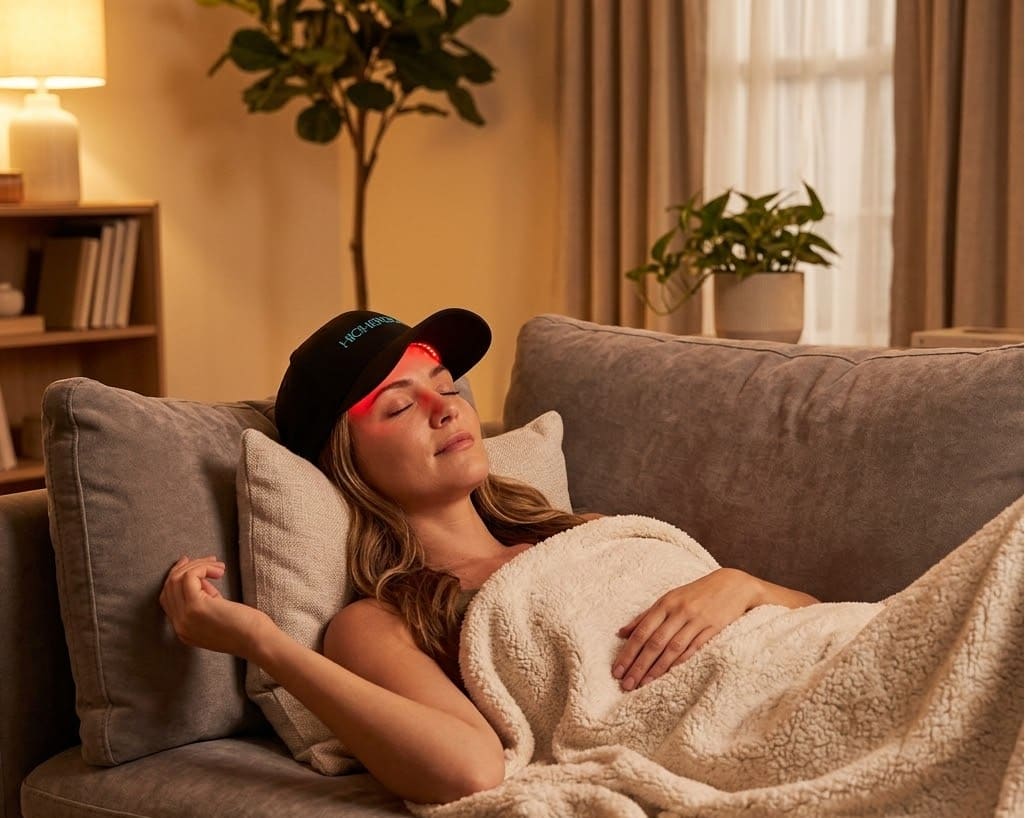
The HigherDOSE Red Light Hat is an at-home wearable phototherapy device designed to expose the scalp to red light during a timed 10-minute session.
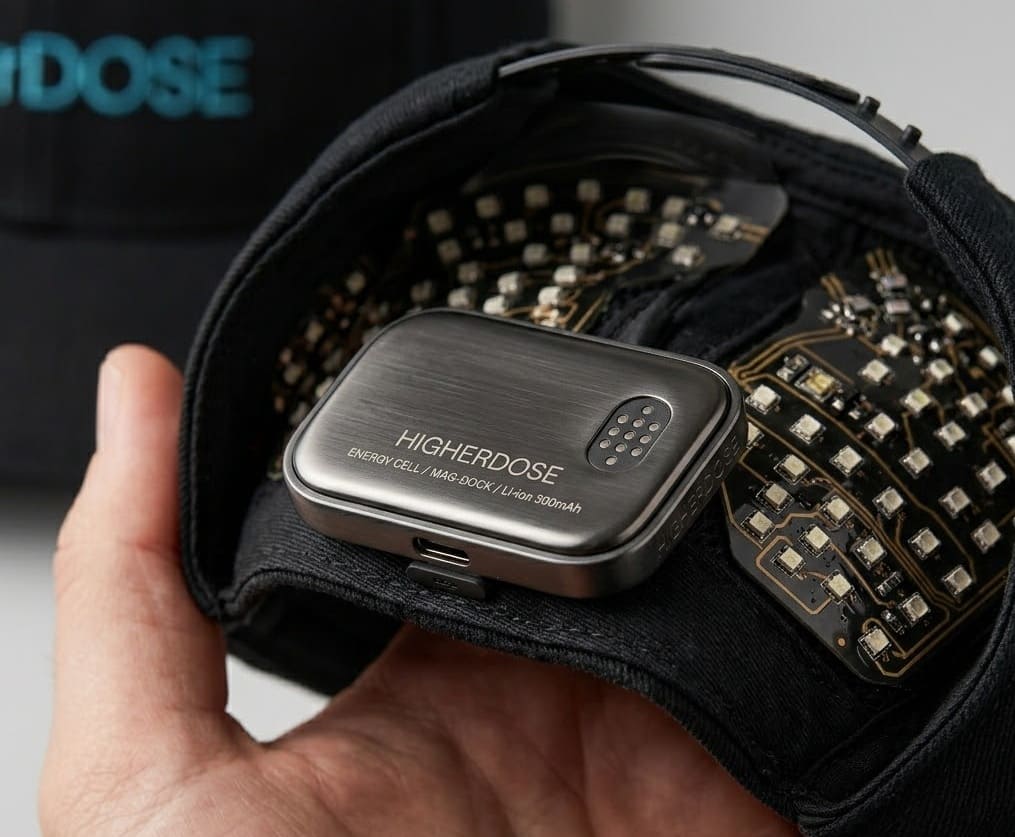
Its exterior resembles a standard black baseball cap. Inside is a removable light insert containing 120 LED bulbs. A rechargeable controller attaches magnetically to the back of the hat, allowing cordless use.
The listed package includes:
- one adjustable Red Light Hat;
- the removable LED insert;
- a rechargeable controller;
- power supply and regional adapters;
- USB-C to USB-A cable;
- instruction manual.
The device does not require a mobile app or subscription. That removes one recurring cost and avoids dependence on software updates for basic operation.
However, the product page does not clearly publish every technical detail a careful buyer may want, such as measured irradiance at the scalp, dose in J/cm², full coverage mapping, battery cycle life, or independent uniformity testing.

Is the HigherDOSE Red Light Hat FDA-Cleared?
Yes. The HigherDOSE Red Light Hat received FDA 510(k) clearance under K242363 in November 2024.
The FDA documentation describes it as a Class II home wearable LED phototherapy device using 650nm ±10nm red light.
Its cleared indication covers androgenetic alopecia and promotion of hair growth in:
- males with Norwood-Hamilton IIa–V patterns of hair loss;
- females with specified Ludwig-Savin or frontal patterns;
- users within Fitzpatrick Skin Types I–IV.
This matters because “FDA-cleared red light therapy” is often interpreted too broadly.
FDA clearance does not mean:
- FDA approval of every marketing statement made by the brand;
- guaranteed hair regrowth for every user;
- clearance for alopecia areata, scarring alopecia, chemotherapy-related hair loss, traction alopecia, nutritional deficiency, or every case of telogen effluvium;
- proof that it lowers cortisol, reduces anxiety, regulates the vagus nerve, or treats burnout;
- proof that the device outperforms other FDA-cleared laser caps or LED hair growth helmets.
A 510(k) clearance means the FDA found the device substantially equivalent to legally marketed predicate devices for the specified intended use.
Does Red Light Therapy for Hair Growth Work?
Low-level light therapy may support hair regrowth in some people with androgenetic alopecia, but results are variable and device-specific.
Research reviews generally describe low-level laser therapy and LED phototherapy as promising, non-invasive options for pattern hair loss. Studies have reported improvements in hair density or count compared with sham devices in selected populations.
That evidence has several limitations:
- devices use different wavelengths, numbers of diodes, irradiance, treatment schedules, and coverage patterns;
- study populations are often narrowly selected;
- follow-up periods may be relatively short;
- manufacturer-funded research and small samples can affect confidence;
- results from a laser cap cannot automatically be transferred to an LED hat with different specifications;
- evidence is stronger for androgenetic alopecia than for many other types of hair loss.
Red light therapy for hair should therefore be treated as one possible tool—not as proof that every thinning follicle can be “rejuvenated” or returned to a full growth phase.
What Evidence Exists for This Specific Hair Growth Device?
The strongest product-specific evidence is the FDA clearance and its technical comparison with predicate devices.
HigherDOSE also publishes results from a 16-week consumer test:
- 86% reported noticing hair growth;
- 93% reported improved overall hair and scalp health;
- 83% reported growth in sparse or balding areas;
- 100% said the hat was easy to integrate into their routine.
These numbers should be interpreted cautiously because the brand states that they came from a survey of 28 users.
The published summary does not provide enough information to establish:
- whether participants were blinded;
- whether there was a placebo or sham group;
- whether hair count was measured objectively;
- whether participants used minoxidil or other treatments;
- what types and stages of hair loss were included;
- how many users completed every session;
- whether the results persisted after the study period.
The survey is useful as early user feedback. It is not equivalent to an independent randomized controlled trial of the finished consumer product.
Who Should Buy the HigherDOSE Red Light Hat?
- You have androgenetic alopecia or a typical pattern of gradual thinning and understand that results are not guaranteed.
- You still have visible hair in the treatment area rather than complete long-standing baldness.
- You want an at-home, non-invasive hair growth device.
- You prefer a flexible cap to a rigid LED hair growth helmet.
- You want hands-free use rather than moving a laser comb across the scalp.
- You can commit to daily 10-minute sessions for 16 weeks.
- You have reviewed whether your medication, scalp condition, eye sensitivity, or medical history requires professional guidance.
- You value a 120-day return period enough to test comfort and routine fit.
Who Should Avoid It?
- Your hair loss is sudden, unexplained, patchy, painful, inflamed, or associated with scalp scarring.
- You are assuming that every case of shedding is androgenetic alopecia.
- You have complete baldness in the area and expect the device to create new follicles.
- You want guaranteed results within several weeks.
- You cannot maintain the initial daily routine.
- You expect the hat to replace diagnosis, minoxidil, prescription treatment, or dermatology care automatically.
- You are buying it to lower cortisol, calm the vagus nerve, treat anxiety, or heal burnout.
- The $449 price would create financial pressure or encourage continued use despite discomfort.
- You need published irradiance, dose, coverage, weight, or independent product-trial data before buying.
How Do You Use the Red Light Hat?
The current manufacturer instructions are straightforward:
- Fully charge the controller.
- Attach it to the magnetic connection at the back of the hat.
- Press and hold the power button until the LEDs illuminate.
- Place the hat securely on a clean, dry scalp.
- Allow the automatic 10-minute session to finish.
- Use it daily for the initial 16-week period.
- Continue with maintenance sessions three or four times weekly if appropriate.
More time is not automatically better. Follow the device instructions rather than doubling sessions in an attempt to accelerate hair growth.
Hair can block light from reaching the scalp. Fit, hair density, hair style, cap positioning, and contact between the LED insert and treatment area may therefore affect practical coverage.
Consistency is important because hair growth cycles are slow. However, consistency cannot overcome an incorrect diagnosis or a treatment area without viable follicles.
Red Light Hat vs Laser Cap vs LED Hair Growth Helmet
The HigherDOSE device is commonly compared with a laser cap, but its light sources are LEDs rather than laser diodes.
| Device type | Main advantage | Main limitation | Best for |
|---|---|---|---|
| HigherDOSE LED Red Light Hat | Flexible, cordless, discreet, 10-minute sessions | Limited published irradiance and product-specific independent evidence | Buyers prioritizing convenience and appearance |
| Rigid LED hair growth helmet | Structured positioning and potentially consistent geometry | Bulky fit, storage, pressure points, and clinical appearance | Home users who prioritize fixed coverage over portability |
| Laser cap | Uses laser diodes with more collimated light | Often expensive; diode count alone does not guarantee results | Buyers comparing detailed technical specifications |
| Handheld laser comb | Can target selected areas | Requires manual movement and consistent technique | Small treatment zones and lower-storage setups |
| Full red light therapy panel | Can cover multiple body areas | Not shaped or cleared specifically for scalp hair growth | General red-light routines rather than dedicated hair treatment |
Neither “laser” nor “medical-grade LED” automatically identifies the best device. Buyers should compare FDA status, intended use, wavelength, dose, coverage, treatment schedule, fit, warranty, return policy, and available clinical evidence.
A large home panel may emit red and near-infrared light, but it does not automatically provide the same scalp positioning or FDA-cleared hair-growth indication. Our red light therapy panel buyer guide covers that separate product category.

Comfort, Fit, Coverage, and Cleaning
Comfort
A flexible cap may feel less restrictive than a rigid helmet, but comfort remains individual. Head size, hair volume, pressure from the controller, heat, scalp sensitivity, and the position of the insert can all affect daily use.
We could not verify claims that the physical pressure or warmth of the hat stimulates the vagus nerve, lowers cortisol, creates “felt safety,” or regulates the autonomic nervous system.
Scalp coverage
The hat contains 120 LEDs, but LED count alone does not show whether every thinning area receives the same dose.
Frontal hairlines, temples, crowns, and wider female-pattern thinning may require different positioning. Buyers should confirm whether the insert covers the area they intend to treat.
Cleaning
The LED insert is removable and held in place by magnets. HigherDOSE advises removing the light section, spot-cleaning the hat, and allowing it to air-dry fully.
Do not wash or immerse the electronic insert.
Because the product sits directly on the scalp during repeated use, buyers should consider sweat, hair products, sebum, dandruff, styling residue, and whether regular spot cleaning will be sufficient.
Price, Returns, Warranty, and Hidden Costs
Current price
The US product page listed the HigherDOSE Red Light Hat at $449 during our review.
There is no required subscription, replacement serum, or paid app. However, buyers may still incur costs for:
- international shipping and customs;
- currency conversion;
- replacement controllers, cables, or accessories outside warranty;
- professional hair-loss assessment;
- other treatments used alongside the device;
- replacement if the battery degrades after warranty.
120-day return policy
HigherDOSE currently states that wellness technology, including the Red Light Hat, can be returned within 120 days from delivery even after use if the customer is not satisfied.
The company says it provides a prepaid return label. Buyers should still confirm whether this applies to their purchase region, affiliate transaction, promotional bundle, and international destination.
One-year warranty
The Red Light Hat carries a one-year limited warranty covering defects in materials and workmanship under normal use.
The warranty excludes normal wear, cosmetic damage, misuse, liquid damage, unauthorised repair, and operation outside published instructions.
For a $449 electronic device intended for repeated long-term maintenance use, one year is not especially generous. Battery degradation and ordinary ageing after the first year may become the buyer’s responsibility.

Why Hair-Loss Diagnosis Matters Before Buying
Red light therapy for hair growth is not equally relevant to every type of hair loss.
Gradual pattern thinning may be androgenetic alopecia. Sudden diffuse shedding may follow illness, surgery, childbirth, weight change, stress, medication, or nutritional issues. Smooth patches may indicate alopecia areata. Pain, scaling, pustules, or scarring can signal other scalp conditions.
These situations do not share one cause or one treatment plan.
Seek appropriate professional assessment when:
- hair loss begins suddenly;
- you see round or irregular bald patches;
- the scalp is painful, red, itchy, inflamed, or scarred;
- hair breaks rather than sheds from the root;
- eyebrows, eyelashes, or body hair are also affected;
- shedding follows a medication change or health event;
- you are unsure whether the pattern fits androgenetic alopecia.
A device can be FDA-cleared and still be the wrong product for the individual cause of hair loss.
Pros and Cons
| Pros | Cons |
|---|---|
| FDA-cleared for specified androgenetic alopecia indications | $449 is expensive for a single-purpose device |
| 120 LEDs using 650nm red light | LED count does not reveal irradiance or complete dose |
| Short 10-minute sessions | Daily use is required initially for 16 weeks |
| Cordless, hands-free design | Battery performance may decline over time |
| Looks less clinical than a rigid helmet | Fit and scalp coverage may vary |
| No subscription or app | No app also means no built-in adherence or usage tracking |
| 120-day return window | International policy details may differ |
| Removable insert for spot cleaning | Electronic insert cannot be washed |
| Potentially useful for pattern hair loss | Not cleared for every type of hair loss |
| Can be used alongside other approaches with suitable guidance | Only a one-year limited warranty |
What We Could Verify
- The device received FDA 510(k) clearance under K242363.
- The clearance applies to specific androgenetic alopecia patterns and Fitzpatrick Skin Types I–IV.
- The FDA summary describes a 650nm ±10nm LED phototherapy device.
- The product contains 120 LED bulbs.
- The US product page listed a price of $449 during our research.
- The manufacturer recommends 10 minutes daily for 16 weeks followed by maintenance use three or four times weekly.
- The device is cordless during use and has a rechargeable controller.
- The LED insert is removable for cleaning the fabric portion.
- HigherDOSE publishes a consumer survey involving 28 users over 16 weeks.
- The current return policy advertises a 120-day money-back period for wellness technology.
- The published limited warranty lasts one year.
- Research supports low-level light therapy as a potentially useful option for some people with androgenetic alopecia.
What We Could Not Verify
- The exact average increase in hair count produced by this specific finished product.
- That the brand’s 28-person consumer survey was blinded, controlled, or independently conducted.
- That the hat works for telogen effluvium, alopecia areata, scarring alopecia, traction alopecia, or every other type of hair loss.
- That it awakens every dormant follicle or reverses complete baldness.
- That the 120 LEDs deliver equal intensity across every area of the scalp.
- Published irradiance, J/cm² dose, or independent coverage mapping.
- Long-term battery life, LED degradation, controller durability, or performance after the warranty period.
- Long-term comfort across different head sizes, hairstyles, and scalp sensitivities.
- That the hat lowers cortisol, stimulates the vagus nerve, stops the stress response, or treats anxiety and burnout.
- That it is more effective than prescription treatments, minoxidil, other FDA-cleared devices, or combined treatment plans.
- Customer-support quality and international return handling over time.
Frequently Asked Questions
Is the HigherDOSE Red Light Hat FDA-approved?
It is FDA-cleared through the 510(k) pathway, not FDA-approved through a premarket approval process. The distinction matters because clearance is based on substantial equivalence to predicate devices for a defined intended use.
What type of hair loss is the hat intended for?
Its FDA clearance covers specified male and female patterns of androgenetic alopecia within Fitzpatrick Skin Types I–IV. It should not be presented as cleared for every type of hair loss.
Is the HigherDOSE hat a laser cap?
No. It uses 120 red-light LEDs. It belongs to the broader low-level light therapy category but does not use laser diodes.
What wavelength does it use?
The product is built around 650nm red light. The FDA summary describes the wavelength as 650nm ±10nm.
How often should you use the Red Light Hat?
HigherDOSE recommends 10 minutes each day for 16 weeks, followed by maintenance sessions three or four times per week.
How long does it take to see hair growth?
Hair growth is slow, and the brand evaluates users over a 16-week initial period. Some people may see no meaningful change. Continue only according to the product instructions and an appropriate hair-loss plan.
Does red light therapy stop hair shedding?
It may support hair density or growth in some users with androgenetic alopecia. It cannot reliably stop shedding caused by every illness, medication, deficiency, hormonal change, inflammatory condition, or stress-related trigger.
Can the hat regrow hair on a completely bald scalp?
It is unlikely to produce new hair where active follicles are no longer present. The brand also states that complete baldness may not respond.
Can you use it with minoxidil?
HigherDOSE says the device can be combined with other approaches. Treatment combinations and timing should be discussed appropriately, especially when scalp irritation, prescription medication, or another diagnosed condition is involved.
Does the Red Light Hat have a money-back guarantee?
The current HigherDOSE policy states that wellness technology can be returned within 120 days from delivery, including after use. Confirm the terms for your country and purchase channel before ordering.
Is the device suitable for every skin type?
The FDA-cleared indication specifies Fitzpatrick Skin Types I–IV. Buyers outside that stated indication should seek clear guidance rather than assuming identical evidence.
Final Verdict

Our HigherDOSE Red Light Hat review finds a legitimate FDA-cleared hair growth device with a convenient format, but also important evidence and buyer-fit limits.
The product is more credible than a generic wellness hat making vague scalp claims. It has an identifiable FDA clearance, 120 LEDs, a specified 650nm wavelength, a clear 10-minute treatment cycle, and a relatively useful 120-day return window.
Its biggest advantage is routine design. The cordless cap is easier to integrate into daily life than a handheld comb and less conspicuous than many rigid hair-growth helmets.
Its biggest weakness is not the technology itself. It is the gap between what can be verified and the much broader promises often attached to red light therapy.
The device is not established as a treatment for every cause of hair loss. It does not guarantee new growth, cannot create new follicles in a fully bald area, and should not be marketed as a method for lowering cortisol, calming the vagus nerve, stopping burnout, or restoring emotional wellbeing.
MindReset recommendation: consider the HigherDOSE Red Light Hat when your hair loss fits the FDA-cleared androgenetic alopecia use case, the $449 price is manageable, and you can maintain the required schedule.
Skip it until the cause of sudden, patchy, inflammatory, or unexplained hair loss has been clarified.
For the right buyer, this is a convenient at-home low-level light therapy device. For the wrong diagnosis, it is an expensive cap that may delay a more appropriate decision.
Sources and Further Reading
- HigherDOSE Red Light Hat: Current Product Information
- FDA 510(k) Database: HigherDOSE Red Light Hat K242363
- FDA 510(k) Summary and Indications for Use
- American Academy of Dermatology: Red Light Therapy Evidence and Safety
- Low-Level Laser and LED Therapy in Alopecia: 2024 Review
- HigherDOSE Return Policy
- HigherDOSE Red Light Hat Limited Warranty