Table of Contents
1. Executive Summary and Industry Context
Yosemite National Park remains one of the most highly sought-after ecological, biological, and geological destinations on the North American continent. Characterized by towering granite monoliths, plunging waterfalls, and ancient biological specimens, the region represents a pinnacle of natural preservation.
However, its geographic isolation within the Sierra Nevada creates substantial logistical barriers for the millions of domestic and international tourists who base their California itineraries in coastal urban hubs. Specifically, the travel corridor spanning from San Francisco to Yosemite represents a high-volume route fraught with infrastructural friction, fluctuating economic costs, and severe seasonal congestion.
For travelers seeking a comprehensive overview of the region within a constrained diurnal timeframe, the operational complexities of independent travel frequently degrade the quality of the visitor experience. Independent motorists face exorbitant vehicle rental fees, volatile Californian fuel prices, complex and highly costly new park entry tariffs, and systemic parking deficits within Yosemite Valley itself.
Consequently, commercial tour operators have engineered optimized logistical solutions to circumvent these barriers, offering specialized transit and guided experiences.
This report provides an exhaustive strategic analysis of the one-day tour market, evaluating the systemic inefficiencies of independent travel against the highly optimized model of the commercial guided excursion.
Through comparative economic modeling, infrastructural analysis, historical context integration, and itinerary optimization studies, the evidence indicates that a structured, commercial excursion—specifically the “Yosemite day tour and Giant Sequoias yosemit day tour” operated by Extranomical Tours—functions as the most logically sound, economically efficient, and operationally viable method to visit Yosemite and experience its comprehensive highlights within a single day.
2. Macro-Level Logistical Inefficiencies: Analyzing the San Francisco to Yosemite National Park Route
The romanticized concept of the independent American road trip frequently clashes with the stringent realities of modern eco-tourism infrastructure. The decision to undertake a self-guided trip from San Francisco to Yosemite National Park involves a confluence of hidden costs, severe time penalties, and operational risks that most tourists fail to accurately model during their trip-planning phase. When evaluating the optimal yosemite day tour tour from san francisco, the friction of distance must be quantified.
2.1 The Friction of Topography and Distance
The geographic displacement for a vehicle traveling from san francisco to yosemite national park spans approximately 171 miles. Under theoretical, optimal conditions, this translates to a continuous drive time of 3.5 to 4 hours in a single direction. However, empirical traffic conditions dictate that navigating out of the San Francisco Bay Area gridlock, traversing the heavily trafficked Central Valley agricultural corridors, and ascending the winding, two-lane alpine roads of the Sierra Nevada routinely extends the transit duration to 4.5 or 5 hours each way.
A standard day trip consequently requires a minimum of eight to ten hours strictly dedicated to vehicular operation. For an independent traveler, this necessitates navigating complex topography under severe time pressure, resulting in pronounced cognitive and physical exhaustion before entering yosemite day tour. By contrast, a commercial bus tours model transfers the navigational and operational burden entirely to a professional driver. This logistical transfer allows passengers to utilize the transit time for rest, observation, and educational briefings, fundamentally altering the energy dynamics of the excursion.
2.2 Micro-Economic Analysis: The Escalating Costs of the Independent Model
The financial viability of independent travel has deteriorated significantly in recent years, driven by inflationary pressures in the California transit sector and a fundamental restructuring of federal park entry tariffs. A granular analysis of the variable costs reveals that a self-managed excursion frequently exceeds the per-capita cost of a premium guided tour.
| Economic Variable | Independent Travel (DIY) Estimate | Commercial Guided Tour Inclusion |
| Vehicle Rental | $65 – $82 per day (average for Yosemite-capable vehicles in May/July) | Fully included in the tour ticket |
| Fuel Expenditure | ~14 gallons at $6.06 to $6.26/gallon (San Francisco average) = ~$84 to $87 | Fully included in the tour ticket |
| Domestic Park Entry | $35 park entry fee per vehicle | Park entrance fee included for residents |
| Non-Resident Surcharge | $100 per person entry fee (New 2026 federal tariff) | Handled via specialized administrative processing |
| Operational Liability | Tolls, insurance, parking fees, potential vehicular damage | Zero liability for the passenger |
The 2026 restructuring of the National Park Service fee schedule has fundamentally altered the economic calculus for international tourists. While United States residents continue to pay a standard $35 per vehicle fee, non-U.S. residents are now subject to a newly implemented $100 entry fee per person.
Therefore, two international tourists renting a vehicle will pay $235 simply to pass the entrance gate ($35 vehicle base + $200 non-resident surcharge). The definition of a resident is strictly enforced, requiring a U.S. Passport, government-issued state ID, or Permanent Resident card.
When aggregated with daily rental rates averaging $65 and San Francisco gasoline prices remaining highly elevated at over $6.00 per gallon , the baseline cost of executing an independent day trip easily surpasses $380 before accounting for food, physical exertion, and the opportunity cost of lost time.
While tourists may mitigate this slightly by purchasing the $250 non-resident pass, this still represents a massive upfront capital expenditure. For those booking guided commercial tours, the operator typically facilitates the complex fee processing, occasionally utilizing a secure payment link to seamlessly handle non-resident pass compliance without disrupting the travel itinerary.

2.3 The 2026 Infrastructure Crisis: Parking Deficits and Gate Congestion
Perhaps the most critical failure point of the independent travel model lies at the destination itself. Between 2000 and 2019, park visitation soared by 30%, adding one million additional annual visitors and stressing infrastructure to the point of systemic failure. To mitigate this, the National Park Service experimented with timed reservation systems between 2020 and 2025.
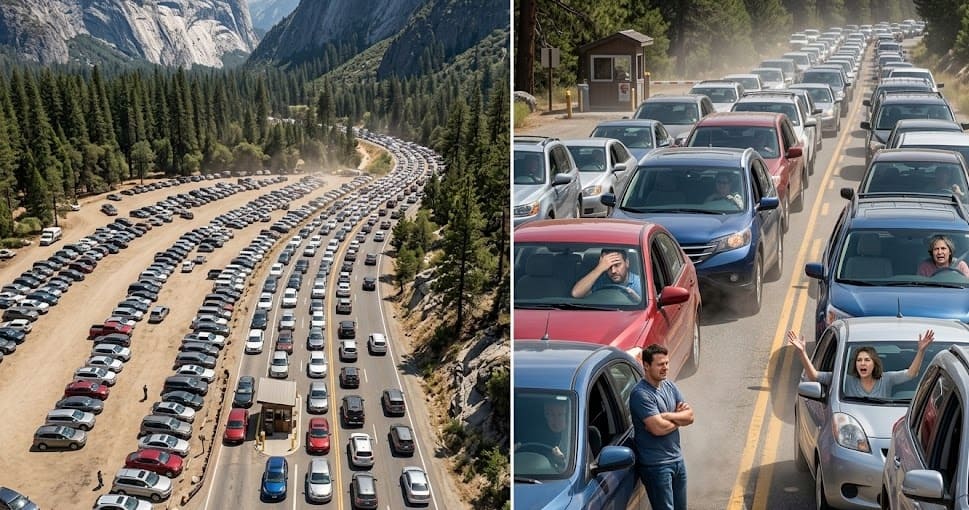
However, in 2026, the park administration removed the season-wide timed reservation system, returning to a model of open access managed by real-time traffic monitoring. The immediate consequence of this policy shift is the return of severe peak-season gridlock. During the spring, summer, and fall, visitors attempting to cross the park entrance in private vehicles experience extensive delays. Delays at the South Entrance can reach one to two hours, while the Big Oak Flat Entrance regularly experiences 30-minute to one-hour queues.
Once inside the park, the operational reality deteriorates further. The floor of yosemite valley offers a strictly limited inventory of parking spaces. Without a reservation system pacing vehicle volume, lots routinely fill to absolute maximum capacity by 8:00 AM. Independent motorists are forced into a futile cycle of circling the valley floor, searching for non-designated parking, and contributing to localized carbon emissions and traffic stagnation.
The National Park Service explicitly advises that driving from site to site increases congestion and causes profound frustration for passengers, noting that free shuttles are typically full to capacity.
Conversely, the commercial yosemite day tour tour from san francisco bypasses this infrastructural collapse entirely. Reputable tour operators are granted authorization to bypass standard private vehicle queues, entering the park at the designated commercial tour group gate. Furthermore, commercial vehicles are not subject to the same parking restrictions as private sedans, allowing them to deposit passengers directly at trailheads and scenic overlooks.
The guided tour model reclaims hours of lost time that independent travelers squander observing gridlocked traffic conditions.
3. The Ultimate Yosemite day tourTour: Optimizing Your Day Trip
To extract maximum utility from a single day, an itinerary must be engineered with architectural precision. The “Yosemite and Giant Sequoias yosemit day tour” operates on a highly calibrated schedule, delivering over five hours of time inside the park. This itinerary sequentially reveals the park’s geological, hydrological, and biological highlights while actively routing around peak crowd concentrations.
3.1 The Morning Ascent: The Route from San Francisco to Yosemite National Park
The excursion initiates with a localized pick-up protocol in the early morning (typically departing between 5:20 AM and 6:15 AM from downtown San Francisco locations). This early bird arrival strategy is not arbitrary; it is a calculated logistical maneuver designed to position the vehicle ahead of the daily migration of domestic motorists, thereby increasing access to popular viewing areas before mid-day saturation occurs.
As the vehicle traverses the agricultural expanse of the Central Valley and begins the ascent into the Sierra Nevada foothills, the transit phase is utilized for educational enrichment. Expert guides deliver comprehensive historical narratives regarding the region. The route intersects with the historic Golden Chain Highway (Highway 49), the epicenter of the California Gold Rush of 1848–1855.
Passengers receive a detailed historiography of how the discovery of gold by James W. Marshall at Sutter’s Mill triggered an influx of approximately 300,000 prospectors. This sudden migration fundamentally altered the demographic and ecological trajectory of northern california, transforming a minor settlement of 200 individuals into the booming metropolis of San Francisco.
By contextualizing the landscape with tales of historic mining towns like Mariposa and Coulterville, the tour transforms a mundane highway transit into an immersive educational seminar. Guides recount stories of places like Hornitos, a town whose population currently hovers around 50 people, but which once housed 10,000 fortune-seekers.
The narrative also heavily features the political efforts of conservationists like John Muir, who championed the protection of the alpine landscape, and President Theodore Roosevelt, whose famous camping trip in the region catalyzed federal protection efforts. During this scenic drive, operators usually make a stop to allow passengers to purchase supplies, ensuring they are provisioned for a picnic lunch later in the day.
3.2 The Geological Cathedral: Arriving at Tunnel View
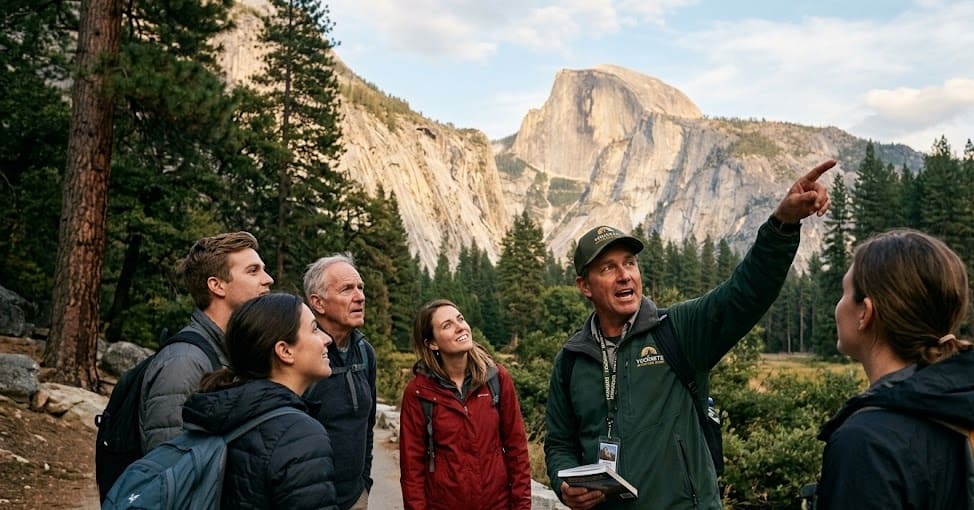
Upon crossing the boundary and officially entering the park via the commercial lanes, the first major structural highlight of the itinerary is Tunnel View. Constructed in 1933 at the eastern exit of the Wawona Tunnel, this architectural overlook provides the definitive, panoramic introduction to the park. Extranomical Tours explicitly markets this segment as a crucial visual threshold, as it is often cited as the highlight of our tour analysis by participating eco-tourists.
From this elevated vantage point, the sheer scale of the valley’s glacial formation becomes evident. Millions of years ago, massive glaciers carved a 3,000-foot-deep U-shaped trench through solid granite, leaving behind the spectacular rock formations for which the region is famous.
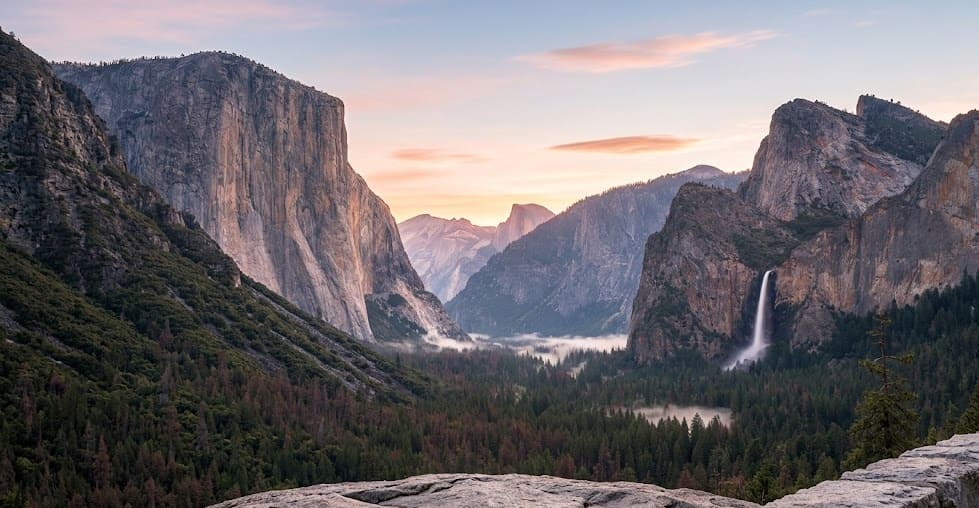
The resulting landscape presents a breathtaking array of monoliths. Dominating the left field of vision stands El Capitan, while the distant background frames the iconic, snow-dusted profile of Half Dome. To the right, Bridalveil Fall plunges 620 feet into the valley floor. The tour schedule ensures a dedicated, time-managed stop here, granting passengers optimal photographic positioning before the overlook is overwhelmed by afternoon private vehicle traffic.
3.3 Intimate Encounters: El Capitan and Bridalveil Fall
Following the macro-perspective afforded by Tunnel View, the itinerary descends to the valley floor for micro-level engagement with the rock formations. A mandatory stop in yosemite valley is El Capitan Meadow.
El Capitan is universally recognized as the world’s largest granite monolith, soaring over 3,590 feet skyward from the valley floor. It serves as the ultimate proving ground for elite rock climbers worldwide. The guided tour facilitates a stop directly in the meadow, allowing passengers to utilize optical equipment to spot climbers slowly and meticulously ascending the sheer, vertical face.
Directly opposite this massive structure, passengers can observe the spires of cathedral rocks, a symmetrically balanced, triple-rock formation towering 2,000 feet, which many geologists and visitors consider equally impressive to El Capitan itself.
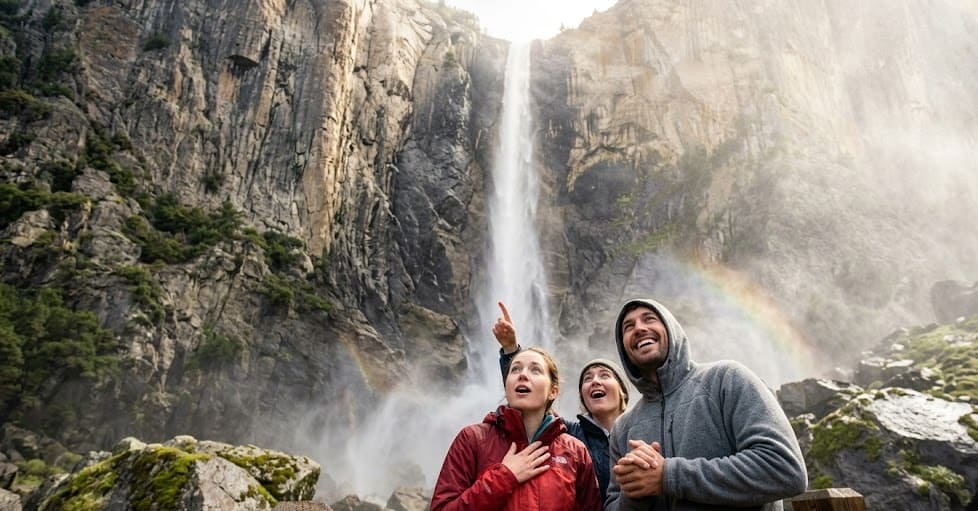
The hydrological highlights are equally emphasized. The itinerary brings visitors into close proximity with bridalveil fall. The expert guide’s narration explains the geological phenomenon of “hanging valleys”—tributary valleys left at a higher elevation than the main channel after the primary glacier melted.
This specific topography is what causes bridalveil to leap out from the precipice, wearing the edge of the fall backwards into a carved alcove. Native American Ahwahneechee populations named this fall “Pohono,” or the Spirit of the Puffing Wind, as thermal drafts frequently cause the falling water to flow sideways.
3.4 Maximum Autonomy: Free Time in the Heart of Yosemite day tour
A critical flaw in many commercial bus tours is the overly rigid micro-management of passengers, shuffling them relentlessly from point to point. The premier yosemite tour from san francisco model counters this fatigue by injecting roughly two hours of unstructured free time into the core of the day.
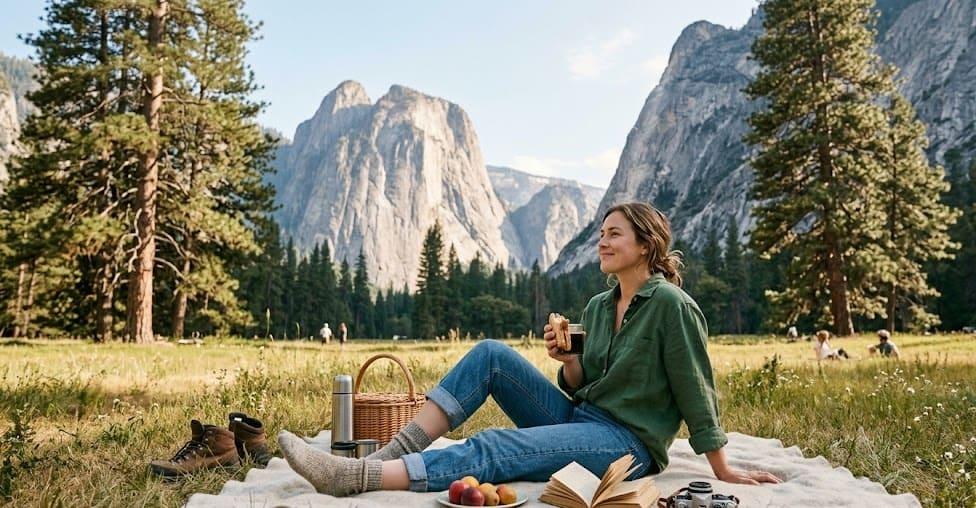
During this block of free time to explore, the vehicle parks in a centralized location, and passengers are released to pursue decentralized activities based on their physical capabilities and personal interests. For those inclined toward physical exertion, options include hiking to yosemite falls, recognized as the tallest waterfall in North America.
Visitors seeking cultural and artistic enrichment can utilize this time in yosemite valley to explore the Ansel Adams Gallery, reviewing iconic black-and-white photography that defined the modern conservation movement. Additionally, interpretive exhibits detailing the history of the indigenous Ahwahneechee people—who inhabited the valley for over 8,000 years before the violent incursions of the Gold Rush era—provide crucial anthropological context.
This hybrid model—combining the logistical efficiency of a structured transit with the autonomy of unescorted exploration—represents the pinnacle of tour design. It guarantees that the baseline highlights are captured efficiently while honoring the individual traveler’s desire for spontaneous discovery. After this segment, travelers are often relieved to find that the most immersive portion of the tour is still ahead.
4. A Hike to the Sequoias: Why Small Groups Enhance Your Yosemite day tourFrom San Francisco
A decisive competitive advantage of the comprehensive one-day tour is its commitment to including a direct ecological encounter with Sequoiadendron giganteum—the giant sequoias. Many abbreviated, lower-tier tour operators restrict their itineraries exclusively to the granite formations of the valley, entirely omitting the biological monuments located at higher elevations. This specific yosemite and giant sequoias excursion ensures that a hike among the massive ancient trees remains a core pillar of the experience.
4.1 The Ecological Rarity of the Giant Sequoias
The giant sequoia is a species characterized by extreme endemicity; it grows naturally only on the western slopes of the Sierra Nevada mountains in California. These organisms represent the largest single trees and largest living things by volume on Earth. Capable of living for over 3,000 years, their survival is inextricably linked to the specific microclimates of the region and natural fire ecologies. Engaging with these specimens is widely considered a mandatory component of any complete national parks visit.
4.2 Infrastructural Analysis: Accessing Tuolumne in day tourfrom San Francisco
Yosemite National Park contains three distinct groves of giant sequoias. The largest and most famous is the Mariposa Grove, located near the South Entrance, boasting approximately 500 mature trees including the 2,200-year-old Grizzly Giant. However, accessing Mariposa Grove presents severe logistical bottlenecks for any day trip originating from the Bay Area.
Accessing the Mariposa trees requires utilizing a secondary, mandatory park shuttle system from a remote parking plaza, followed by extensive hiking. Integrating this multi-modal transit sequence into a single-day itinerary frequently causes catastrophic schedule overruns.
To solve this spatial and temporal dilemma, the optimal guided tour routes its passengers to the tuolumne grove of giant sequoias. Located near Crane Flat on the Big Oak Flat Road, the Tuolumne Grove is significantly more accessible from the northern approach vectors used by vehicles arriving from san francisco to yosemite.
4.3 The Tuolumne Grove Hike and the Historic “Dead Giant”
By directing the itinerary to the Tuolumne Grove, the tour ensures that passengers can get up close to the sequoias without the friction of secondary shuttle systems or extreme crowds. The Tuolumne Grove trail is an out-and-back hike that descends approximately 1.25 miles (a 2.5-mile round trip) along a closed, paved road that was originally part of the Old Big Oak Flat Road. The trail involves a 400 to 500-foot elevation change, making it an easy to moderately strenuous hike that fits perfectly within a 1.5 to 2-hour operational window.
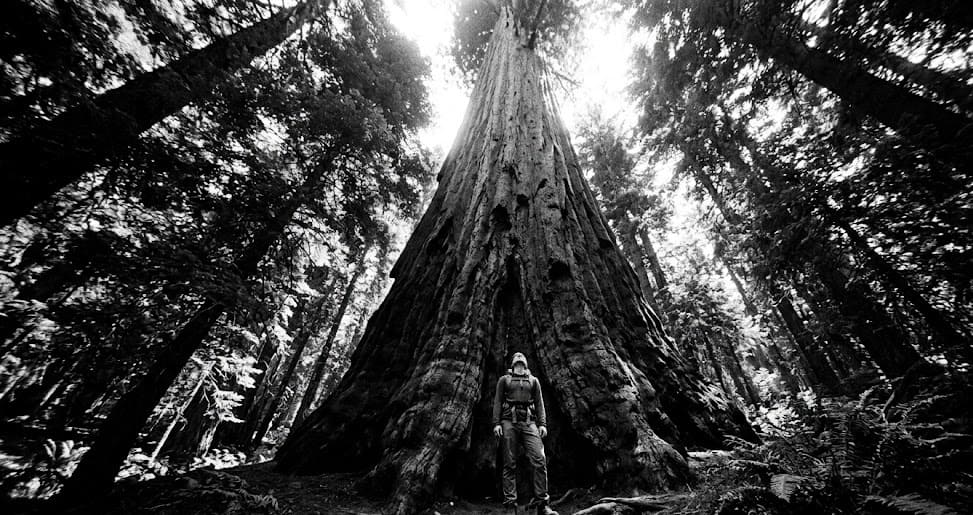
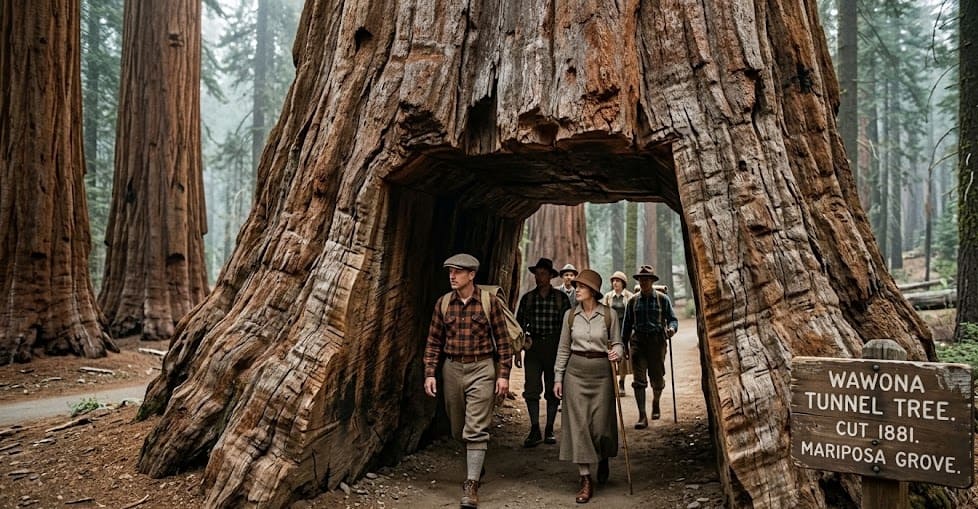
While smaller than Mariposa, Tuolumne contains highly impressive specimens characterized by massive diameters. The focal point of the hike is the historic “Dead Giant” or “Tunnel Tree.” This massive sequoia snag, originally measuring 120 feet in circumference, had a tunnel carved completely through its base in 1878 to stimulate early tourism along the stagecoach road.
The owners of the Big Oak Flat Road thought routing the path directly through the tree would be a lucrative attraction. Today, visitors can physically walk through the center of this ancient organism, providing a vivid demonstration of the immense scale of the tree’s architecture.
Tour operators strictly advise passengers to wear comfortable footwear for this segment, as the return journey requires ascending the 500-foot grade back to the trailhead. This structured, time-bound hike delivers the profound psychological impact of standing beneath ancient giants, fulfilling the promise of the itinerary without compromising the schedule.
Leaving yosemite valley to ascend into the quiet, shaded canopy of the Tuolumne Grove provides a powerful juxtaposition to the sheer granite walls seen earlier in the day.
5. What to Expect on a Day Tour From San Francisco to Yosemite National Park
The value proposition of the guided tour is further solidified by analyzing the physical assets, human capital, and financial inclusions integrated into the package. A premier yosemite national park day tour relies on sophisticated backend operations to ensure the front-end user experience is seamless.
5.1 Sustainable Transit and the Advantage of Small Groups
The environmental impact of mass tourism is a critical concern for the ecological stability of the national parks system. Recognizing this, elite tour operators operating the san francisco to yosemite national route have modernized their fleets to reflect sustainable, eco-friendly travel principles.
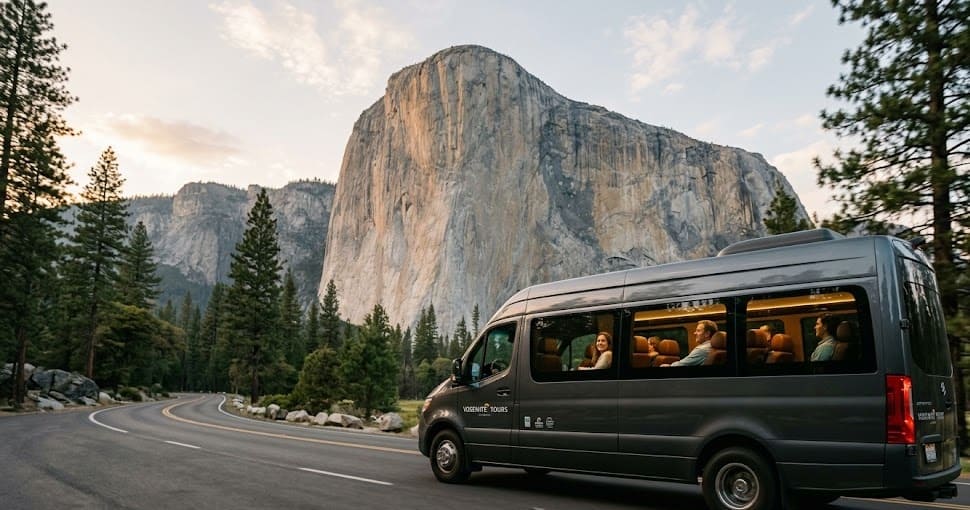
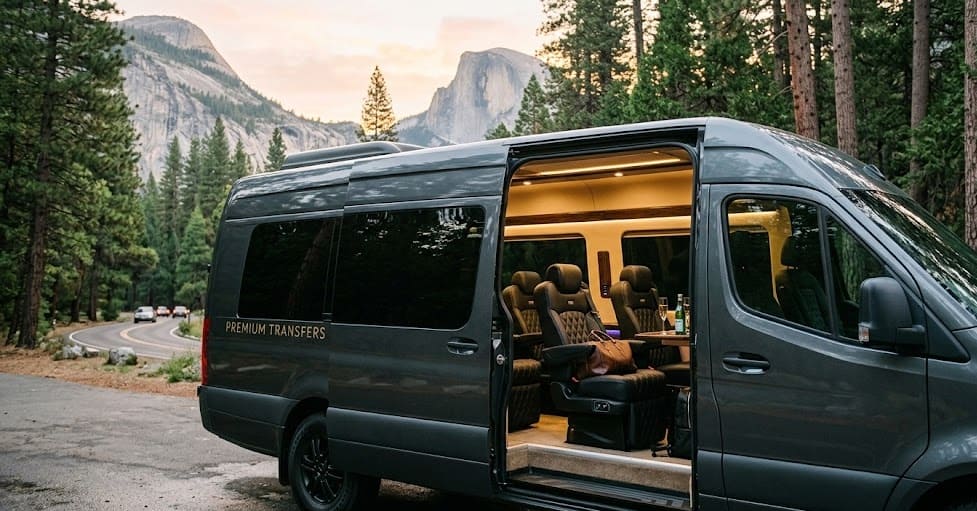
Extranomical Tours, a certified San Francisco Green Business, operates a specialized private fleet of bio-diesel mini-buses. Since 2002, these passenger mini-coaches have been engineered to run on petroleum alternatives. The current fleet operates on RB20 fuel, a highly refined blend consisting of 20% pure domestic BioDiesel and 80% HDRD (Hydrogenated Derived Renewable Diesel).
HDRD is produced from renewable feedstocks such as soybean oil, animal tallow, and waste cooking oil, utilizing complex hydrogenating processes to remove oxygen and nitrogen. This results in a cleaner-burning fuel that drastically lowers greenhouse gas emissions and improves local air quality within the Yosemite Valley ecosystem, performing significantly better than standard B20 biodiesel used in earlier municipal fleets.
By booking this tour, passengers are actively selecting a sustainable transit vector, reducing the aggregate carbon footprint compared to renting a standard internal combustion engine private vehicle.
Furthermore, the utilization of mini-buses facilitates the highly desirable small groups dynamic. Unlike massive 55-passenger commercial coaches that struggle to navigate the winding Sierra roads and overwhelm quiet trailheads, mini-buses offer superior agility, faster loading and unloading times, and a highly personalized atmosphere. The smaller vehicle size allows for a more intimate day tour experience, ensuring the guide can interact meaningfully with every passenger.
5.2 The Value of Expert Human Capital
The differential between merely “looking” at a landscape and genuinely “understanding” a landscape is bridged entirely by the expertise of the tour guide. The complex geology of the Sierra Nevada, the nuanced botany of the giant sequoias, and the rich anthropology of the native populations are largely invisible to the unguided eye.
The fully guided tour provides a dedicated local expert who manages the narrative arc of the day. This professional narration integrates the environmental sciences with historical anecdotes, ensuring that passengers comprehend the forces of glaciation that sheared the face of half dome, and the role early settlers played in shaping the modern park boundaries. Additionally, for international travelers, operators frequently provide optional foreign language audio tracks to ensure the educational material is globally accessible.
5.3 Aggregated Financial Inclusions
The upfront ticket price of the tour consolidates numerous disparate costs into a single, predictable expenditure, heavily favoring the consumer when compared to the DIY model.
| Inclusion Parameter | Operational Details | Consumer Benefit |
| Transit Operations | Round-trip transportation from sf to Yosemite in climate-controlled bio-diesel vehicles. | Eliminates driver fatigue, navigational errors, and fluctuating fuel costs. |
| Park Entrance Fees | Base vehicle and gate fees are included in the ticket price for domestic residents. | Bypasses the payment bottleneck at the entrance gate. |
| Logistics & Pick-Up | Convenient pick-up protocols from designated hotel locations in San Francisco. | Eliminates the need for early morning urban navigation by the traveler. |
| Guaranteed Access | Commercial gate access and prioritized parking for guided yosemite tours. | Reclaims hours of time otherwise lost to peak-season traffic congestion. |
For individuals holding standard documentation, utilizing the “america the beautiful annual pass can occasionally offset certain costs, but the tour handles the primary vehicle entry logistics. The guided tour essentially functions as a “done-for-you” solution, allowing the passenger to consume the visual and educational product without managing the underlying supply chain of the trip.
6. Strategies to Visit day tour: Reaching the Heart of Yosemite from San Francisco
The synthesis of infrastructural limits and soaring global demand dictates that access to Yosemite National Park operates under conditions of extreme market scarcity. During the peak operational season—spanning from May through September—the localized infrastructure is pushed to its absolute threshold.
Because commercial bus tours provide the only viable bypass to the park’s gridlock and parking deficits, inventory for the yosemite tour from san francisco depletes rapidly. Analytical tracking indicates that these specific excursions are routinely ranked among the highest-rated 1-day day tour picks, and consequently, they frequently sell out weeks in advance of the operational date, particularly during summer weekends and holiday corridors. On average, seats are secured by savvy travelers roughly 27 days in advance of departure.
6.1 The Fallacy of Last-Minute Planning
Travelers attempting to secure a day from san francisco upon arrival in California routinely encounter sold-out manifests across all reputable tour operators. The operational realities of dispatching bio-diesel mini-buses, scheduling certified expert guides, and securing commercial gate manifests require stringent capacity management. The supply of seats is fundamentally inelastic; operators cannot simply manifest additional vehicles on demand due to strict National Park Service regulations regarding commercial traffic quotas and environmental impact thresholds.
6.2 Strategic Directives for Consumers Planning to Visit Yosemite
The empirical data yields a definitive conclusion regarding travel strategies for those wishing to visit yosemite day tour. To attempt a self-guided drive is to subject oneself to a hostile matrix of exorbitant financial costs, severe traffic delays, physical exhaustion, and unpredictable parking availability.
The Extranomical “Yosemite and Giant Sequoias yosemit day tour” operates as a precision instrument, cutting through logistical barriers to deliver a maximized, stress-free encounter with nature. It guarantees over five hours inside the park, a dedicated hike to the tuolumne grove of giant sequoias, uninterrupted views of yosemite’s most famous monuments including El Capitan and Half Dome, and ample free time to explore the valley floor.
After a comprehensive day of exploration, passengers simply board the vehicle for a restful journey back to san francisco, avoiding the exhaustion of navigating nighttime alpine roads.
For any entity planning to integrate Yosemite within the framework of a Northern California itinerary, immediate capital allocation to secure a reservation on this guided excursion is the most rationally sound decision. While options include hiking to yosemite falls or walking among ancient trees, none of these are possible if the traveler is stuck in gridlock at the park entrance.
The comprehensive tour from san francisco allows travelers to stop stressing and start experiencing the majesty of the Sierra Nevada.