Table of Contents
A mattress upgrade does not always require buying a completely new mattress. If the mattress is still level and supportive but feels too firm, too flat, or less comfortable than it used to, a topper may change the sleep surface for far less money.
But a topper has limits. It can add cushioning, alter surface feel, and create a different material layer between you and the mattress. It cannot rebuild broken springs, restore a collapsed support core, or permanently repair deep sagging.
This guide helps you decide between a mattress topper and a new mattress. It also explains where a thick wool-and-latex option such as the MyWoolly Latex Topper may fit — without pretending that one bedding product can solve every sleep or comfort problem.
Quick verdict: Buy a topper when the mattress remains structurally sound and the main problem is surface comfort. Replace or professionally assess the mattress when it has deep impressions, broken components, unstable edges, persistent sagging, or inadequate underlying support.
Affiliate disclosure: MindReset.org may earn a commission if you buy through our links. This does not increase your price and does not affect our editorial judgment.
Research note: We have not personally tested the MyWoolly Latex Topper yet. This support guide is based on current manufacturer specifications, public care instructions, general mattress guidance, and comparison with common topper materials. It is not a second hands-on product review.
Health note: A mattress or topper is not a treatment for chronic pain, insomnia, anxiety, mobility problems, or a sleep disorder. Persistent pain, numbness, severe sleep disruption, or unexplained fatigue should be discussed with an appropriate healthcare professional.
Mattress Upgrade: Topper or New Mattress?
The first decision is not which topper to buy. It is whether the existing mattress is still worth upgrading.
A topper changes the upper comfort layer. It may make a firm mattress feel softer, add a more responsive surface, reduce the direct feel of coils or firm foam, and change how warm or cushioned the bed feels.
A new mattress replaces both the comfort layers and the underlying support system. That matters when the problem is structural rather than cosmetic.
| What is wrong with the bed? | Topper or new mattress? | Why |
|---|---|---|
| The mattress is supportive but too firm | Try a topper | A thicker comfort layer may soften the surface |
| The mattress feels flat but has no visible sagging | Consider a topper | The support core may still be usable |
| A guest-room mattress needs more comfort | Try a topper | Lower-cost upgrade for occasional use |
| You can feel deep body impressions | Inspect or replace the mattress | A topper follows the shape underneath it |
| The bed sags toward the middle | Check the base, then replace if needed | The mattress or foundation may be failing |
| Springs are broken, noisy, or easy to feel | Replace the mattress | A topper does not repair internal components |
| The mattress edge collapses when sitting | Usually replace | Edge-support failure is structural |
| You want a different material against the body | Consider a topper | A topper can add wool, latex, foam, or fiberfill |
| The mattress and bed frame both move or dip | Inspect the frame and foundation first | The mattress may not be the only problem |
The key distinction is simple: a topper may improve feel, but it does not rebuild support.
What Can a Mattress Topper Actually Change?
A topper sits above the mattress, so its strongest influence is on the surface you directly feel.
- It can make a firm mattress feel softer.
- It can add cushioning beneath the shoulders and hips.
- It can create a more responsive or more contouring surface.
- It can place a different material between you and the mattress.
- It can make a guest bed or temporary bed more comfortable.
- It can reduce the immediate feel of a firm quilted cover or shallow comfort layer.
- It can slightly increase the overall bed height.
The amount of change depends on the material, thickness, density, body weight, sleep position, and the condition of the mattress underneath.
A thin mattress pad may add a little softness. A substantial topper can create a more noticeable change. But even a thick topper still follows the broad shape and support characteristics of the mattress below it.
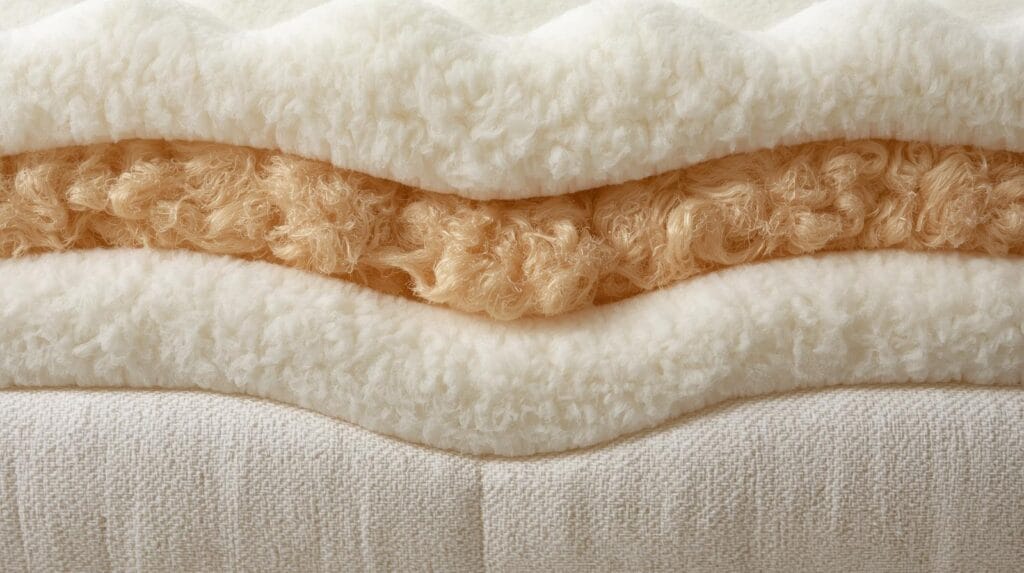
A topper changes the comfort layer above the mattress; it does not replace the support system underneath.
What a Mattress Topper Cannot Fix
A topper cannot permanently repair a mattress that is already failing.
- It cannot remove deep sagging.
- It cannot rebuild compressed foam.
- It cannot repair broken or weakened coils.
- It cannot stabilize a damaged bed frame.
- It cannot restore a collapsed edge.
- It cannot make an undersized or unsuitable mattress larger.
- It cannot guarantee relief from pain.
- It cannot correct every sleep-position mismatch.
A topper may temporarily make a sagging mattress feel less harsh, but the topper usually settles into the same depression. Sleep Foundation similarly notes that a sagging mattress cannot truly be repaired with a topper; replacement or manufacturer repair is the actual structural solution. See its guide on how to deal with a sagging mattress.
Seven Signs a Topper May Be Enough
1. The Mattress Is Level
Remove the bedding and look across the surface. Small impressions can be normal, but there should not be a major dip pulling you toward one area.
2. The Support Still Feels Stable
You should not feel as though the bed is collapsing beneath your hips, shoulders, or middle. The mattress can feel firm without feeling structurally unstable.
3. The Main Complaint Is Firmness
A mattress that feels too firm is one of the clearer cases for trying a topper. Adding a comfort layer is more realistic than expecting a topper to make a severely soft mattress firm again.
4. The Bed Is Still in Reasonable Condition
Age alone does not decide whether a mattress needs replacement. Condition matters more. Check for sagging, torn fabric, broken components, major compression, instability, and changes in support.
5. You Want a Different Surface Material
A topper can add wool, latex, memory foam, down alternative, or another material without replacing the entire mattress.
6. You Need a Reversible Upgrade
A topper can usually be removed if the feel does not suit you, subject to the seller’s return conditions. Replacing a mattress is a larger and less flexible decision.
7. The Bed Is for Temporary or Occasional Use
A guest room, rental, student room, or temporary living arrangement may not justify an immediate full mattress replacement when the base mattress remains usable.
Six Signs You Probably Need a New Mattress
1. Visible Sagging or Deep Impressions
When the surface has a clear hollow, a topper usually conforms to it instead of removing it.
2. Broken, Noisy, or Protruding Components
Broken springs, sharp areas, loud internal movement, or damaged foam are not comfort-layer problems.
3. The Edge No Longer Supports Weight
Severe edge collapse can make entering, leaving, and using the full surface of the bed more difficult.
4. The Mattress Feels Unsupportive in Every Position
If changing pillows, positions, and surface cushioning does not help, the support system may no longer suit you.
5. You Sleep Noticeably Better on Other Beds
This does not prove that your mattress is defective, but it is useful evidence that the current setup may no longer fit your comfort and support needs.
6. The Foundation Is Damaged or Incorrect
Inspect the frame, slats, foundation, and center support before blaming the mattress. A good mattress on an unsuitable base can still dip or feel unstable.
The Five-Minute Mattress Upgrade Test
Before purchasing anything, strip the bed and perform this basic check.
- Look: Check for dips, uneven areas, damaged seams, or edge collapse.
- Press: Apply pressure across different sections and compare the response.
- Listen: Notice broken-spring sounds, creaking, or unusual internal movement.
- Check the base: Inspect slats, center support, and the floor beneath the bed.
- Name the problem: Decide whether the main issue is firmness, heat, surface texture, motion, sagging, noise, or general support.
If you cannot identify the problem, do not start by purchasing the most expensive topper. A vague complaint such as “the bed feels bad” can lead to buying the wrong material.
Which Mattress Topper Material Fits Which Problem?
| Material | Typical surface feel | Best reason to consider it | Possible drawback |
|---|---|---|---|
| Solid latex | Responsive, springy, available in different firmness levels | You want cushioning without a slow foam feel | Heavy, often expensive, distinct latex feel |
| Memory foam | Slow contouring and deeper sink | You prefer close body conforming | Some sleepers dislike heat or restricted movement |
| Wool | Soft, lofty, less body-hugging | You want a natural fiber comfort layer | Compresses over time and provides limited structural change |
| Wool and latex blend | Lofty with springier pieces inside | You want a softer natural-material surface with some responsiveness | Feel may be less uniform than a solid latex slab |
| Fiberfill or down alternative | Soft and pillow-like | You want inexpensive surface plushness | Can flatten and may require frequent fluffing |
| Feather or down | Very soft and moldable | You like traditional plush bedding | May need regular redistribution and is unsuitable for some buyers |
No material is automatically best. The correct choice depends on what you are trying to change and what type of feel you already dislike.
Where the MyWoolly Latex Topper Fits
The MyWoolly Latex Topper is relevant when the mattress remains supportive but the buyer wants a thick, softer comfort layer made primarily from wool with added latex pieces.
According to the manufacturer’s current specifications, the topper uses:
- approximately three inches of loft;
- Shropshire wool batting in the upper and lower layers;
- woolly puffs and natural latex noodles in the middle;
- a natural cotton percale outer fabric;
- elastic straps at both ends;
- hand-tufting to help hold the fill in place;
- a five-year manufacturer warranty.
This is not the same construction as a solid three-inch latex slab. The latex is present as noodles mixed into the middle layer rather than as one continuous latex core.
That means buyers should expect the feel of a thick, tufted wool topper with added responsiveness — not the uniform pushback of a solid Dunlop or Talalay latex topper.

The best use case is a structurally sound mattress that needs a softer, more substantial comfort layer.
For current pricing, complete specifications, advantages, disadvantages, care requirements, and our product-specific buyer verdict, read the full MyWoolly Latex Topper review.
Who Should Consider the MyWoolly Topper?
- Your mattress is structurally sound but feels too firm.
- You prefer wool and latex over a conventional memory foam surface.
- You want a substantial, approximately three-inch comfort layer.
- You prefer a tufted, lofty feel rather than deep foam contouring.
- You are comfortable with regular airing, flipping, and occasional fluffing.
- You understand that natural fill can compress gradually.
- You are prepared to pay more than for a basic polyester or entry-level foam topper.
Who Should Skip It?
- Your mattress is deeply sagging or structurally damaged.
- You want a firm, uniform slab of latex.
- You need a lightweight topper that is easy to move alone.
- You want simple, frequent machine washing.
- You dislike maintaining, airing, or redistributing natural fill.
- You need guaranteed cooling rather than a different bedding material.
- You are sensitive to the natural aroma of wool or latex.
- You have not checked the seller’s return and trial conditions.
Care and Maintenance Reality Check
The topper uses materials described as washable, but that does not mean it should be treated like an ordinary lightweight mattress pad.
The current manufacturer care guidance recommends:
- protecting the topper with a fitted sheet;
- spot-cleaning the cotton cover with mild detergent;
- air-drying fully after cleaning;
- airing and sunning the topper periodically;
- gently shaking, flipping, and fluffing it;
- using limited-moisture eco-friendly dry cleaning for major stains;
- avoiding normal machine washing when possible because of the size and weight.
Machine washing may technically be possible under the manufacturer’s detailed instructions, but it requires a delicate wool cycle, no agitation or spin, suitable detergent, and careful drying. For most buyers, this should not be treated as a routine convenience feature.
Hidden Costs and Practical Issues
New Sheets May Be Needed
A thick topper increases total bed height. Measure the mattress and topper together to confirm that your fitted sheets have enough pocket depth.
The Topper Is Heavy
Wool and latex are not especially light materials. Rotating, airing, cleaning, or moving a larger size may require two people.
Natural Fill Compresses
Some compression is normal. Fluffing and rotating may help the surface wear more evenly, but the original loft should not be assumed to remain unchanged forever.
Return Shipping May Be Difficult
A topper that arrives vacuum-pressed may not return easily to its original package. Review the current return policy, trial conditions, packaging requirements, and return-shipping responsibility before ordering.
A Topper May Hide the Real Problem
Do not spend premium-topper money before checking the mattress foundation, frame, slats, and support system.
A Practical 14-Night Mattress Upgrade Test
When the seller’s current return policy allows sufficient evaluation time, assess the change systematically rather than relying only on the first night.
Nights 1–3: Notice initial softness, stability, movement, height, and any material aroma.
Nights 4–7: Check whether you can change positions comfortably and whether the topper stays evenly placed.
Nights 8–10: Review temperature comfort, bunching, compression, and whether the elastic straps remain secure.
Nights 11–14: Decide whether the actual problem has improved. Compare the result with the original reason for buying the topper.
Use simple questions:
- Is the surface more comfortable?
- Does the underlying mattress still feel supportive?
- Can I change position easily?
- Does the topper stay in place?
- Is the total bed height practical?
- Is care manageable?
- Would replacing the mattress have solved the problem more directly?
Common Mattress Upgrade Mistakes
Buying Before Diagnosing the Mattress
Do not assume every uncomfortable bed needs extra softness. A soft, sagging mattress may become worse with another plush layer.
Choosing Only by Material Claims
“Natural,” “organic,” “cooling,” and “luxury” do not tell you whether the surface feel will suit your body or mattress.
Ignoring Total Bed Height
A three-inch topper changes sheet fit and may make the bed harder to enter for some people.
Expecting a Topper to Cure Pain
A different sleep surface may feel more comfortable, but pain has many possible causes. Product testimonials are not medical evidence.
Assuming Washable Means Easy to Wash
Large wool-and-latex bedding can be technically washable while still being impractical for an ordinary home machine.
Skipping the Return Policy
Comfort is subjective. Check the current trial, return, condition, packaging, and shipping rules before opening and using the topper.
Build the Rest of the Bedroom Around the Real Problem
A mattress upgrade matters when the bed is the actual source of discomfort. But do not buy a topper when the bigger issue is light, noise, room temperature, phone use, inconsistent scheduling, or an unsuitable pillow.
Use our sleep-friendly bedroom setup guide to identify whether comfort, darkness, sound, lighting, or digital stimulation should be addressed first.
What We Could Verify
- The current manufacturer-stated construction and materials.
- The approximately three-inch loft.
- The use of wool batting, woolly puffs, and natural latex noodles.
- The natural cotton percale outer fabric.
- The presence of elastic straps and hand-tufting.
- The listed OEKO-TEX Standard 100 and Woolmark certifications.
- The current five-year manufacturer warranty.
- The published care instructions and warning that routine machine washing is not recommended because of size and weight.
What We Could Not Verify
- Long-term loft retention in normal home use.
- Compression across different body weights and sleep positions.
- How warm or cool the topper feels to every sleeper.
- Whether the handwriting-style product photography accurately represents the in-person texture and loft.
- How easily each size can be moved, aired, or cleaned.
- The natural wool or latex aroma experienced by individual buyers.
- Customer support quality and return handling in every case.
- Whether it will improve pain, sleep quality, or night-time comfort for a specific person.
FAQ
Can a topper fix a bad mattress?
A topper can change surface comfort, but it cannot repair deep sagging, broken springs, damaged foam, edge collapse, or an unsuitable foundation.
Should I buy a topper if my mattress is too firm?
A structurally sound mattress that feels too firm is one of the clearest situations where a topper may help. Choose the material and thickness according to the type of surface feel you want.
Can a topper make a soft mattress firmer?
A firm topper may change the immediate surface feel, but it cannot fully correct a soft or failing support core. Results are usually less predictable than softening a firm mattress.
Is MyWoolly a solid latex topper?
No. Its current construction uses wool batting, woolly puffs, and natural latex noodles. It does not use one continuous three-inch solid latex slab.
Is the MyWoolly Latex Topper machine washable?
The manufacturer provides limited machine-washing instructions but does not recommend routine machine washing because of the product’s size and weight. Spot cleaning, airing, fluffing, and careful professional cleaning are more practical for many owners.
Will a wool-and-latex topper sleep cool?
Wool can manage moisture and latex is generally more responsive than slow memory foam, but no topper can guarantee a particular sleeping temperature. Room temperature, sheets, mattress construction, bedding, body heat, and personal preference also matter.
How thick should a mattress topper be?
Thicker toppers usually create a more noticeable change but also add weight, bed height, and deeper cushioning. The right thickness depends on the current mattress and the problem you are trying to solve.
Final Verdict: Upgrade the Surface, Not a Broken Mattress
A mattress topper is a useful upgrade when the mattress underneath remains supportive and level.
Use a topper to change surface firmness, cushioning, material feel, and bed height. Do not use it to hide deep sagging, broken springs, edge collapse, or an unstable foundation.
The MyWoolly Latex Topper makes the most sense for buyers who want a substantial, tufted wool comfort layer with natural latex noodles and who understand the maintenance, weight, compression, and cost involved.
Decision: If the mattress is structurally sound but too firm, a premium topper may be a rational first step. If the support system is failing, put the money toward a replacement mattress instead.
Before buying, compare current pricing, construction, care instructions, return conditions, and the full buyer verdict in our Sleep & Beyond MyWoolly Latex Topper review.