Table of Contents
Audible for sleep can make sense when spoken-word audio helps you stop scrolling, rest your eyes, and move into a quieter evening routine. It is not a sleep treatment, and an engaging audiobook can keep you awake just as easily as a stimulating podcast or video.
The practical buyer question is not whether audiobooks are universally relaxing. It is whether Audible offers enough convenience, listening value, and control to justify another monthly subscription.
Affiliate disclosure: MindReset.org may earn a commission if you buy through our links. This does not increase your price and does not affect our editorial judgment.
As an Amazon Associate, we earn from qualifying purchases.
Research note: We have not personally tested every Audible plan, audiobook, narrator, device, or bedtime routine discussed here. This guide is based on current Audible documentation, publicly available plan information, U.S. sleep guidance, and comparison with lower-cost listening options.
What we assessed: Audible plan structure, ownership after cancellation, sleep-timer functionality, offline listening, bedtime usability, hidden costs, and free alternatives.
What we could not independently verify: whether Audible improves sleep quality, how every title affects individual alertness, long-term app stability, narrator preference, customer-support quality, or whether users maintain the routine over time. Prices, introductory offers, plan features, catalogue access, and cancellation terms may change.
Health note: Audiobooks may support a calmer routine for some listeners, but they do not treat insomnia, anxiety, sleep apnea, depression, or another health condition. Persistent or severe sleep problems should be discussed with a qualified healthcare professional.
Quick Verdict: Is Audible Worth Using Before Bed?
Audible is worth considering if you already enjoy audiobooks, want a reliable sleep timer, prefer offline listening, and expect to use the service beyond bedtime.
Audible Standard offers the cheaper entry point, but the monthly audiobook selections remain accessible only while the membership stays active. It is better viewed as continuing access than permanent ownership.
Premium Plus is the stronger option for building a permanent audiobook library. Its monthly credit can be used for a title that remains in your library after cancellation. It also includes access to eligible Plus Catalog content while the membership is active.
Skip Audible if you only listen occasionally, dislike recurring subscriptions, become too absorbed in stories at night, or can borrow suitable audiobooks free through Libby.
Best practical starting point: Try one calm audiobook with a 15–30 minute timer for seven evenings. Pay for Audible only if this routine genuinely replaces scrolling or another habit you want to reduce.
Who Should Use Audible for Sleep?
- People who enjoy spoken-word audio but feel too visually tired to read at night.
- Listeners who want a predictable alternative to social media, news, and short videos.
- Regular audiobook users who will also listen while walking, commuting, cooking, or doing household tasks.
- People who want offline downloads for travel or phone-free listening through a compatible speaker.
- Listeners who can choose a title before bed and avoid browsing the app after the timer ends.
- People who find a calm, familiar narrator more comfortable than complete silence.
If the larger issue is frequent phone checking rather than a lack of bedtime content, start with our guide to analog digital detox tools. A basic timer or phone box may solve the problem without adding a subscription.
Who Should Skip Audible at Night?
- You become absorbed in stories and regularly stay awake for another chapter.
- You sleep best in silence or find voices distracting.
- You dislike subscriptions and rarely finish one audiobook per month.
- You already have free audiobook access through a public library.
- You keep unlocking the phone to search, change speed, browse titles, or check notifications.
- You share a room and playback would disturb another person.
- You use uncomfortable earbuds in bed or fall asleep wearing hardware not designed for sleep.
The wrong title can make a bedtime routine more stimulating rather than less. Thrillers, horror, intense true crime, political commentary, and aggressive productivity books may work better during daytime listening.

Audible Standard vs Premium Plus
This guide focuses on the current U.S. Audible plans. Pricing and introductory promotions may vary by date, account, and region, so confirm the final terms on the checkout page.
| Feature | Audible Standard | Audible Premium Plus |
|---|---|---|
| Current U.S. monthly price | $8.99 per month | $14.95 per month |
| Monthly audiobook | Select one audiobook each month | Receive one credit to purchase a title |
| Do you keep the monthly title after cancellation? | No. Standard selections require an active membership | Yes. Titles purchased with credits remain in your library |
| Included listening catalogue | More limited selection of included audio | Access to eligible Plus Catalog titles while subscribed |
| Unused monthly benefit | Selections do not accumulate when missed | Unused credits can accumulate under current terms but should be used before cancellation |
| Best for | Lower-cost regular listening without building a permanent collection | Listeners who want ownership, broader membership benefits, and a lasting library |
| Skip if | You may cancel soon and want to keep every selected audiobook | You do not use credits consistently enough to justify the higher price |
Buyer warning: Standard is not simply a cheaper version of Premium Plus with permanent monthly ownership. The key difference is what happens to selected audiobooks after cancellation.
Premium Plus may provide better long-term value when you deliberately choose expensive or frequently replayed titles. Standard may be sufficient when you mainly want one fresh book each month and expect to keep the membership active.
Audible Buyer Decision Table
| Your situation | Best option | Why | Skip if |
|---|---|---|---|
| You want one bedtime audiobook each month at the lowest Audible price | Audible Standard | Lower monthly cost and a new selection each month | You want to keep selections after cancelling |
| You want to build a permanent audiobook library | Premium Plus | Credit-purchased titles remain after cancellation | You rarely use one credit each month |
| You listen only a few times per year | Buy individual titles or use Libby | A recurring membership may cost more than occasional use | You want instant access without library waitlists |
| You want free bedtime audiobooks | Libby | Eligible library members can borrow audiobooks without a monthly Audible fee | Your library has limited availability or long holds |
| You want background voices rather than full books | Free podcasts or sleep stories | No need to pay for a full audiobook plan | Ads, topic changes, or inconsistent volume disturb you |
| You need non-verbal background sound | Sound machine or audio track | Speech may be too engaging for bedtime | You specifically find narration calming |
Does Audible Have the Right Features for Bedtime?
Sleep timer
Audible includes a timer that can automatically stop playback after a selected period. This is the most useful bedtime feature because it prevents an audiobook from continuing for hours after you fall asleep.
A 15–30 minute timer is a sensible starting point. Extend it only when a short period consistently ends before you have settled into the routine.
Offline downloads
Downloaded titles can be played without an active mobile-data connection. This is useful for travel, airplane mode, limited connectivity, or reducing incoming notifications during listening.
Screen-off playback
The phone screen can remain locked while audio continues. That makes an audiobook more suitable for a screen-free routine than video or reading inside a brightly lit app.
Narration speed
Adjustable playback speed can make a narrator more comfortable, but faster is not always better at night. A normal or slightly slower pace may feel less demanding than trying to finish the book efficiently.
Continuous listening settings
Check whether automatic previews or queued titles continue after the current selection. A bedtime routine works better when playback ends cleanly instead of turning into another endless feed.
What Types of Audiobooks Work Best Before Bed?
There is no universal bedtime genre. Choose content that is pleasant enough to hold light attention but not so exciting that you resist the timer.
Better starting options
- Familiar novels you do not mind replaying.
- Gentle memoirs with an even narrative pace.
- Nature writing and travel writing without constant suspense.
- Calm historical narratives.
- Reflective essays.
- Low-stakes fiction.
- Books narrated by a voice you already find comfortable.
Potentially overstimulating choices
- Thrillers and horror.
- Intense true crime.
- Breaking-news analysis.
- Highly tactical business books.
- Fast self-improvement books that encourage planning or note-taking.
- Any title that repeatedly makes you extend the timer.
A useful rule is simple: if the book makes you want to sit up, take notes, plan tomorrow, or immediately start the next chapter, move it to daytime listening.
Hidden Costs and Cancellation Details
Automatic renewal
Introductory offers convert into paid memberships unless cancelled under the applicable terms. Check the renewal date and normal monthly price before starting any promotion.
Standard selections are not permanent purchases
Audible Standard members lose access to their monthly selections after cancelling. This is a major limitation for anyone expecting to build a permanent library at the lower monthly price.
Unused Premium Plus credits
Use remaining credits before cancelling a Premium Plus membership. Under Audible’s current terms, unused credits may be lost when the membership ends, while titles already purchased with those credits remain accessible.
Plus Catalog access
Plus Catalog content is included access rather than permanent ownership. A title may become unavailable when the membership ends or when Audible removes it from the included catalogue.
Additional audiobook purchases
One monthly selection or credit may not be enough for frequent listeners. Additional purchases can raise the effective monthly cost substantially.
Listening hardware
Audible does not require special headphones. Use a phone speaker, pillow speaker, bedside speaker, or comfortable headphones according to your environment. Avoid buying new hardware until you know that spoken audio actually suits your evening routine.
Our guide to open-ear headphones may help if you want less ear-canal pressure, although open designs can disturb someone sharing the room.
Audible vs Libby vs Podcasts
| Option | Main advantage | Main limitation | Best for |
|---|---|---|---|
| Audible Standard | Lower-cost access to one selected audiobook per month | Selections are locked after cancellation | Regular listeners who plan to remain subscribed |
| Audible Premium Plus | Credit-purchased titles remain in your library | Higher recurring cost | Building a permanent audiobook collection |
| Libby | Free borrowing through participating libraries and a built-in sleep timer | Waitlists, borrowing periods, and local catalogue limits | Budget-conscious listeners with library access |
| Free podcasts | Large range of free spoken-word content | Ads, changing topics, sudden volume differences, and endless recommendations | Occasional listening without a book commitment |
| Individual audiobook purchase | No recurring subscription | Higher upfront price for some titles | People who replay one or two favourites |
Libby should be the first alternative for U.S. readers with a participating public-library card. The app provides audiobook borrowing and a customizable sleep timer without an Audible membership fee.
For readers who prefer steady non-verbal audio, compare narration with our Sound Oasis S-680 review. A sound machine may be a better fit when words keep you mentally engaged.
How to Use Audible Without Extending Screen Time
- Select the book earlier: Do not browse the catalogue while already in bed.
- Download the title: This allows airplane mode or reduced connectivity during the routine.
- Set the timer: Begin with 15–30 minutes rather than leaving the book running indefinitely.
- Reduce the volume: The narration should be clear without demanding attention.
- Place the phone out of reach: Use screen-off playback and avoid checking progress repeatedly.
- Disable unnecessary notifications: Do Not Disturb or airplane mode can reduce interruptions.
- Do not extend the timer automatically: Treat the end of playback as the end of the routine.
- Resume from the last remembered point: There is no need to identify the exact sentence where you fell asleep.
The audiobook should be the final digital action of the evening, not an entry point into shopping, messages, news, or social media.
For a broader sequence involving lighting, phone placement, and other evening cues, see our evening wind-down routine.
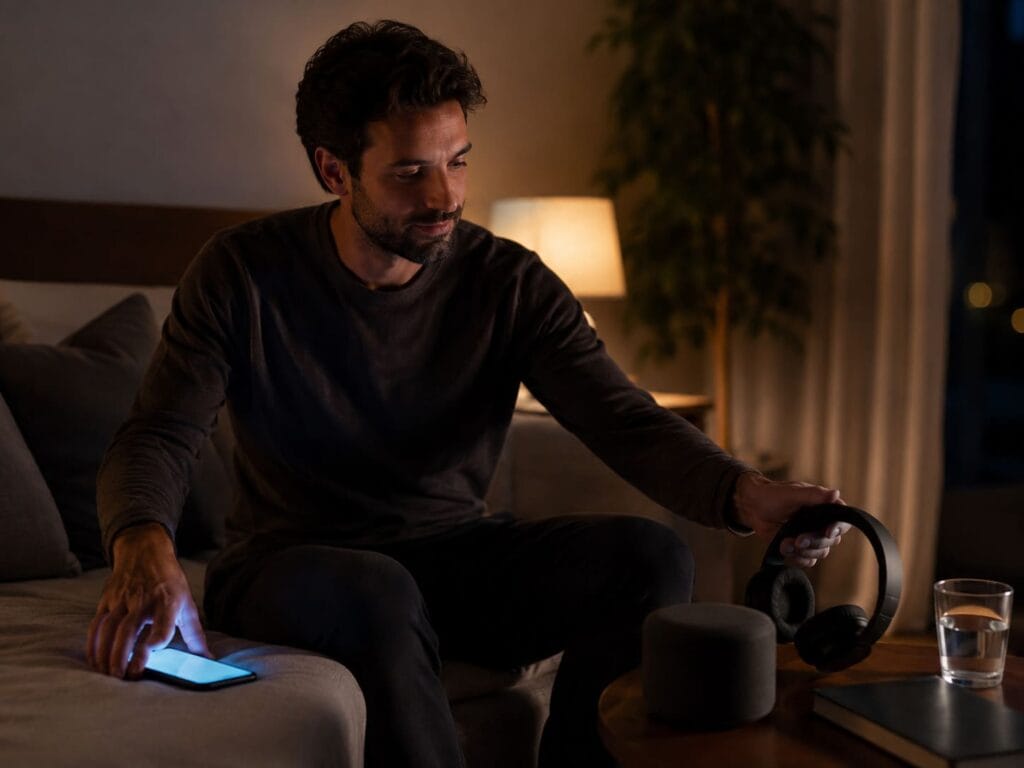
A Seven-Night Audible Test
Before committing to a long membership, test whether the routine fits your actual behaviour.
| Step | What to do | What to observe |
|---|---|---|
| Choose one title | Use a calm, familiar, or low-stakes audiobook | Does the content feel comfortable rather than compelling? |
| Choose one time | Start at approximately the same point each evening | Does consistency make the routine easier? |
| Set one timer | Begin with 15–30 minutes | Do you accept the stopping point or repeatedly extend it? |
| Remove visual browsing | Prepare the book in advance and lock the screen | Does phone checking decrease? |
| Review after seven nights | Compare bedtime, scrolling, comfort, and subscription value | Is Audible useful enough to keep paying for? |
Do not judge the test only by whether you fell asleep faster. Also consider whether it reduced unwanted scrolling, made the evening feel simpler, or provided useful listening time elsewhere in the day.
What We Could Verify
- Audible currently offers Standard and Premium Plus monthly plans in the United States.
- Standard members can select one audiobook per month but lose access to those selections after cancelling.
- Premium Plus members receive credits that can purchase titles retained after cancellation.
- Premium Plus includes access to eligible Plus Catalog content while the membership remains active.
- Audible provides a sleep timer and supports downloaded offline listening.
- Libby allows eligible library users to borrow audiobooks and provides a customizable sleep timer.
- General U.S. sleep guidance supports maintaining a consistent routine and creating a quiet, comfortable sleep environment.
What We Could Not Verify
- That Audible directly improves sleep quality or reduces the time required to fall asleep.
- That audiobooks are universally more relaxing than podcasts, music, physical books, or silence.
- That one narrator, genre, timer duration, or playback speed works for every listener.
- That Audible treats insomnia, anxiety, depression, or another health condition.
- Long-term adherence to an audiobook-based bedtime routine.
- Future pricing, catalogue availability, app stability, promotional terms, or plan changes.
Frequently Asked Questions
Is Audible good for sleep?
Audible may support a calmer bedtime routine when an audiobook replaces scrolling and the listener uses a sleep timer. It is not a sleep treatment, and stimulating titles may keep some people awake longer.
Does Audible have a sleep timer?
Yes. The Audible player includes a timer that stops playback after a selected duration. This helps prevent losing several hours of progress after falling asleep.
Do I keep Audible books if I cancel?
Titles purchased with money or Premium Plus credits remain accessible after cancellation. Monthly selections made through Audible Standard and titles borrowed from the Plus Catalog require an active qualifying membership.
Which Audible plan is better for bedtime listening?
Standard may be sufficient when you want one lower-cost selection each month and expect to stay subscribed. Premium Plus is better when you want to keep the monthly audiobook permanently and use broader membership benefits.
Is Libby better than Audible?
Libby provides better value when your public library has the audiobooks you want and you accept borrowing periods or waitlists. Audible provides more immediate commercial access and is stronger for building a permanent purchased library through Premium Plus.
Should I wear earbuds while sleeping?
Standard earbuds may become uncomfortable when lying on your side and can disconnect or fall out overnight. A low-volume phone speaker, bedside speaker, pillow speaker, or purpose-designed sleep audio product may be more practical.
How long should I set the sleep timer?
Start with 15–30 minutes. Shorten the timer if you regularly lose your place, or extend it slightly when playback stops before the routine has helped you settle.
Can Audible replace a proper sleep routine?
No. Listening is only one optional cue. Consistent timing, suitable lighting, a comfortable room, reduced late-night stimulation, and professional support for persistent problems remain more important.
Final Verdict
Audible for sleep is worth trying when it replaces a worse evening habit and provides value during the rest of the day. Its sleep timer, offline downloads, broad catalogue, and screen-off listening make it easy to build a repeatable audio routine.
Choose Audible Standard when the lower monthly price matters most and you are comfortable losing access to monthly selections after cancellation.
Choose Premium Plus when you want to build a permanent audiobook library and will reliably use the monthly credit.
Choose Libby when free library borrowing covers your needs and you can tolerate waitlists or limited availability.
Skip all three at bedtime when spoken content keeps you alert. Silence, gentle ambient audio, or a simpler screen-free routine may suit you better.
The right bedtime audiobook is not the title that sounds most productive or impressive. It is the one you enjoy, can stop without resistance, and do not mind resuming the following evening.