
Table of Contents
The anatomy of a panic attack is often described as a sudden alarm response: intense fear or discomfort appears alongside physical sensations such as a racing heart, shaking, sweating, dizziness, chest discomfort, nausea, tingling, or difficulty breathing.
The sensations can feel dangerous even when no clear external threat is present. However, the experience should not be reduced to claims that the rational brain has completely “shut down” or that one breathing trick, vibration, frequency, or vagus nerve device can command the body to stop.
This guide explains what may happen during a panic attack, how to respond safely, when symptoms require urgent medical assessment, and why consumer calming devices should be treated as optional wellness tools rather than emergency interventions.
Research note: This article is based on current information from the U.S. National Institute of Mental Health, MedlinePlus, FDA documentation, crisis-support resources, and public manufacturer information. We have not personally tested Sensate or Pulsetto for panic attacks.
What we assessed: common panic symptoms, breathing changes, grounding methods, urgent warning signs, evidence-based treatment, prescription vagus nerve stimulation, consumer wellness devices, contraindications, and unsupported marketing claims.
What we could not independently verify: that Sensate, Pulsetto, Apollo Neuro, 432 Hz audio, cold exposure, or another consumer tool can stop a panic attack, prevent panic disorder, directly “switch on” the parasympathetic nervous system, or provide reliable physiological control on demand.
Urgent safety note: Panic symptoms can overlap with heart, lung, neurological, medication-related, and other medical emergencies. Call 911 in the United States when symptoms are new, severe, different from previous episodes, or include fainting, severe breathing difficulty, persistent chest pressure, one-sided weakness, confusion, injury, or another sign of immediate danger.
If you are in emotional crisis, feel unable to remain safe, or are thinking about harming yourself, call or text 988 in the United States for 24/7 crisis support.
Quick Answer: What Happens During a Anatomy of Panic?
A panic attack is a sudden period of intense fear or discomfort that may occur with or without an obvious trigger. The body may respond with a faster heart rate, sweating, trembling, muscle tension, nausea, dizziness, tingling, chest discomfort, and changes in breathing.
The sensations can create a feedback loop:
- A physical sensation appears, such as a pounding heart or lightheadedness.
- The sensation is interpreted as immediate danger.
- Fear increases attention to the body.
- Breathing, heart rate, tension, and dizziness may become more noticeable.
- The stronger sensations appear to confirm that something catastrophic is happening.
This does not mean the symptoms are imaginary. The physical sensations are real. The problem is that their meaning may be interpreted as more dangerous than it is during a familiar panic episode.
A single panic attack does not automatically mean that a person has panic disorder. Panic disorder involves recurrent unexpected attacks together with continuing worry, avoidance, or significant changes in behaviour.
What Can a Panic Attack Feel Like?
| Type of symptom | Possible experience |
|---|---|
| Heart and circulation | Racing or pounding heart, chest discomfort, sweating, chills, flushing |
| Breathing | Shortness of breath, tight chest, choking sensation, rapid or deep breathing |
| Balance and sensation | Dizziness, weakness, tingling, numbness, trembling, feeling unsteady |
| Digestive | Nausea, stomach discomfort, dry mouth |
| Thoughts | Fear of dying, fainting, losing control, becoming trapped, or “going crazy” |
| Perception | Feeling detached from the body or as though the environment is unreal |
| Afterwards | Tiredness, muscle soreness, worry about another episode, avoidance of the location |
Panic attacks often build quickly and then reduce, although individual attacks and lingering symptoms vary. Do not use a timer to decide whether unfamiliar chest pain or breathing difficulty is “only panic.” Seek medical assessment when the cause is uncertain.
Does the Prefrontal Cortex Shut Down?
No—not in the simple on-or-off way often described in wellness marketing. Intense fear can narrow attention, make complex reasoning harder, and increase focus on perceived danger. That is different from claiming that the prefrontal cortex completely stops functioning.
A person may still be able to move, speak, seek help, recognise familiar surroundings, or follow a practised instruction. However, long explanations and demands to “think logically” may be difficult to use during the most intense part of an episode.
This is why short, familiar actions are often more practical than debating every fearful thought while the symptoms are peaking.
How Can Breathing Affect Panic Symptoms?
Some people begin breathing faster or more deeply during panic. Overbreathing can contribute to dizziness, tingling, chest discomfort, muscle spasms, and the feeling that it is impossible to get enough air.
The goal is not to take the biggest possible breath. Repeated forced deep breaths can maintain overbreathing for some people.
A gentler approach is:
- Let the shoulders drop where possible.
- Breathe in gently without forcing the lungs completely full.
- Let the breath out slowly and comfortably.
- Pause naturally rather than holding the breath aggressively.
- Repeat only while the exercise feels manageable.
Some people find a slightly longer exhale comfortable. Others become more focused on breathing and feel worse. In that case, switch to an external grounding task rather than forcing the exercise.
Rapid breathing can also have medical causes. When breathing difficulty is new, severe, or unexplained, seek medical help rather than assuming it is caused by anxiety.
What Can You Do During a Familiar Panic Attack?
These steps are not a guaranteed three-minute cure. They are simple actions that may make a familiar episode easier to navigate while it passes.
1. Check immediate safety
Stop driving, climbing stairs, cooking, swimming, using machinery, or standing close to traffic. Sit or move to a safer position when possible.
2. Name the situation carefully
When the episode is familiar and has previously been medically assessed, use a neutral statement:
“This feels intense. I have experienced this pattern before. I will check my safety and allow the wave to pass.”
Avoid making an absolute promise that every symptom is harmless when the situation is new or different.
3. Orient to the present environment
Look outward rather than checking the body every few seconds. Name:
- three objects you can see;
- three sounds you can hear;
- three points where your body touches a stable surface.
The purpose is not to “switch off” the nervous system. It is to give attention a simple external task.
4. Reduce unnecessary stimulation
Move away from crowds, flashing screens, loud conversations, or intense lighting where practical. Do not create complete darkness in an unfamiliar place if doing so makes balance or orientation less safe.
5. Use gentle breathing if it helps
Slow the exhale rather than repeatedly gulping large breaths. Stop counting if the counting creates more pressure.
6. Ask for one specific form of support
Examples include:
- “Please stay with me for a few minutes.”
- “Help me move somewhere quieter.”
- “Speak slowly and ask one question at a time.”
- “Please call for medical help because this feels different from previous attacks.”
7. Let the episode reduce before making decisions
Avoid sending major messages, making purchases, arguing, driving immediately, or changing medication while symptoms are intense.
What Should You Avoid During Panic?
- Do not force repeated huge breaths. This may worsen overbreathing-related sensations.
- Do not use alcohol or recreational drugs as an emergency calming strategy.
- Do not take extra prescription medication unless this is part of a clinician-approved plan.
- Do not drive while dizzy, detached, visually impaired, or unable to concentrate.
- Do not use extreme cold exposure, prolonged breath holds, or aggressive “vagus hacks.”
- Do not turn headphones to an unsafe volume to overpower the environment.
- Do not rely on 432 Hz audio to stabilise heart rate or stop an attack.
- Do not place an unfamiliar electrical device on the neck during an unexplained medical event.
- Do not allow a wearable to delay emergency help.
When Should Panic-Like Symptoms Be Treated as an Emergency?
Call 911 or seek urgent medical assessment when:
- this is the first episode and the cause is unknown;
- chest pain is severe, persistent, or different from previous episodes;
- there is fainting, collapse, confusion, seizure, or difficulty waking;
- breathing difficulty is severe or continues to worsen;
- there is one-sided weakness, facial drooping, or difficulty speaking;
- symptoms started after a new medication, overdose, stimulant, substance use, or possible allergic reaction;
- the person is pregnant and symptoms are new or concerning;
- there is serious injury or danger in the environment;
- the person feels unable to remain safe.
A person who has previously experienced panic can still develop a separate medical problem. A familiar diagnosis should not be used to dismiss every future symptom automatically.
How Can You Help Someone Else?
- Stay calm and use short sentences.
- Ask whether this has happened before.
- Ask what normally helps.
- Help them sit or move away from immediate hazards.
- Do not crowd, restrain, lecture, or demand eye contact.
- Do not insist that they “just relax.”
- Offer to contact a trusted person or healthcare service.
- Call emergency services when the symptoms are new, severe, medically concerning, or unsafe.
What Should You Do After the Attack?
The period afterwards may include tiredness, embarrassment, muscle tension, headache, or fear of another episode. Keep the immediate recovery simple:
- move to a safe, quieter environment;
- drink water or eat when appropriate;
- avoid immediately analysing every sensation;
- record what happened once you feel more settled;
- note possible triggers, substances, medications, sleep loss, and physical symptoms;
- contact a healthcare professional when attacks repeat or begin changing daily life.
Repeated avoidance may gradually make work, travel, shopping, exercise, or social situations more difficult. Getting support early is usually more useful than organising life around avoiding every possible sensation.
What Is the Difference Between a Panic Attack and Panic Disorder?
| Panic attack | Panic disorder |
|---|---|
| A single or occasional episode of intense fear and physical symptoms | Recurrent unexpected panic attacks |
| Can occur in many different situations or conditions | Includes continuing worry or behavioural change related to future attacks |
| Does not automatically mean a mental disorder is present | Requires professional assessment and diagnostic criteria |
| May still require medical assessment when symptoms are new | Often interferes with daily activities, travel, work, or relationships |
A healthcare professional may review symptom history and perform a physical assessment to check whether another condition is contributing to the episodes.
What Treatments Have Stronger Evidence?
The U.S. National Institute of Mental Health states that panic disorder is generally treated with psychotherapy, medication, or both.
Cognitive behavioral therapy
CBT helps people examine how they interpret panic sensations and change the thoughts and behaviours that maintain the fear cycle. NIMH describes CBT as a well-studied and commonly used psychotherapy for panic disorder.
Exposure-based methods
Exposure therapy may address feared situations and bodily sensations. Interoceptive exposure deliberately brings on selected panic-like sensations in a controlled therapeutic context.
This is not the same as experimenting alone with hyperventilation, extreme cold, breath restriction, stimulants, or unsafe exercise. A qualified clinician can determine what is appropriate after relevant medical issues have been considered.
Medication
Healthcare professionals may prescribe medications according to the person’s symptoms, health history, risks, preferences, and other medicines. Do not start, stop, increase, or combine medication based on a wellness article or device advertisement.
What Does the Vagus Nerve Actually Do?
The vagus nerves carry signals between the brain and several organs and form an important part of the parasympathetic nervous system. They contribute to the regulation of functions including heart rate, digestion, and other involuntary processes.
This does not make the vagus nerve a manual master switch for emotions. A person cannot reliably deactivate panic simply by touching the neck, humming, applying cold water, using a vibration, or activating a consumer electrical device.
Implanted vagus nerve stimulation is a medical treatment used under professional supervision for specific indications. It involves prescribed equipment, clinical screening, defined stimulation parameters, monitoring, and potential adverse effects.
Prescription non-invasive vagus nerve stimulation also has specific regulated indications. For example, FDA documentation for gammaCore covers selected cluster headache and migraine uses—not panic attacks.
These medical systems should not be used as proof that every product marketed around the vagus nerve has equivalent evidence, safety controls, or clinical effects.
Consumer Device Reality Check
| Device | What it does | What we could not verify | Buyer caution |
|---|---|---|---|
| Sensate | Rests on the chest and combines vibration or low-frequency sound with app-based soundscapes | Direct treatment of panic attacks, reliable vagus nerve stimulation, or emergency physiological control | Consider it an optional vibration and audio relaxation routine |
| Pulsetto | Uses electrical stimulation through contacts positioned around the neck | Stopping panic attacks, replacing treatment, or reproducing outcomes from prescription VNS systems | Electrical neck stimulation has contraindications and should not be used during an unexplained emergency |
| Apollo Neuro | Provides patterned vibration through a wrist or ankle wearable | Stopping panic attacks or directly controlling the autonomic nervous system | Best evaluated as a general wellness wearable rather than emergency equipment |
| Generic Amazon stimulators | Design, placement, output, seller, and intended use can vary widely | Product quality, regulatory status, correct nerve targeting, safety, and effectiveness | Avoid products making broad claims about depression, Parkinson’s disease, panic, or multiple unrelated conditions |
Sensate
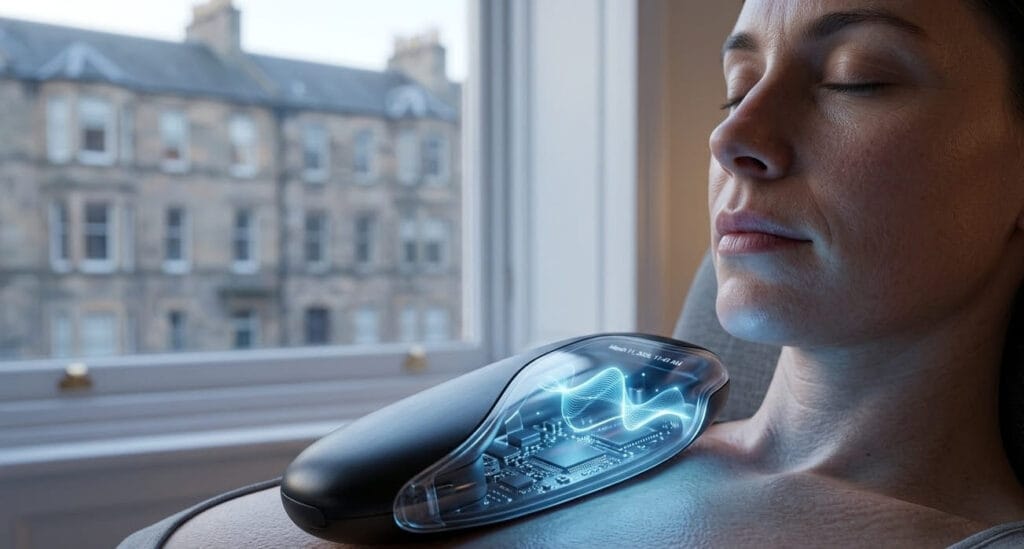
Sensate is placed on the chest and pairs physical vibration with app-based audio. The company describes the experience using terms such as vagal toning and nervous-system regulation.
The practical experience may feel like a guided vibration and sound session. Some users may find the sensory input pleasant or distracting from racing thoughts. That does not establish Sensate as a panic treatment, direct vagus nerve stimulator, or emergency intervention.
Pulsetto
Pulsetto is a consumer electrical neck device marketed for general wellness. The manufacturer itself states that it is not intended to diagnose, treat, cure, or prevent disease.
The company lists important precautions involving implanted electrical devices, seizure disorders, pregnancy, heart or carotid conditions, and recent neck or throat surgery. Buyers should review the complete current instructions and speak with a healthcare professional when medical risks or medications are involved.
We could not verify Pulsetto as an acute panic intervention. Do not place it on the neck while experiencing new chest pain, faintness, an irregular heartbeat, severe breathing difficulty, or another unexplained symptom.
Apollo Neuro
Apollo Neuro uses vibration rather than direct electrical neck stimulation. That may make it a more approachable sensory cue for some users, but it should still not be described as an emergency brake or a device that commands the brain to stop panic.
Read our separate Apollo Neuro research-based review for its features, subscription considerations, evidence limitations, and buyer guidance.
Who Might Consider a Consumer Calming Device?
- You want a structured vibration, audio, or relaxation cue during non-emergency routines.
- You understand that the product is supplementary rather than treatment.
- You have reviewed current contraindications and manufacturer instructions.
- You can afford the device, app costs, accessories, and return risk.
- You will not use it to delay medical or mental-health support.
- You can return the product if the sensation is uncomfortable or unhelpful.
Who Should Avoid Electrical Neck Stimulation Without Medical Guidance?
- People with a pacemaker or another implanted electrical device.
- People with epilepsy or a seizure disorder.
- Pregnant users.
- People with known heart rhythm, carotid, vascular, neck, or neurological conditions.
- People who recently had neck or throat surgery.
- Anyone experiencing new chest pain, faintness, severe breathing difficulty, or an unexplained irregular heartbeat.
- Children or adolescents unless the product and a qualified clinician explicitly support that use.
- Anyone unable to understand or follow the complete safety instructions.
This is not a complete contraindication list. Product instructions and individual medical advice take priority.
Decision Table: What Is the Best Next Step?
| Your situation | Best next step | Why | Do not rely on |
|---|---|---|---|
| First severe panic-like episode | Medical assessment | Heart, lung, medication, neurological, and other conditions can overlap | A wearable or internet breathing protocol |
| Familiar episode with a clinician-approved plan | Use the agreed grounding, breathing, medication, and support steps | The plan reflects your history and risks | Adding unfamiliar devices during the episode |
| Repeated unexpected attacks | Speak with a healthcare or mental-health professional | Assessment can identify panic disorder and other possible causes | Avoiding more and more situations |
| Fear of bodily sensations maintains attacks | Ask about CBT and professionally guided exposure | These approaches directly address the panic cycle | Unsupervised extreme “vagus hacks” |
| You want a non-emergency relaxation cue | Test a free routine before buying hardware | Gentle breathing, grounding, audio, or vibration may be tested cheaply | Claims of guaranteed physiological control |
| You are in emotional crisis or cannot remain safe | Call or text 988 in the U.S.; call 911 for immediate danger | Live crisis support is available | A consumer wellness app or device |
Hidden Costs and Limitations of Calming Devices
The device may create reassurance dependence
A person may begin believing that they cannot leave home, travel, sleep, or tolerate bodily sensations without the device. Discuss this pattern with a therapist when the product becomes another condition for feeling safe.
Apps and subscriptions
Sound libraries, additional programs, app access, premium features, conductive gel, charging accessories, or replacement parts may increase the long-term cost.
Physical discomfort
Vibration may feel unpleasant on the chest. Electrical stimulation may cause tingling, skin irritation, discomfort, dizziness, or another unwanted sensation. Stop using a product and seek appropriate advice when unusual symptoms occur.
Marketing can exceed the evidence
Testimonials about panic relief, sleep, HRV, cortisol, vagal tone, or “nervous system regulation” do not establish that the same result will occur for another buyer.
A product can delay effective support
The largest hidden cost may be time spent repeatedly buying wellness tools while recurrent panic, avoidance, medication effects, substance use, thyroid problems, breathing conditions, or another contributing issue remains unassessed.
What We Could Verify
- Panic attacks may involve sudden fear, rapid heart rate, sweating, shaking, breathing difficulty, dizziness, tingling, chest pain, nausea, and fear of losing control.
- A panic attack does not automatically mean that a person has panic disorder.
- Rapid or deep breathing can contribute to dizziness, tingling, chest discomfort, and difficulty thinking clearly.
- Panic disorder is commonly treated with psychotherapy, medication, or both.
- CBT and exposure-based approaches are established treatment options for panic disorder.
- FDA-cleared prescription non-invasive vagus nerve stimulation devices have specific indications rather than a general approval for panic attacks.
- Sensate uses chest vibration or low-frequency sound with app-based audio.
- Pulsetto is marketed as a general wellness electrical neck-stimulation product and publishes important contraindications.
- 988 provides 24/7 crisis support by call, text, or chat in the United States.
What We Could Not Verify
- That the prefrontal cortex completely shuts down during a panic attack.
- That the vagus nerve functions as a manual master switch for panic.
- That Sensate directly stimulates vagus nerve branches near the heart and lungs.
- That Pulsetto provides reliable acute relief during panic attacks.
- That Apollo Neuro stops panic or directly deactivates survival mode.
- That 432 Hz audio stabilises heart rate during panic.
- That cold exposure or a breath-holding technique forces the body into calm.
- That any consumer device creates a panic-free life, physiological freedom, or dependable emergency control.
Frequently Asked Questions
Can a panic attack feel like a heart attack?
Yes. Panic may involve chest pain, rapid heart rate, sweating, dizziness, nausea, and difficulty breathing. Because these symptoms can also have medical causes, seek urgent assessment when they are new, severe, different, or uncertain.
How long does a panic attack last?
Panic attacks often rise quickly and may reduce within minutes, but the duration and lingering symptoms vary. Do not wait for a specific time limit before seeking help for medically concerning symptoms.
Should I take deep breaths during panic?
Use gentle, regular breathing rather than repeated forced inhalations. A slower comfortable exhale may help some people. Switch to external grounding when focusing on breathing increases distress.
Can the vagus nerve stop a panic attack?
The vagus nerve contributes to parasympathetic regulation, but it is not a button that can reliably stop panic on command. No consumer vagus nerve product should be treated as guaranteed emergency equipment.
Is Sensate a vagus nerve stimulator?
Sensate uses vibration or low-frequency sound on the chest with app-based audio. The company distinguishes its “vagal toning” approach from medical electrical VNS. We could not independently verify it as a direct vagus nerve treatment or panic intervention.
Is Pulsetto FDA-approved for panic attacks?
We found no FDA indication establishing Pulsetto as a treatment for panic attacks. The manufacturer describes it as a general wellness product rather than a device intended to diagnose, treat, cure, or prevent disease.
Can panic disorder improve?
Yes. NIMH states that people can manage symptoms and improve quality of life with appropriate treatment and support. Common treatment approaches include CBT, other psychotherapy methods, medication, or a combination selected with a healthcare professional.
When should I call 988?
Call or text 988 in the United States when you are in emotional crisis, feel unable to cope safely, are thinking about self-harm, or need immediate crisis support. Call 911 when there is immediate physical danger or a possible medical emergency.
Final Verdict
Understanding the anatomy of a panic attack can make the experience less mysterious, but it should not create false confidence that every intense physical symptom is harmless.
During a familiar episode, prioritise physical safety, gentle breathing if comfortable, external grounding, reduced stimulation, and support from another person. Seek urgent medical help when symptoms are new, severe, different, or medically concerning.
For recurrent panic attacks, avoidance, or ongoing fear of another episode, professional assessment offers more value than moving from one wellness gadget to another. CBT, exposure-based methods, medication, or a combined plan have stronger support than consumer vagus nerve marketing.
Sensate, Pulsetto, Apollo Neuro, soundscapes, and other sensory products may feel calming to some users as part of a non-emergency routine. They should not be presented as emergency brakes, medical VNS substitutes, or reliable methods for stopping panic.
The goal is not to gain perfect remote control over every body sensation. It is to recognise danger appropriately, respond safely, reduce the fear cycle, and get effective support when panic begins changing daily life.
Explore more practical, claim-safe guides in our Mindful Living section.
Sources and Further Reading
- National Institute of Mental Health: Panic Disorder — What You Need to Know
- MedlinePlus: Panic Disorder
- MedlinePlus: Hyperventilation
- NHS: Breathing Exercises for Stress, Anxiety, and Panic
- FDA: gammaCore Sapphire Indications for Use
- FDA: Implanted Vagus Nerve Stimulation Safety and Effectiveness Data
- SAMHSA: 988 Suicide & Crisis Lifeline
- Sensate: Current Product Information and Manufacturer Claims
- Pulsetto: Current Product Information, Disclaimer, and Safety Guidance