Table of Contents
Accessible healing should not mean buying cheap products that promise to repair your brain, regulate your nervous system, or cure burnout. In this guide, the term means something simpler: affordable tools that may support better light exposure, quieter routines, screen-free focus, environmental awareness, and more consistent sleep habits.
You do not need an expensive neurotechnology stack to improve a daily routine. In many cases, a visual timer, sleep mask, white noise machine, basic e-reader, open-ear headphones, or correctly chosen light can solve a more specific problem at a much lower cost.
This buyer guide compares six affordable wellness tools, explains what each one actually does, and highlights where wellness marketing goes beyond what we could verify.
Affiliate disclosure: MindReset.org may earn a commission if you buy through our links. This does not increase your price and does not affect our editorial judgment.
Amazon disclosure: As an Amazon Associate, we earn from qualifying purchases.
Research note: We have not personally tested every product included in this guide. This article is based on official product specifications, public documentation, available safety guidance, practical use cases, and comparison with similar tools.
What we assessed: primary use case, setup effort, portability, app dependence, recurring costs, noise level, comfort considerations, screen exposure, maintenance, and whether the product solves a clearly defined problem.
What we could not independently verify: long-term durability, comfort for every user, app stability, customer support quality, real-world battery degradation, exact sleep or focus benefits, and whether the product will produce a meaningful wellness benefit for an individual buyer.
Health note: These products are routine and environmental tools. They are not treatments for anxiety, depression, ADHD, insomnia, burnout, trauma, chronic stress, or another medical or mental-health condition.
Availability note: Prices, product versions, shipping, warranties, subscriptions, included accessories, and regional availability may change. Check the current offer before purchasing.
Quick Verdict: Which Affordable Wellness Tool Should You Buy?
Start with the problem, not the product.
- Dark mornings or limited daylight: consider the Lumie Vitamin L.
- Unpredictable household or street noise: consider the Yogasleep Dohm Classic.
- Phone distraction during work: choose the Time Timer MOD.
- Need to hear your surroundings: choose the Shokz OpenMove.
- Bedroom light is the main sleep problem: start with the Manta Sleep Mask.
- Evening phone scrolling: consider the basic Amazon Kindle.
For most buyers, the best first purchase is the simplest product that removes one repeated source of friction. Do not build a six-product wellness stack before confirming that you will use one tool consistently.
Accessible Healing Decision Table
| Main problem | Best option | Why it may help | Skip if |
|---|---|---|---|
| Dark indoor mornings | Lumie Vitamin L | Provides bright, UV-free light in a compact format | You have not checked whether bright-light use is appropriate for you |
| Variable background noise | Yogasleep Dohm Classic | Creates steady fan-based sound without an app | You need silence or a battery-powered travel device |
| Automatic phone checking | Time Timer MOD | Creates a visible work boundary without opening another app | You need precise billing or audible repeat alarms |
| Audio with environmental awareness | Shokz OpenMove | Keeps the ear canal uncovered | You need strong isolation in loud places |
| Bedroom light | Manta Sleep Mask | Blocks light without adding an electronic device | You dislike masks or need to hear an alarm visually |
| Evening scrolling | Basic Kindle | Provides a reading-focused device without social media | You already read comfortably on paper |
What Accessible Healing Does—and Does Not—Mean
The phrase accessible healing can easily become misleading. A timer, lamp, sleep mask, headphone, or sound machine does not heal a medical condition.
What these products can sometimes do is change the environment around a routine:
- reduce unnecessary light at bedtime;
- provide brighter light during dark mornings;
- mask inconsistent environmental noise;
- create a visible work period;
- reduce the need to pick up a phone;
- allow audio while preserving more environmental awareness.
That may make a routine easier to follow. It does not guarantee better sleep, lower anxiety, improved mental health, hormonal changes, nervous-system regulation, or cognitive recovery.
Try the Free Fix Before Buying Anything
Before purchasing a wellness product, test whether a free change solves the same problem.
- Move your desk closer to a window before buying a light.
- Use a basic kitchen timer before buying a premium focus timer.
- Move your phone outside the bedroom before buying a digital-detox gadget.
- Use existing curtains before buying a sleep mask.
- Try a fan before buying a dedicated white noise machine.
- Borrow a library book before buying an e-reader.
- Test lower headphone volume before replacing your headphones.
A product is worth considering when the free option is inconvenient, inconsistent, unavailable, or clearly less suitable for your routine.
For more genuinely low-cost options, see our guide to affordable mind resets under $25.
1. Lumie Vitamin L: Best for Dark Mornings and Indoor Work
The Lumie Vitamin L is a compact bright-light lamp designed for daytime use. The US model is rated at 10,000 lux at close range and uses UV-free LEDs.
Its practical value is straightforward: it gives people who spend dark mornings indoors access to a brighter workspace without requiring a large floor lamp or complicated app.
This is not the same as ordinary decorative lighting. Bright-light devices are intended to deliver much greater intensity at a specified distance, so positioning and manufacturer instructions matter.
Bright-light use is not appropriate for everyone. The U.S. National Center for Complementary and Integrative Health notes that light therapy may cause headaches, eye strain, nausea, dizziness, or tired eyes.
It may also be unsuitable for people with retinal disease, recent eye surgery, bipolar disorder, or medications that increase sensitivity to light. Check with a qualified healthcare professional before use if any of these apply.
Best for: dark winter mornings, indoor workers, compact desks, and buyers who want a dedicated daytime light.
Skip if: you expect it to treat depression without professional guidance, dislike bright light, have relevant eye concerns, use photosensitizing medication, or already receive sufficient morning daylight.
2. Yogasleep Dohm Classic: Best App-Free Sound Machine
The Yogasleep Dohm Classic produces fan-based sound using a real internal fan rather than a digital audio loop. It provides two speed settings and an adjustable tone collar.
The main benefit is consistency. Unlike music, podcasts, or changing nature tracks, the Dohm creates a continuous neutral sound that can mask part of an unpredictable background environment.
It is also app-free. There is no Bluetooth pairing, account, subscription, software update, or phone screen required.
The limitations are equally clear. It is a corded US/Canada product, does not eliminate every sound, and may be unsuitable for buyers who need a silent room or portable battery operation.
Best for: bedrooms, shared homes, traffic noise, unpredictable household sounds, and buyers who want a simple physical control.
Skip if: you need complete silence, travel frequently, want several recorded sound options, or dislike continuous fan noise.
3. Time Timer MOD: Best Screen-Free Focus Tool
The Time Timer MOD is a 60-minute visual timer. As time passes, the colored disk becomes smaller, providing an immediate visual indication of how much time remains.
This makes it useful for work blocks, reading periods, household tasks, breaks, and other routines where opening a phone can lead to notifications or unplanned scrolling.
The timer does not improve concentration by itself. Its value is that it creates a visible boundary around one chosen activity.
Best for: Pomodoro-style work, writing, studying, household tasks, phone-free sessions, and people who prefer visible time.
Skip if: you need exact time records, repeated alarms, automatic session history, or a completely silent device.
For more physical tools that reduce dependence on apps, see our analog digital-detox tools guide.
4. Shokz OpenMove: Best Affordable Open-Ear Headphones
The Shokz OpenMove uses an open-ear bone-conduction design. It sits outside the ear canal, allowing more environmental sound to remain audible while listening.
Shokz lists six hours of battery life, IP55 resistance, and a lightweight 29-gram design.
Open-ear listening is useful when you need to hear children, colleagues, doorbells, announcements, or approaching traffic. It is not ideal for loud public transport, aircraft, machinery, or buyers seeking strong bass and isolation.
Open-ear headphones are not automatically safer for hearing. Loud surroundings may tempt users to increase volume. WHO guidance emphasizes that hearing risk depends on both sound level and listening duration.
Best for: walking, household tasks, quieter offices, awareness-focused listening, and buyers who dislike in-ear earbuds.
Skip if: you need active noise cancellation, privacy, aircraft use, powerful low-frequency sound, or certified workplace hearing protection.
Compare open-ear designs with ANC alternatives in our noise cancelling vs open ear headphones guide.
5. Manta Sleep Mask: Best Non-Electronic Sleep Upgrade
The standard Manta Sleep Mask uses adjustable eye cups designed to block light without pressing directly against the eyelids.
Its appeal is simplicity. There is no app, charging cable, subscription, sound library, sensor, score, or morning report.
A sleep mask is most useful when light is a clear environmental problem: streetlights, early sunrise, travel, shared rooms, or a partner using a lamp.
It will not solve noise, pain, sleep apnea, restless legs, medication effects, irregular shifts, or persistent insomnia.
Best for: bedroom light, travel, daytime sleep, shared rooms, and buyers wanting a non-electronic option.
Skip if: you dislike facial contact, need to monitor the room visually, experience skin irritation, or light is not the actual reason your sleep is disrupted.
For a broader bedroom setup, read our sleep sanctuary and recovery guide.
6. Basic Amazon Kindle: Best for Replacing Evening Scrolling
The basic Kindle is a compact e-reader with a six-inch glare-free display, adjustable front light, dark mode, and a reading-focused interface.
Its main wellness advantage is not a special screen frequency or therapeutic reading mode. It simply removes many of the distractions built into a smartphone.
A Kindle can support a screen-light routine when you already enjoy reading but repeatedly become distracted by messages, email, video, social media, or shopping apps.
It may create additional costs through book purchases or Kindle Unlimited. Library books, paper books, and an existing e-reader may provide the same practical benefit without buying another device.
Best for: regular readers, evening phone replacement, travel, small homes, and people who want one purpose-built reading device.
Skip if: you rarely read, already own an e-reader, prefer library books, or expect a Kindle to fix persistent sleep problems.
What We Would Skip
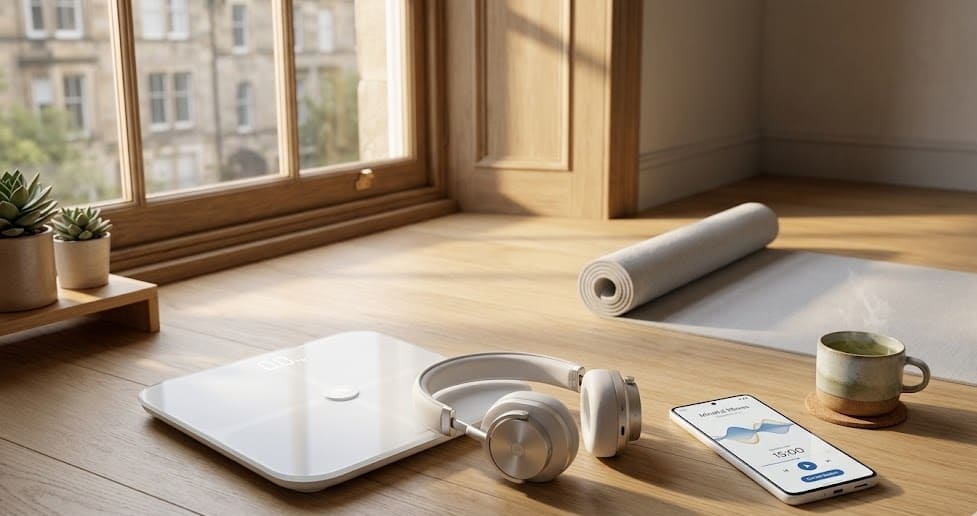
Smart scales marketed as stress detectors
A consumer smart scale can track weight trends and estimate body-composition metrics. It cannot reliably tell you that your nervous system is overloaded, your cortisol is high, or you need a recovery day.
432 Hz and “healing frequency” subscriptions
We found no reliable basis for presenting 432 Hz audio as necessary for nervous-system regulation, brain repair, hormonal balance, or therapeutic relaxation.
Cheap generic neurofeedback headsets
Skip devices that do not clearly identify their sensors, manufacturer, data access, app support, warranty, and evidence limitations.
Multiple free trials started at the same time
A “free” trial still creates cancellation dates, account management, notifications, and possible renewal charges. Add a subscription only when it replaces an existing cost or solves a clear problem.
Products promising to stop burnout
No lamp, scale, headphone, book service, sound machine, or timer can repair an unsustainable workload, untreated illness, chronic sleep deprivation, or a serious mental-health problem.
Hidden Costs and Practical Checks
- Replacement parts: masks, cushions, straps, cables, and ear pads wear over time.
- Books and subscriptions: e-readers can lead to recurring content costs.
- Returns: opened wellness and personal-use products may have different return rules.
- Regional power: some sound machines and lights are designed for specific electrical systems.
- Apps: certain headphones and connected devices need an account or smartphone.
- Maintenance: fabric masks and headphone contact surfaces require cleaning.
- Fit: head size, glasses, hair, sleeping position, and sensory preferences affect comfort.
- Abandonment: the biggest cost is a product that adds setup effort and is no longer used after two weeks.
Who Should Consider These Tools?
- People with one clearly identified environmental or routine problem.
- Buyers who prefer simple tools over complex biohacking dashboards.
- People reducing phone use during work or before bed.
- Remote workers dealing with inconsistent light or background noise.
- Readers who want a distraction-reduced device.
- Buyers willing to test one product before building a larger setup.
Who Should Avoid Buying More Wellness Tools?
- Anyone expecting a product to diagnose or treat a health condition.
- People already overwhelmed by apps, scores, subscriptions, and daily tracking.
- Buyers unable to identify the specific problem the product will solve.
- Anyone replacing professional care with shopping.
- People whose main difficulty is workload, pain, medication effects, housing conditions, or another issue that a small gadget cannot change.
- Buyers responding mainly to urgency, fear, or neurobiological marketing language.
What We Could Verify
- The US Lumie Vitamin L is rated at 10,000 lux at close range and uses UV-free LEDs.
- The Yogasleep Dohm Classic uses a real internal fan, two speed settings, and an adjustable tone control.
- The Time Timer MOD Home Edition is a 60-minute visual timer.
- The Shokz OpenMove uses an open-ear design and is listed with six-hour battery life and IP55 resistance.
- The standard Manta Sleep Mask uses adjustable eye cups intended to create blackout without direct eyelid pressure.
- The basic Amazon Kindle has a six-inch glare-free display, adjustable front light, and dark mode.
- The World Health Organization advises considering both listening volume and duration when assessing hearing risk.
- The U.S. NCCIH notes that light therapy may be unsuitable for people with retinal disease, recent eye surgery, bipolar disorder, or medications that increase light sensitivity.
What We Could Not Verify
We could not verify that these products heal the nervous system, stop burnout, repair neural connections, prevent cognitive decline, reduce amygdala activity, balance cortisol, or produce a predictable mental-health outcome.
We could not verify that binaural beats, 432 Hz audio, lossless music, audiobooks, or white noise reliably create a therapeutic brain state.
We also could not verify that a consumer smart scale can identify stress, fluid retention caused by cortisol, nervous-system overload, or the need for a recovery day.
FAQ
What does accessible healing mean?
In this guide, accessible healing means affordable environmental and routine support. It does not mean medical treatment, nervous-system repair, or a guaranteed mental-health result.
What is the best affordable wellness tool to buy first?
Choose the tool that solves your clearest repeated problem. A sleep mask is more useful than a light when bedroom brightness is the issue. A timer is more useful than headphones when phone distraction is the problem.
Can affordable wellness tools reduce stress?
They may reduce specific sources of environmental or routine friction. They should not be treated as treatments for chronic stress, anxiety, burnout, or another condition.
Are expensive biohacking devices more effective?
A higher price does not guarantee better results. Expensive products may offer more sensors, data, customization, or support, but usefulness still depends on the problem being solved and whether the buyer uses the device consistently.
Do 432 Hz or binaural beats heal the brain?
We found no strong basis for claiming that a particular frequency heals the brain or nervous system. Some listeners may find particular sounds relaxing, but preference is not proof of a therapeutic effect.
Should I buy a smart scale for stress tracking?
No. A smart scale may help monitor weight trends or estimated body composition, but it is not a stress, cortisol, burnout, or nervous-system monitor.
Final Verdict: Buy Less, but Solve the Right Problem
Accessible healing does not require a premium biohacking stack. It requires an honest definition of the problem and the simplest tool capable of reducing that friction.
Choose Lumie Vitamin L for dark mornings, Yogasleep Dohm for inconsistent noise, Time Timer MOD for screen-free work blocks, Shokz OpenMove for awareness-focused audio, Manta Sleep Mask for bedroom light, or the basic Kindle for replacing evening phone scrolling.
Skip smart scales marketed as stress dashboards, healing-frequency subscriptions, vague neurofeedback gadgets, and products promising to stop burnout or repair the nervous system.
The strongest budget wellness purchase is not the most scientific-looking device. It is the one that removes a real obstacle without adding another subscription, dashboard, maintenance burden, or unsupported promise.