Table of Contents
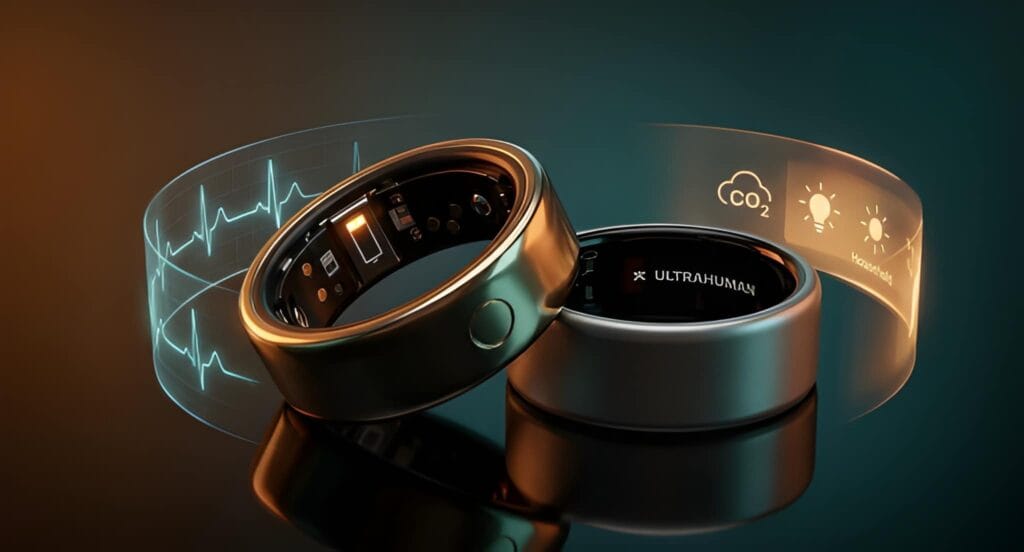
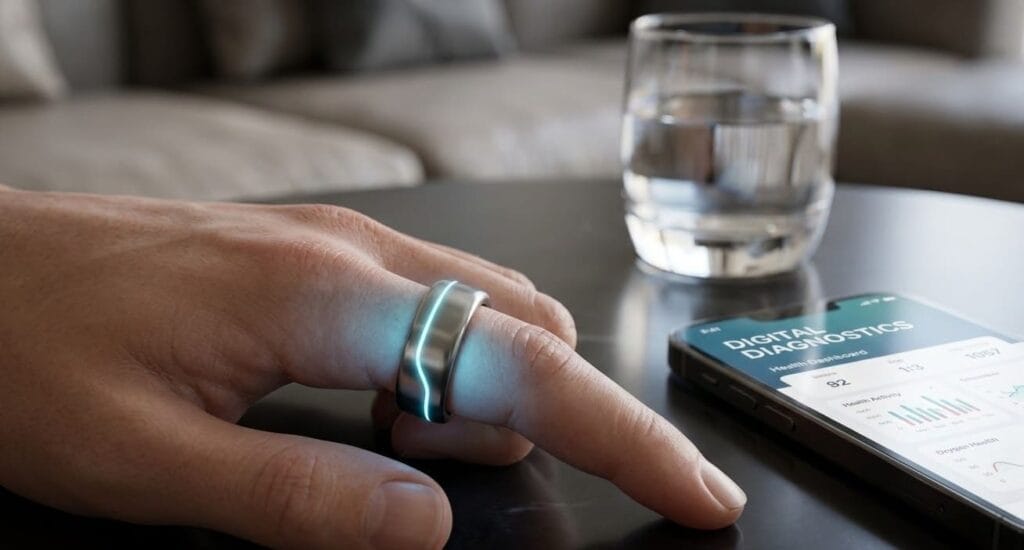
Circular Ring 2 vs Ultrahuman Ring PRO is a choice between two very different smart-ring priorities. Circular focuses on on-demand ECG recording and heart-rhythm features. Ultrahuman focuses on longer battery life, offline data storage, sleep and recovery trends, and a broader wellness ecosystem.
Neither ring is a doctor on your finger. Neither can confirm that your heart is healthy, diagnose the cause of fatigue, rule out a medical condition, or guarantee better sleep and recovery.
This research-based comparison explains what each ring actually offers, which claims require caution, what the hidden costs are, and which model makes more sense for different buyers.
Affiliate disclosure: MindReset.org may earn a commission if you buy through our links. This does not increase your price and does not affect our editorial judgment.
Research note: We have not personally tested Circular Ring 2 and Ultrahuman Ring PRO side by side. This comparison is based on current manufacturer specifications, official product documentation, public pricing, available regulatory claims, buyer information, and comparison with other smart rings.
Health note: Smart rings are not substitutes for medical assessment, diagnostic ECG equipment, emergency cardiac monitoring, or professional advice. Do not use a wearable score or ECG classification to rule out heart problems, alter medication, diagnose anxiety, or decide that symptoms are harmless.
We could compare published sensors, ECG availability, battery claims, materials, prices, charging systems, subscriptions, storage, sizing, and current app features. We could not independently verify diagnostic accuracy, long-term app reliability, comfort for every user, battery degradation, customer support quality, or whether either ring will improve health, sleep, stress, or recovery for a specific buyer.
Quick Verdict: Circular Ring 2 vs Ultrahuman Ring PRO
Circular Ring 2 and Ultrahuman Ring PRO solve different buyer problems.
Circular Ring 2 is the more relevant choice if on-demand ECG is your main priority. It offers a single-lead ECG recording, heart-rhythm analysis, sleep tracking, HRV, temperature trends, SpO₂-related readings, activity tracking, and an AI coaching layer.
Ultrahuman Ring PRO is the stronger choice for battery life, travel, and ecosystem depth. It does not include ECG, but it offers up to 15 days of stated ring battery life, up to 45 days through the PRO Charging Case, up to 250 days of onboard storage, and integration with the wider Ultrahuman platform.
Choose Circular Ring 2 if: you specifically want an on-demand ECG feature and accept the risks of a less mature app and feature rollout.
Choose Ultrahuman Ring PRO if: sleep and recovery trends, long battery life, travel storage, and the charging case matter more than ECG.
Skip both if: you need a medical diagnosis, continuous ECG, emergency monitoring, detailed workout screens, built-in GPS, or know that wearable alerts and health scores increase your anxiety.
Circular Ring 2 vs Ultrahuman Ring PRO Comparison Table
| Feature | Circular Ring 2 | Ultrahuman Ring PRO |
|---|---|---|
| Current starting US price | $349 | $479 |
| Best for | On-demand ECG and heart-rhythm features | Battery life, travel, storage, sleep and recovery ecosystem |
| ECG | 40-second, single-lead on-demand ECG | No ECG sensor |
| AFib feature | Circular states that its AFib algorithm is FDA-cleared | No ECG-based AFib feature |
| Stated battery life | Approximately 7–8 days in Power Mode; 4–5 days in Performance Mode | Up to 15 days; approximately 12 days in Turbo Mode |
| Charging | Wireless case; around 30 minutes for a full charge | Magnetic PRO Charging Case with USB-C and Qi charging |
| Additional case power | Charging case included, but no comparable 45-day case claim | Up to 45 days through the PRO Charging Case |
| On-device storage | Not clearly quantified on the current product page | Up to 250 days on the ring |
| Sensors | ECG, PPG, temperature sensor, accelerometer | Redesigned PPG, temperature sensor, 6-axis IMU |
| Sizes | US 6–14, no half sizes | US 5–14, no half sizes |
| Materials | Titanium exterior with hypoallergenic interior | Titanium unibody with PVD coating and internal polymer components |
| Water use | Brand says suitable for swimming and showering | Rated to 100 metres |
| Core-data subscription | No required subscription for core features; some premium features may use a freemium model | No required subscription for core ring data; optional paid ecosystem features may exist |
| App focus | Kira AI coaching, ECG, sleep, stress and activity trends | Sleep, recovery, movement, circadian guidance and wider Ultrahuman ecosystem |
| Current US status | Available to order | Pre-order; current page lists shipping from August 15, 2026 onward |
Pricing and availability note: Prices, shipping dates, colour premiums, warranties, subscriptions, feature access, and return terms may change. Confirm the current US product page before purchasing.
The Biggest Difference: ECG vs Battery and Ecosystem
The easiest way to choose between these rings is to ignore the broad wellness marketing and focus on the feature that genuinely separates them.
Circular Ring 2 includes hardware for an on-demand, single-lead ECG. Ultrahuman Ring PRO does not.
Ultrahuman Ring PRO instead concentrates on longer continuous wear, substantially more offline storage, a portable charging case, newer processing hardware, and integration with services such as Jade, Blood Vision, CGM products, and Ultrahuman Home.
That creates two different buyer paths:
- Circular: “I want to take a spot ECG and record a heart-rhythm snapshot.”
- Ultrahuman: “I want fewer charging gaps and a broader sleep, recovery, and lifestyle-data ecosystem.”
Neither path guarantees better health. The right purchase depends on which function you will actually use and whether the limitations are acceptable.
Circular Ring 2: Who Should Buy It?
Best for: buyers who specifically want an on-demand ECG feature in a smart-ring format
Product type: titanium smart ring with ECG, PPG, temperature, sleep, activity, and coaching features
Skip if: app stability and mature software matter more than having ECG
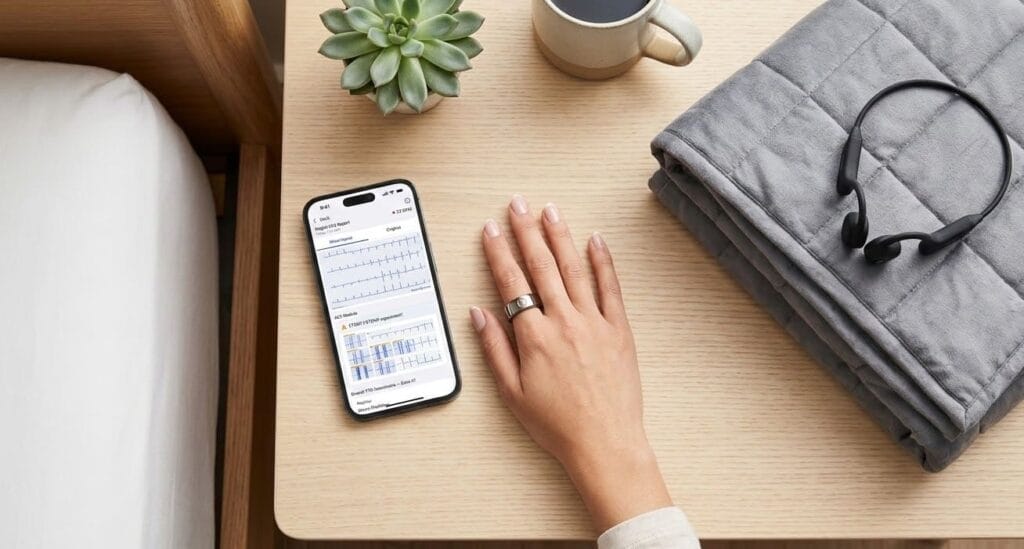
Circular Ring 2 is unusual because it combines normal smart-ring tracking with a single-lead ECG sensor. The ECG is not recorded continuously. The user opens the Circular app, begins a session, and touches the ring with the opposite hand to complete the electrical circuit.
The current product documentation describes a 40-second ECG recording that can be exported and shared. This may be useful for documenting a rhythm snapshot, but it is not the same as a hospital 12-lead ECG, a Holter monitor, or continuous cardiac monitoring.
Circular also tracks sleep stages, heart rate, HRV, breathing rate during sleep, skin-temperature trends, activity, and SpO₂-related readings during rest and sleep. Kira, the companion AI layer, translates these readings into recommendations and summaries.
The hardware case is attractive: titanium exterior, wireless charging case, up to eight days of stated battery life in the lower-frequency mode, and a full charge in approximately 30 minutes.
The main buyer risk is software maturity. Circular has changed product generations, altered feature roadmaps, and introduced a model where some future or advanced features may use direct payment or in-app Circular Coins. Do not buy based on promised blood-glucose or blood-pressure features that are not clearly available and independently validated at checkout.
Buy if: ECG is the deciding feature, you want a discreet ring rather than a watch, and you are comfortable with a developing app ecosystem.
Avoid if: you need continuous ECG, guaranteed arrhythmia detection, mature fitness tracking, or a completely predictable feature roadmap.
MindReset verdict: the more distinctive ring, but also the purchase that requires more caution around software, regulatory wording, and future-feature promises.
Ultrahuman Ring PRO: Who Should Buy It?
Best for: frequent travellers, people who dislike regular charging, and buyers already interested in the Ultrahuman ecosystem
Product type: premium smart ring for sleep, movement, temperature, HRV, and recovery trends
Skip if: ECG is a requirement or you want the lightest and least expensive ring
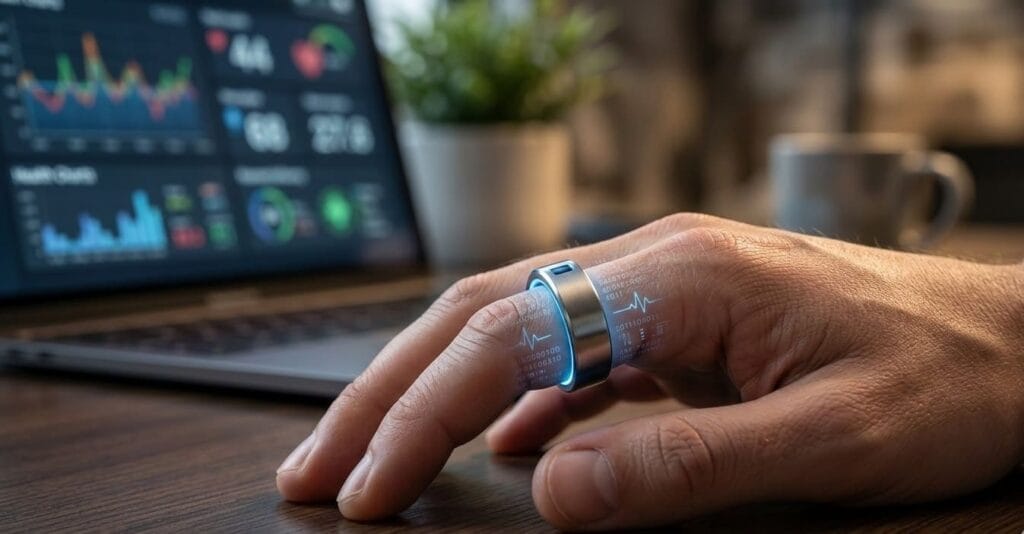
Ultrahuman Ring PRO takes a different approach. It does not attempt to become an ECG ring. Its strongest features are battery continuity, offline storage, a travel-friendly charging case, and integration with the wider Ultrahuman platform.
The company currently states up to 15 days of battery life in Chill Mode and approximately 12 days in Turbo Mode. The PRO Charging Case can extend the system to a stated 45 days and stores up to one year of ring data. The ring itself can store up to 250 days.
Those features address a real smart-ring problem: missing data because the ring was left charging or could not sync during travel.
Ring PRO also includes a redesigned PPG system, a dual-core processor with on-chip machine learning, magnetic charging, and ProRelease Technology designed to make the ring easier to cut apart if finger swelling or injury creates an emergency.
None of this makes Ring PRO a diagnostic device. It remains a consumer wellness wearable that estimates sleep, heart rate, HRV, temperature trends, movement, and recovery-related patterns.
For a direct comparison with the established Ultrahuman model, see our Ultrahuman Ring AIR vs Ring PRO buyer guide.
Buy if: long battery life, travel storage, and Ultrahuman integration solve a clear problem for you.
Avoid if: ECG is the main reason you are buying a wearable or you do not want to wait for a pre-order product.
MindReset verdict: the stronger all-round sleep and recovery platform, but not the right alternative to Circular for a buyer specifically seeking ECG.
How Useful Is the Circular Ring 2 ECG?
Circular Ring 2 uses a single-lead ECG. This is similar in concept to the spot ECG functions offered by some consumer smartwatches: it records one electrical pathway rather than the multiple views used in a standard clinical 12-lead ECG.
The user must remain still and maintain contact with the ring during the recording. Results can then be displayed in the app and exported.
Circular states that its AFib detection algorithm is FDA-cleared. During this review, we could not confidently match that claim to a specific public FDA clearance record under the Circular Ring 2 product name. Buyers should therefore check the current US labelling, supported regions, age restrictions, intended-use wording, and app availability before relying on the feature.
Even an authorised consumer ECG feature is normally intended to provide informational rhythm classification, not a final diagnosis. A normal or unclassified result does not prove that no heart condition exists.
For current US information about authorised wearable sensor technologies, see the FDA’s sensor-based digital health technology resource.
Seek qualified medical help for chest pain, fainting, severe shortness of breath, new neurological symptoms, a sustained abnormal heart rhythm, or other urgent symptoms regardless of what a ring reports.
Can Circular Ring 2 Diagnose AFib or Heart Disease?
It should not be presented as a general heart-disease diagnosis tool.
An ECG algorithm may classify a supported recording as possible AFib, normal rhythm, or another limited result. That does not mean it can detect every arrhythmia, identify blocked arteries, rule out a heart attack, explain palpitations, or confirm that the heart is healthy.
The most responsible use is documentation. A buyer may record a spot ECG and share the result with a qualified professional. Clinical decisions still require appropriate medical context and, when necessary, conventional testing.
This is also why Circular Ring 2 should not be marketed as a way to reduce health anxiety. More data can reassure some people, but it can also increase repeated checking, uncertainty, and symptom monitoring.
Which Ring Is Better for Sleep and Recovery Tracking?
Ultrahuman Ring PRO has the stronger buyer case for uninterrupted sleep and recovery trend collection.
Its stated battery life and large onboard storage make it less likely that travel, charging, or delayed syncing will create missing nights. Ultrahuman also has a more developed ecosystem around sleep timing, movement, recovery scores, circadian guidance, and optional integrations.
Circular Ring 2 also tracks sleep stages, heart rate, HRV, temperature, breathing rate, and SpO₂-related readings. Its Kira system provides coaching and trend summaries.
The limitation is that neither company’s sleep-stage labels should be treated as laboratory sleep testing. Consumer rings estimate sleep stages from movement, pulse, temperature, and related signals. They do not directly measure brain activity in the way a clinical sleep study does.
Sleep verdict: Ultrahuman PRO is the safer ecosystem choice; Circular is the more experimental option with additional ECG functionality.
Battery Life and Charging
Battery life is Ultrahuman Ring PRO’s clearest advantage.
| Battery factor | Circular Ring 2 | Ultrahuman Ring PRO |
|---|---|---|
| Maximum stated ring runtime | Up to 8 days | Up to 15 days |
| Higher-frequency mode | Approximately 4–5 days | Approximately 12 days in Turbo Mode |
| Charging system | Wireless charging case | Magnetic PRO Charging Case |
| Stated charge time | Approximately 30 minutes | Not the main advertised advantage |
| Case extension | No comparable 45-day claim | Up to 45 days |
| Offline storage | Not clearly quantified | Up to 250 days on-ring |
Manufacturer battery claims represent favourable test conditions. Real-world results depend on measurement frequency, app syncing, Bluetooth use, temperature, charging habits, battery age, and firmware.
Neither ring has a user-replaceable battery. Long-term battery degradation remains an ownership risk for both.
App Stability and Data Sync
Hardware specifications are only half of a smart ring purchase. The app determines whether the collected data is understandable and whether the ring syncs reliably.
Circular has an ambitious app with ECG records, Kira coaching, sleep data, stress estimates, activity tracking, women’s health features, medication reminders, and other tools. The risk is that a wide feature list can become inconsistent when some functions are delayed, redesigned, or moved into a freemium model.
Ultrahuman has a more mature ring platform, but it is also becoming more complex. Jade, PowerPlugs, Blood Vision, CGM products, women’s health tools, and Ultrahuman Home can make the ecosystem useful—but also harder to understand and potentially more expensive.
For either ring, the practical questions are:
- Does the app sync consistently?
- Can you export useful records?
- Are promised features actually available in your region?
- Are important features moved behind subscriptions?
- Does the app explain uncertainty, or present every score as fact?
Comfort, Sizing, and Water Use
Circular Ring 2 is available in sizes 6–14. Ultrahuman Ring PRO is available in sizes 5–14. Neither offers half sizes.
Use the official sizing kit and wear the sample ring overnight before confirming the final size. Finger size can change with heat, exercise, travel, salt intake, pregnancy, swelling, and weight change.
Circular describes its titanium ring as suitable for swimming and showering. Ultrahuman lists Ring PRO with water resistance to 100 metres.
Water resistance does not protect a ring from every chemical, impact, scratch, or pressure situation. Rinse and dry the device after salt water or chlorine, and follow the current care instructions.
Rigid smart rings can be uncomfortable during heavy lifting. Remove either ring when barbells, kettlebells, machinery, swelling, or strong grip pressure creates a risk to the finger or device.
Subscriptions and Hidden Costs
Both brands advertise access to core ring data without a mandatory monthly subscription. However, neither ecosystem is completely free from optional costs.
| Possible cost | Circular Ring 2 | Ultrahuman Ring PRO |
|---|---|---|
| Core data subscription | No required subscription for listed core features | No required subscription for core ring data |
| Premium software | Some future or advanced features may use payment or Circular Coins | Some PowerPlugs and partner features may be paid |
| Protection plan | Optional yearly accidental-damage plan | Optional UltrahumanX membership |
| Extra hardware | Extra charger and accessories | Ultrahuman Home, Blood Vision, CGM products and other ecosystem hardware |
| Colour premium | Price may vary by finish | Current PRO colours share the listed base price, but terms may change |
| Battery replacement | Battery is not user-replaceable | Battery is not user-replaceable |
Do not base the purchase on features marked “coming soon.” Buy for what is currently available in your country and account.
Which Ring Is Better for US Buyers?
Circular Ring 2 currently starts at $349 in the United States. Ultrahuman Ring PRO is listed at $479.
Circular is the less expensive option and the only one of the two with an on-demand ECG sensor. Ultrahuman costs $130 more but offers much longer stated battery life, significantly more storage, a stronger charging case, and a more established recovery platform.
The current US Ultrahuman page lists Ring PRO as a pre-order product with shipping from August 15, 2026 onward. Circular is available to order, although colours, sizes, and delivery dates may vary.
US buyers should verify:
- the current return window;
- whether sizing-kit delays affect the return period;
- which ECG and AFib features are enabled in the United States;
- whether HSA/FSA payment requires additional eligibility documentation;
- which optional software features carry separate fees;
- the warranty and battery-replacement policy.
Who Should Avoid Both Rings?
Neither ring is a strong fit if you:
- need continuous clinical ECG or emergency monitoring;
- want a wearable to confirm that symptoms are harmless;
- need built-in GPS, maps, messages, or a smartwatch display;
- mainly train with heavy metal equipment;
- cannot comfortably sleep while wearing a ring;
- are likely to repeatedly check health scores or ECG results;
- expect a wearable to treat fatigue, anxiety, poor sleep, palpitations, or burnout;
- will not consistently charge, sync, and wear the device.
What We Could Verify
- Circular Ring 2 currently starts at $349 and includes a single-lead, on-demand ECG sensor.
- Circular currently describes the ECG session as approximately 40 seconds.
- Circular lists approximately 7–8 days in Power Mode and 4–5 days in Performance Mode.
- Circular lists a roughly 30-minute full charging time and includes a wireless charging case.
- Ultrahuman Ring PRO currently costs $479 on the US product page.
- Ultrahuman lists up to 15 days of ring battery life and up to 45 days through the PRO Charging Case.
- Ring PRO stores up to 250 days of data on the ring and up to one year through the case.
- Ring PRO does not list an ECG sensor.
- Both products provide access to core ring data without a mandatory monthly subscription.
What We Could Not Verify
- the exact public FDA clearance record supporting Circular’s current AFib claim;
- real-world ECG classification accuracy across different users and conditions;
- that a normal Circular ECG result rules out a cardiac condition;
- real-world Ring PRO battery life across different settings and users;
- long-term battery degradation for either model;
- app stability, sync reliability, and customer support quality over months of ownership;
- comfort for every finger shape and body type;
- whether either ring will improve sleep, recovery, stress, activity, or health for a specific buyer.
Final Verdict: Circular Ring 2 or Ultrahuman Ring PRO?
Circular Ring 2 is the better choice when ECG is the deciding feature. It is less expensive, records an on-demand single-lead ECG, and includes a broad collection of core tracking features without a required monthly subscription.
Its main weaknesses are software maturity, uncertainty around future-feature rollouts, and the need to interpret regulatory and medical claims carefully.
Ultrahuman Ring PRO is the better all-round choice for sleep, recovery, battery life, and travel. Its charging case, offline storage, longer stated runtime, and broader ecosystem create a stronger ownership case for users who do not need ECG.
Best for on-demand ECG: Circular Ring 2.
Best for battery life and travel: Ultrahuman Ring PRO.
Best for buyers concerned about app maturity: Ultrahuman Ring PRO, although the PRO hardware itself is still new.
Best for medical diagnosis: neither. A smart ring can collect useful signals, but symptoms and abnormal results still require appropriate professional assessment.
Choose the ring for the one difference you will actually use—not because its marketing promises certainty, control, or a digital version of your doctor.
FAQ
Does Circular Ring 2 have ECG?
Yes. Circular Ring 2 includes a single-lead ECG sensor for on-demand recordings. The current documentation describes a recording of approximately 40 seconds that requires contact with the opposite hand.
Does Ultrahuman Ring PRO have ECG?
No ECG sensor is listed in the current Ring PRO specifications. It uses PPG, temperature, and motion sensors for sleep, heart-rate, HRV, movement, and recovery-related trends.
Is Circular Ring 2 FDA approved?
Circular states that its AFib detection algorithm is FDA-cleared. That wording should not be expanded into a claim that the entire ring is FDA-approved for diagnosing every heart condition. Confirm the current US labelling and intended use before purchase.
Can Circular Ring 2 diagnose atrial fibrillation?
Its ECG software may classify a supported recording as showing signs consistent with AFib. It should not replace diagnosis, clinical ECG testing, professional interpretation, or emergency care.
Which ring has better battery life?
Ultrahuman Ring PRO has the stronger stated battery specifications: up to 15 days for the ring and up to 45 days through the PRO Charging Case. Circular lists up to eight days in its lower-frequency mode.
Do Circular or Ultrahuman require a subscription?
Neither currently requires a subscription for access to the main ring data. Both ecosystems may offer optional protection plans, paid integrations, freemium features, or additional hardware.
Which ring is better for sleep tracking?
Ultrahuman Ring PRO has the stronger case for continuous sleep and recovery tracking because of its longer stated battery life, larger offline storage, and established Ultrahuman platform. Neither ring replaces a clinical sleep study.
Which ring is better for health anxiety?
Neither should be purchased as a treatment for health anxiety. ECG alerts, recovery scores, and frequent biometric checks may reassure some users but increase repeated checking and worry for others.
Can I wear either ring during weight training?
Removing a rigid smart ring is safer when gripping barbells, kettlebells, machines, or other heavy metal equipment. Strong pressure can damage the ring or injure the finger.