
Table of Contents
Fidget tools are often marketed as miniature solutions for stress, poor concentration, restlessness, and even ADHD. The reality is less dramatic.
A well-chosen tactile tool may give your hands a quiet, repeatable action during calls, reading, planning, or desk work. A badly chosen one becomes another noisy distraction sitting beside your phone.
This guide compares six practical fidget tools for focus, ranging from discreet silent rollers to magnetic desk toys and shape-shifting puzzles. The goal is not to promise a nervous system reset. It is to help you choose a tool that matches how, where, and why you tend to fidget.
For broader workspace upgrades, see our guide to desk gadgets for focus and work stress.
Affiliate disclosure: MindReset.org may earn a commission if you buy through our links. This does not increase your price and does not affect our editorial judgment.
Amazon disclosure: As an Amazon Associate, we earn from qualifying purchases.
Research note: We have not personally tested every product in this guide. Our comparison is based on official product specifications, public documentation, available research, visible user feedback patterns, design differences, noise level, portability, and comparison with similar tactile tools.
What we assessed: movement type, sound, weight, portability, learning curve, durability risks, ease of one-handed use, suitability for meetings, and whether the tool is likely to support or interrupt desk work.
What we could not independently verify: long-term durability, bearing wear, hinge quality, seller consistency, individual comfort, customer support quality, or whether a particular fidget tool will improve your concentration.
Health note: Fidget tools are not treatments for anxiety, ADHD, depression, autism, insomnia, or any other health condition. Effects vary between users, and some devices can make attention worse rather than better. Seek qualified support when attention problems, distress, or repetitive behaviours interfere substantially with daily life.
Quick Verdict: Which Fidget Tool Should You Buy?
The ONO Roller Aluminum is the best overall option for quiet office use. Its continuous rolling movement is discreet, one-handed, and less visually demanding than a spinner, puzzle, or multi-button cube.
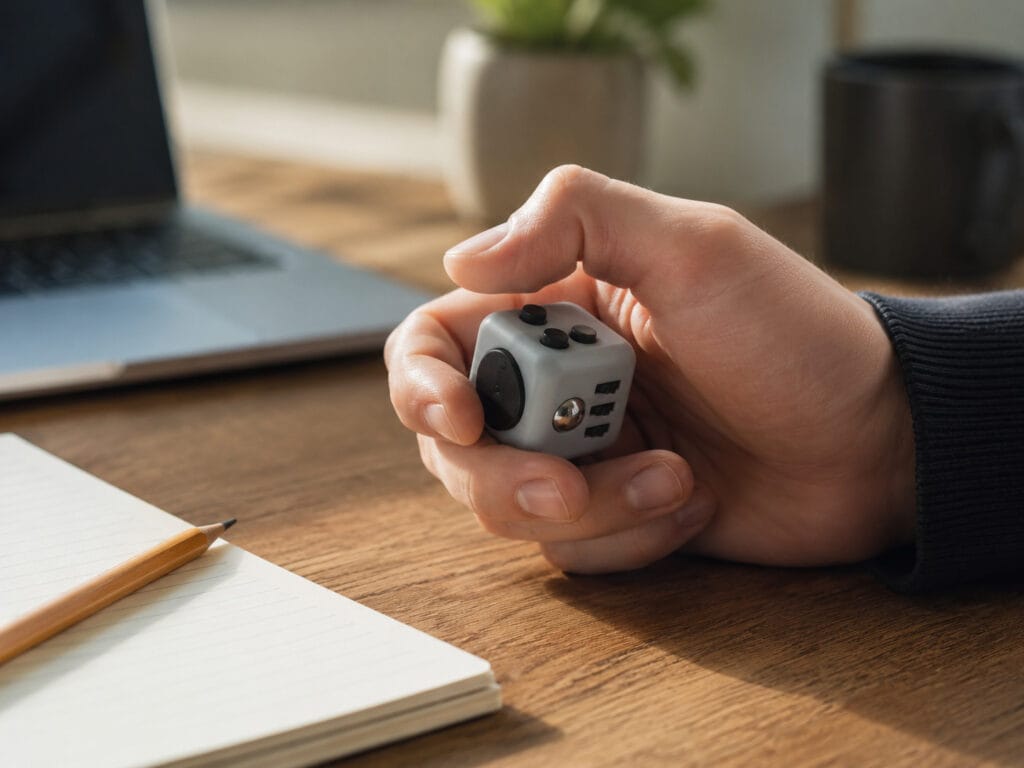
The Original Fidget Cube by Antsy Labs is best if you need variety. Its six surfaces provide different movements, but some controls create audible clicks and may not suit silent meetings.
PILPOC theFube Infinity Cube is best for continuous folding. It provides a simple repeating sequence, although its metal construction may be more noticeable than a soft or silent tool.
Speks Crags is best for open-ended desk use. The magnetic pieces can be rolled and reshaped without a fixed solution, but they require a clean surface and responsible storage.
Tangle Jr. Classic is the best low-cost starting point. It is light, simple, and easy to twist, although it looks more like a traditional toy than a premium office accessory.
SHASHIBO is best for a longer creative break. It is more visually and cognitively engaging than the other options, making it less suitable for simultaneous use while working.
The best fidget tools for focus should support the task without becoming the main source of attention.
Fidget Tool Decision Table
| Main use case | Best option | Noise level | Skip if |
|---|---|---|---|
| Quiet desk work and meetings | ONO Roller Aluminum | Very low | You dislike weighted metal objects |
| Several different tactile actions | Original Fidget Cube | Low to noticeable | Clicks would distract coworkers |
| Continuous folding movement | PILPOC theFube Infinity Cube | Low to moderate | You need a completely silent tool |
| Open-ended magnetic handling | Speks Crags | Low | You may lose small pieces |
| Low-cost beginner option | Tangle Jr. Classic | Low | You want a premium office appearance |
| Creative screen-free break | SHASHIBO | Low to moderate | You need to keep typing or taking notes |
Do Fidget Tools Really Help Focus?
The honest answer is: sometimes, for some users, in some situations.
Fidgeting and commercial fidget toys are not the same thing. Natural movement may help some people maintain alertness during demanding tasks. A purchased object can also become visually interesting, noisy, socially distracting, or more engaging than the work itself.
A 2024 study of adults with ADHD suggested that natural fidgeting may sometimes relate to better sustained attention during cognitively demanding tasks. That does not prove that buying a fidget device improves attention.
Other results have been less positive. A classroom study involving young children with ADHD found that fidget spinner use was associated with poorer attention. A later study of adults with ADHD did not find that a supplied fidget device reliably reduced reported anxiety or physiological stress responses.
That is why a sensible buyer guide should not label these products as proven concentration tools. The practical test is simpler:
- Does it keep your hands occupied without taking your eyes off the task?
- Can you use it without creating noise for other people?
- Does it reduce phone checking or simply add another distraction?
- Can you put it down when the task requires both hands?
- Do you feel more settled after using it, or more stimulated?
Test the tool during a defined work block and judge it by your actual output—not by the claims printed on the packaging.
How to Choose a Fidget Tool for Work
Choose quiet movement for meetings
A product can feel satisfying to you and still irritate everyone nearby. Magnetic snapping, switches, hard plastic hinges, loose components, and metal surfaces can all create more sound than expected.
For meetings and shared workspaces, prioritize smooth rolling, soft twisting, or textured surfaces over clicking and spinning.
Choose one-handed use for active work
If you need to type, write, operate a mouse, or take notes, a two-handed puzzle will interrupt the task. One-handed tools are better for calls, reading, listening, and short thinking pauses.
Choose weight carefully
Weighted metal tools can feel substantial, but heavier is not automatically better. A product that causes hand fatigue, gets dropped on a desk, or feels awkward in a pocket is unlikely to become part of your routine.
Choose low visual demand for deep work
The more you need to look at the tool, solve it, arrange it, or watch it move, the more likely it is to compete with your main task.
For writing or analytical work, choose a repetitive movement you can operate mostly by touch. For a planned break, a more visual or creative object can be appropriate.
Use a trial period
Use one tool for several short sessions before deciding whether it belongs on your desk. Do not buy six products at once and turn the experiment into another shopping cycle.
Below are six fidget tools for focus chosen for different work environments, movement preferences, and noise limits.
The 6 Best Fidget Tools for Focus at Work
1. ONO Roller Aluminum: Best Overall Quiet Fidget Tool
The ONO Roller uses two connected cylinders that rotate continuously around each other inside one hand. Unlike a traditional spinner, it does not require a table, a visible spinning disc, or repeated restarting.
The aluminum version is the most balanced choice in the current ONO range. The manufacturer describes it as a medium-weight roller made from 6061 aluminum with a bead-blasted finish. It is lighter and less expensive than the steel version but more substantial than the plastic model.
Its main advantage is discretion. The movement can be performed below a desk or during a call without requiring you to look at the object. ONO also designs its rollers to operate quietly, which matters more in a workplace than dramatic magnetic feedback.
Best for: meetings, reading, phone calls, listening tasks, shared workspaces, and adults who want a professional-looking tool.
Skip if: you dislike weighted objects, have limited hand strength, want several different movements, or prefer a low-cost first purchase.
Buyer caution: choose the size according to your hand rather than assuming the largest model is best. A heavy roller can become uncomfortable during longer use.
2. Original Fidget Cube by Antsy Labs: Best for Tactile Variety
The original Antsy Labs Fidget Cube provides six different surfaces: click, glide, flip, breathe, roll, and spin. That variety is useful for people who quickly lose interest in a single repetitive motion.
It can be used one-handed and does not need to be watched continuously. You can switch between a rotating dial, buttons, a switch, rolling elements, and other surfaces depending on the amount of movement you want.
The drawback is sound. Some sides are discreet, while others deliberately click or switch. It may work well in a private office or at home but become annoying in a quiet shared room.
Buyers should also check that the listing is for an authentic Antsy Labs product rather than an unbranded copy. The original manufacturer warns that third-party copies may use weaker controls and lower-quality construction.
Best for: people who want several tactile actions, long calls, private offices, travel, and users who become bored with single-motion tools.
Skip if: you need complete silence, dislike small controls, or want a more premium metal object.
3. PILPOC theFube Infinity Cube: Best for Continuous Folding
The PILPOC theFube Infinity Cube consists of connected sections that repeatedly fold from a compact cube into a longer shape and back again.
Its strongest feature is predictability. There is no puzzle to solve and no separate pieces to arrange. Once you learn the folding sequence, the movement can continue almost automatically.
PILPOC uses aluminum alloy rather than lightweight plastic for this model and includes a storage case. That gives it a more substantial feel, but the hard material and hinges may create more sound than a soft twisting tool.
Best for: continuous folding, travel, waiting rooms, private desk use, and users who enjoy repetitive mechanical movement.
Skip if: you need silent operation, dislike hinged objects, or want something that can be used invisibly in your pocket.
Buyer caution: check recent feedback for hinge looseness and surface wear. These are the most important long-term risks for an infinity cube.
4. Speks Crags Magnetic Putty: Best Open-Ended Desk Fidget
Speks Crags is not conventional putty. It is a collection of small ferrite magnetic stones stored in a metal tin. The pieces move together in a loose, malleable mass that can be rolled, pressed, separated, and returned to the container.
This makes Crags more open-ended than a cube or roller. There is no single movement and no correct result. It works better as a short desk break than as something to use while actively typing.
The official product information notes that Crags uses weaker ferrite magnets rather than the stronger miniature magnets used in some other Speks products. The material is designed for handling rather than building stable shapes.
Best for: private desks, short screen breaks, people who like texture and loose movement, and buyers who dislike repetitive hinges or switches.
Skip if: you may lose small pieces, share your workspace with young children, want a pocket tool, or need something usable during typing.
Safety note: store all magnetic components securely and follow the manufacturer’s age and safety instructions. Keep small magnetic pieces away from young children and pets.
5. Tangle Jr. Classic: Best Budget Fidget Tool
Tangle Jr. Classic consists of connected curved sections that can be twisted continuously into different loops and shapes. It is light, simple, and does not depend on batteries, an app, bearings, or separate accessories.
The product is less visually refined than an ONO Roller, but that simplicity is also its strength. It provides continuous hand movement at a much lower entry cost than most precision-machined metal tools.
Tangle lists the Jr. Classic as having eighteen connected curved sections. The sections can separate, so users should avoid pulling the product apart unnecessarily and should follow the manufacturer’s age guidance.
Best for: beginners, low-cost experimentation, home use, travel, and people who prefer twisting to clicking or spinning.
Skip if: you want a heavy object, a premium corporate appearance, completely rigid construction, or a product that stays hidden in one hand.
6. SHASHIBO Shape-Shifting Box: Best for a Creative Focus Break
SHASHIBO is a magnetic cube that unfolds and transforms into a wide range of connected geometric forms. It is more like a tactile puzzle than a traditional fidget tool.
The manufacturer uses 36 internal magnets enclosed inside a 2.4-inch cube. Unlike loose magnetic pieces, the connected structure stays together while you manipulate it.
SHASHIBO is the most visually engaging product in this guide. That makes it useful for a deliberate five- or ten-minute screen break, but less appropriate while reading, listening, or trying to complete deep work.
Best for: planned desk breaks, geometric exploration, screen-free downtime, gifts, and buyers who want a tactile puzzle rather than an automatic hand movement.
Skip if: you need one-handed operation, want a discreet meeting tool, or tend to turn short breaks into long distractions.
For more structured screen-free challenges, see our guide to logic puzzles for overthinking and focus.
What We Would Buy First
For shared offices, meetings, reading, or phone calls, we would start with the ONO Roller Aluminum. Its quiet continuous movement is less likely to compete with the task or disturb other people.
For a lower-cost experiment, we would choose the Tangle Jr. Classic. It lets you test whether tactile movement is actually useful before spending more on a precision-machined desk accessory.
For someone who needs several different inputs, the Original Fidget Cube is the better choice. Use its quieter surfaces during work and save the clicking controls for private use.
For a planned break rather than simultaneous work, choose Speks Crags or SHASHIBO.
What We Would Skip
- Unbranded sliders with unclear materials or weak internal construction.
- Products claiming to treat ADHD, anxiety, panic, or nervous system dysfunction.
- Sharp-edged metal tools that may pinch skin.
- Loud magnetic sliders for shared offices.
- Very heavy tools bought only because they look premium.
- Small magnetic products without clear safety guidance.
- Complex fidget toys that require more attention than the work itself.
- Several nearly identical products purchased before testing one.
The original version of this article included 15 products, many of which repeated the same slider, coin, ring, or metal mechanism with little practical difference. More options did not create a better buying decision.
Hidden Costs and Buyer Risks
- Replacement risk: hinges, bearings, magnets, and moving joints can wear over time.
- Loss risk: small magnetic pieces and portable objects are easy to misplace.
- Noise risk: a product described as discreet may still be audible in a quiet room.
- Weight risk: premium metals can become uncomfortable or damage a desk when dropped.
- Counterfeit risk: popular designs such as the Fidget Cube have many unbranded copies.
- Seller risk: Amazon inventory may come from different sellers with different return handling.
- Import risk: uncommon premium EDC products may include international shipping, tax, or customs costs.
- Distraction risk: the most visually impressive product may be the worst option for actual work.
None of the six products in this guide should require a subscription. A tactile desk object should work without an app, account, firmware update, or monthly fee.
How to Test Whether a Fidget Tool Helps
- Choose one real task, such as reading, planning, listening, or answering email.
- Set a 20- to 30-minute work block.
- Use the fidget tool only when your hand would normally reach for your phone, pen, or another distraction.
- Track whether you completed the task more easily.
- Repeat the same test without the tool.
- Keep it only if it reduces interruption without becoming the main activity.
For a cleaner work structure, combine this test with the method in our single-tasking versus multitasking guide.
Who Should Buy a Fidget Tool?
- People who repeatedly click pens, tap surfaces, or pick up their phone during listening tasks.
- Remote workers who want a physical break from digital input.
- Buyers who already know that quiet hand movement feels useful.
- People who want a non-screen desk object for calls or reading.
- Users willing to test one product rather than collect many.
Who Should Avoid These Products?
- Anyone expecting a medical or therapeutic result.
- People who are easily distracted by mechanical objects.
- Workers in environments where clicking or visible movement would disturb others.
- Buyers with hand pain, reduced grip, or sensitivity to repetitive movement.
- Households where small magnetic components cannot be stored safely.
- People who already own unused fidget toys.
What We Could Verify
We could verify the core design and current product positioning of the six selected tools through official manufacturer documentation.
- ONO offers quiet rollers in several materials and weights, including a medium-weight 6061 aluminum version.
- The Antsy Labs Fidget Cube provides six different tactile surfaces.
- PILPOC describes theFube as an aluminum-alloy infinity cube with a carrying case.
- Speks Crags uses small ferrite magnetic stones stored in a metal tin.
- Tangle Jr. Classic uses eighteen connected curved sections.
- SHASHIBO uses internal magnets inside a connected shape-shifting cube.
What We Could Not Verify
We could not verify that any of these products reliably improves focus, lowers stress, reduces anxiety, supports ADHD symptoms, changes nervous system activity, or produces a measurable productivity benefit.
We also could not verify long-term hinge wear, bearing durability, magnet strength after extended use, seller consistency, return quality, or whether a particular movement will feel satisfying to an individual buyer.
FAQ
What is the best fidget tool for focus at work?
The ONO Roller Aluminum is the strongest overall choice for quiet desk use because it provides continuous one-handed movement without requiring visual attention. It may still be unsuitable for users who dislike weighted objects.
Are fidget tools scientifically proven to improve focus?
No. Research is mixed and depends on the person, task, type of movement, and device. Some natural fidgeting may relate to attention in specific groups, while some commercial fidget devices have been shown to worsen attention.
Which fidget tool is quietest?
A smooth roller such as the ONO Roller is likely to be quieter than a clicker, magnetic slider, metal infinity cube, or multi-button device. Actual sound can change as moving parts wear.
Is the Original Fidget Cube silent?
Not completely. Some surfaces are relatively discreet, while the buttons and switch can create intentional clicking sounds. Use the quieter controls in shared spaces.
Are expensive metal fidget toys worth it?
They may be worth it if you already know that you prefer weight, precise movement, and durable materials. Beginners should test a lower-cost option before paying for steel, titanium, or collector-grade products.
Can a fidget tool replace phone scrolling?
It may give your hands an alternative action, but it will not automatically change a scrolling habit. Remove the phone from reach and use the tactile tool as part of a wider digital boundary.
For stronger phone boundaries, see our guide to digital detox tools for focus.
Final Verdict
Choose the ONO Roller Aluminum when you need a quiet, one-handed tool for meetings, calls, reading, or desk work.
Choose the Original Fidget Cube when variety matters more than silence. Choose PILPOC theFube when you prefer a continuous folding movement.
Choose Speks Crags for open-ended desk handling, Tangle Jr. Classic for a low-cost first experiment, and SHASHIBO for a more visual screen-free break.
Do not buy a fidget tool because it promises to reset your nervous system or unlock peak mental performance. Buy one only when its movement, noise level, size, and use case fit a real habit you are trying to improve.
The right fidget tools for focus are quiet, simple, and easy to stop using when both hands are needed.
The best tactile tool is not the most expensive or mechanically complex one. It is the one that stays in your hand without taking your attention away from the work.