
Table of Contents
Scrolling is easy because it asks very little from your hands or imagination. A screen-free creative activity does the opposite: it gives you a defined physical task, visible progress, and something concrete to complete.
The best screen-free creative activities for adults are not necessarily artistic, expensive, or complicated. Some provide clear instructions. Others create space for experimentation. The right choice depends on whether you want a five-minute reset, a structured evening project, or a hobby that can hold your attention for several weeks.
This guide compares eight practical creative products, from guided journals and water-drawing boards to LEGO sets, puzzles, embroidery, coloring supplies, and origami kits.
For more ways to reduce passive screen use, see our guide to digital detox tools for focus.
Affiliate disclosure: MindReset.org may earn a commission if you buy through our links. This does not increase your price and does not affect our editorial judgment.
Amazon disclosure: As an Amazon Associate, we earn from qualifying purchases.
Research note: We have not personally tested every product in this guide. Our recommendations are based on official product information, design and materials, learning curve, setup requirements, visible buyer feedback patterns, replacement costs, and comparison with similar creative tools.
What we assessed: setup time, difficulty, mess, portability, required supplies, repeat value, storage needs, screen dependence, and suitability for short or long creative sessions.
What we could not independently verify: long-term durability, Amazon seller consistency, missing components, individual enjoyment, customer support quality, or whether a specific activity will improve focus, mood, stress, or cognitive performance.
Health note: Creative activities may support relaxation, enjoyment, routine, and screen-free engagement for some people. They are not treatments for anxiety, depression, ADHD, trauma, insomnia, cognitive decline, or another medical or mental-health condition.
Availability note: Product versions, packaging, prices, specifications, and availability may change. Check the current Amazon listing and seller details before purchasing.
Quick Verdict: Which Creative Activity Should You Choose?
The Buddha Board is the best option for a short creative reset. It uses only water, requires almost no cleanup, and clears itself as the drawing dries.
LEGO Botanicals Tiny Plants is the best structured project. It provides clear instructions, several difficulty levels, and a finished display rather than another item that disappears into a drawer.
The DMC Learning Embroidery Kit is the best beginner craft. It includes the essential materials and teaches a reusable skill instead of offering only one finished result.
The Five Minute Journal is the easiest daily habit. It asks for only a small amount of writing and does not require craft storage or a large workspace.
Wreck This Journal is best for low-pressure creative play. It deliberately encourages experimentation and imperfect pages rather than polished artwork.
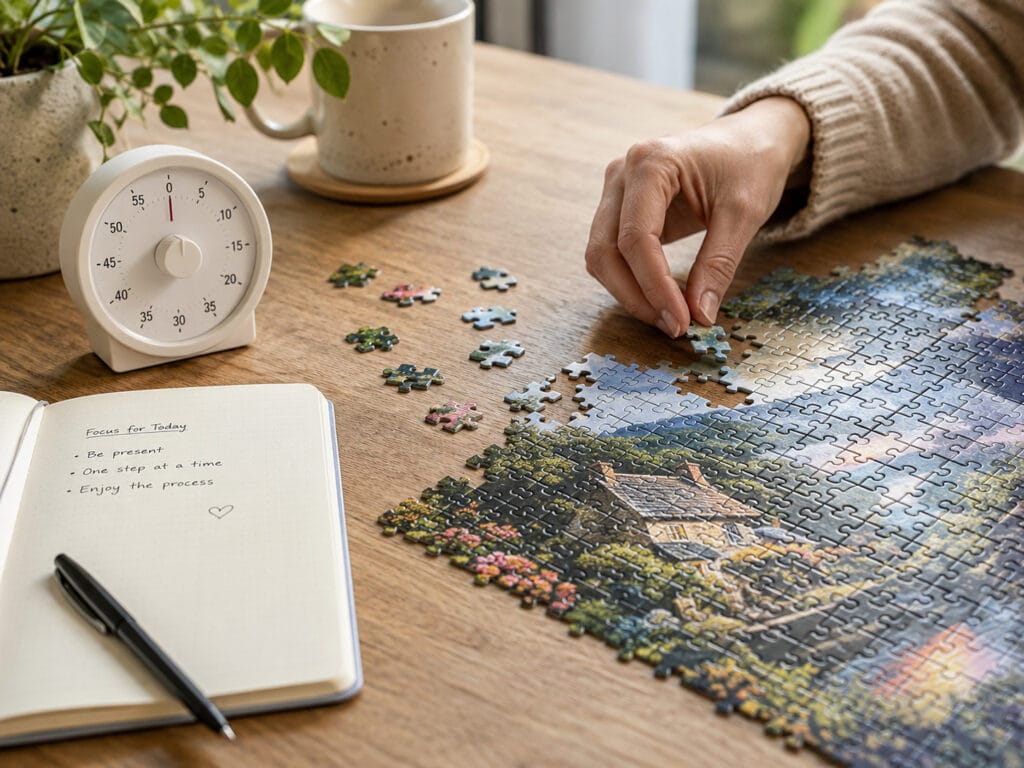
A Ravensburger 1000-piece puzzle is best for long visual engagement. Choose it only when you have enough table space and do not need to pack everything away after each session.
Prismacolor Premier pencils are best for coloring and drawing. They cost more than basic pencils, so beginners should start with a smaller set.
The Tuttle Deluxe Origami for Beginners Kit is the best portable option. It provides paper and instructions without requiring paint, glue, batteries, or a permanent workspace.
Screen-Free Creative Activity Decision Table
| Main use case | Best option | Typical setup | Skip if |
|---|---|---|---|
| Five-minute daily reflection | The Five Minute Journal | Very low | You dislike structured prompts |
| Messy, experimental creativity | Wreck This Journal | Low | Damaging pages feels wasteful |
| Short reusable drawing sessions | Original Buddha Board | Very low | You want to keep your artwork |
| Coloring and free drawing | Prismacolor Premier pencils | Low | You only need basic school pencils |
| Structured construction project | LEGO Tiny Plants | Medium | You dislike following instructions |
| Long visual-spatial activity | Ravensburger puzzle | High | You lack permanent table space |
| Beginner textile craft | DMC embroidery kit | Medium | Needles or fine work are unsuitable |
| Portable paper craft | Tuttle origami kit | Low | Precise folding frustrates you |
Can Creative Activities Really Help You Disconnect?
A creative activity can provide an external task that competes with passive scrolling, but the mechanism should not be exaggerated.
Research has associated participation in arts and crafts with subjective wellbeing, enjoyment, social connection, achievement, and meaningful use of leisure time. However, many studies are observational, small, or focused on organised interventions rather than commercial craft kits.
A 2025 systematic review of crafts-based interventions found some promising mental-health and wellbeing outcomes but also concluded that stronger research is needed. A large 2024 study found an association between arts-and-crafts participation and life satisfaction, although association does not prove that crafting caused the improvement.
Jigsaw puzzles clearly require visual scanning, rotation, matching, working memory, and problem solving. Research shows that puzzling engages multiple cognitive abilities, but short-term puzzle use should not be marketed as a proven way to prevent cognitive decline or permanently improve intelligence.
The realistic benefit is simpler: an analog activity can give your attention somewhere specific to go for twenty minutes without notifications, feeds, advertising, or another browser tab.
How to Choose the Right Creative Activity
Choose for the time you actually have
A five-minute journal and a 1000-piece puzzle solve completely different problems. Do not buy a large project when your realistic free time is ten minutes before bed.
Choose structure or freedom
LEGO, puzzles, embroidery patterns, and origami instructions provide a defined path. Buddha Board, coloring, and Wreck This Journal allow more experimentation.
Structure reduces decision-making. Freedom provides more creative control. Neither is automatically better.
Check the cleanup burden
Paper folding and journaling require almost no cleanup. Embroidery needs thread storage. Puzzles need table space. Coloring requires sharpening and organising pencils. LEGO creates hundreds of small components during the build.
Avoid buying an aspirational identity
A craft machine, premium pencil collection, or complicated kit will not automatically turn you into someone who creates every evening. Start with one small activity and prove that the habit fits your life before expanding the setup.
The 8 Best Screen-Free Creative Activities for Adults
1. The Five Minute Journal: Best for a Short Daily Routine
The Five Minute Journal is a guided journal built around brief morning and evening prompts. It removes the pressure of filling a blank page and gives each session a clear endpoint.
This is the least craft-focused option in the guide, but it is also the easiest to use consistently. You do not need art supplies, a permanent table, technical skills, or a long period of uninterrupted time.
The main limitation is repetition. Structured prompts can support consistency, but some users may eventually find the format restrictive or repetitive. A plain notebook is cheaper and more flexible.
Best for: short morning routines, evening reflection, beginners who dislike blank pages, and buyers with limited space.
Skip if: you prefer free writing, dislike gratitude prompts, already journal regularly, or do not want a format that eventually needs replacing.
2. Wreck This Journal: Best for Low-Pressure Creative Play
Keri Smith’s Wreck This Journal uses unusual prompts that encourage readers to alter, stain, fold, draw on, and physically change the pages.
Its strongest feature is permission. You are not asked to create a beautiful sketchbook. You are asked to interact with the object, try something strange, and continue even when the result looks messy.
This may suit adults who delay creative activities because they do not know what to make or worry that the result will look amateurish. It will not suit everyone: some buyers dislike destroying a new book or following deliberately chaotic prompts.
Best for: creative blocks, experimental journaling, people who fear blank pages, and buyers who enjoy unusual prompts.
Skip if: you want a traditional journal, dislike mess, want to preserve every page, or prefer calm and orderly activities.
3. Original Buddha Board: Best for a Five-Minute Creative Reset
The Original Buddha Board is a reusable drawing surface that responds to water. You paint on the board with the included brush, and the marks gradually disappear as the water evaporates.
This creates an activity with almost no consumable materials and no pressure to preserve the finished result. You can draw, write, practise brush movements, or make simple patterns and then begin again.
The disappearing image is also the product’s biggest limitation. It is not appropriate when you want to keep, frame, scan, or share the artwork.
Best for: short desk breaks, reusable drawing, minimal cleanup, small workspaces, and people who do not want more stored artwork.
Skip if: you want permanent results, detailed color work, portable use, or a project lasting several hours.
4. Prismacolor Premier Soft Core Pencils: Best for Coloring and Drawing
Prismacolor Premier Soft Core pencils are designed for smooth color application, layering, shading, and blending. They are available in several set sizes, so beginners do not need to start with the largest collection.
These pencils make sense when the physical quality of the material matters to you. Softer cores can feel more satisfying on paper than hard school pencils and provide more control over gradients and shading.
The trade-off is cost and maintenance. Soft cores can require careful sharpening and storage. Premium pencils are unnecessary when you only want occasional simple coloring.
Best for: adult coloring books, botanical drawings, sketching, shading practice, and buyers who already enjoy working with color.
Skip if: you need a basic beginner set, tend to lose pencils, dislike sharpening, or expect the materials to create motivation by themselves.
5. LEGO Botanicals Tiny Plants: Best Structured Building Project
LEGO Botanicals Tiny Plants is an adult building set containing nine small plant models based on arid, tropical, and carnivorous species. The complete set contains 758 pieces.
It is a strong choice for people who want creativity without beginning from a blank page. The instructions provide a clear sequence, while the nine separate plants divide the project into smaller sessions.
The finished models also serve as desk or shelf decoration. The main downsides are price, storage during construction, plastic components, and limited replay value once every plant is complete.
Best for: instruction-based building, plant lovers, couples or families, several medium-length sessions, and buyers who want a display object.
Skip if: you dislike following instructions, want an endlessly repeatable activity, lack storage space, or already own unfinished building sets.
6. Ravensburger The Reading Room 1000-Piece Puzzle: Best for Long Visual Engagement
The Reading Room is a 1000-piece adult jigsaw puzzle from Ravensburger. It provides the familiar combination of edge sorting, color matching, visual scanning, spatial rotation, and gradual assembly.
A 1000-piece puzzle can hold attention across several evenings, but it also requires a surface that can remain undisturbed. A puzzle mat or sorting trays may become additional costs when the dining table cannot stay occupied.
The image matters. Choose a design with clear color regions and details you enjoy looking at. A visually muddy or repetitive image can make the puzzle feel tedious rather than engaging.
Best for: long screen-free evenings, shared activities, visual problem solving, and buyers with permanent table space.
Skip if: you need short sessions, must pack the activity away daily, have pets that disturb small pieces, or become frustrated by slow progress.
For smaller structured challenges, see our guide to logic puzzles for overthinking and screen-free focus.
7. DMC Learning Embroidery Kit: Best Beginner Textile Craft
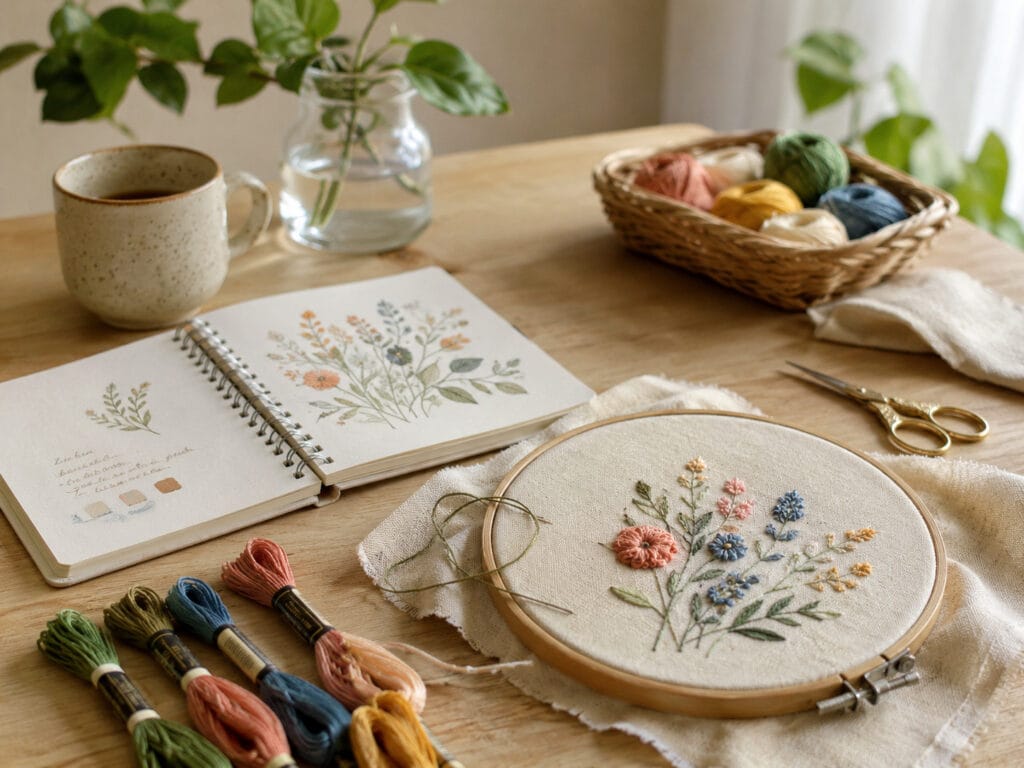
DMC’s Learning Embroidery Kit provides a pre-printed fabric project, cotton thread, a wooden hoop, a needle, printed instructions, and access to a stitch tutorial.
This makes it more approachable than buying thread, needles, fabric, patterns, and hoops separately. The project teaches basic stitches that can later be used with other patterns.
Embroidery requires patience, good lighting, and enough hand control for detailed needlework. Thread tangles and mistakes are part of the process, so it is not the right choice for someone seeking instant visible progress.
Best for: learning a reusable skill, repetitive handwork, quiet evenings, portable projects, and buyers who enjoy visible progress over several sessions.
Skip if: fine needlework is physically uncomfortable, you have visual difficulties, you need a child-safe activity, or repetitive stitching frustrates you.
8. Tuttle Deluxe Origami for Beginners Kit: Best Portable Creative Activity
The Tuttle Deluxe Origami for Beginners Kit includes 78 sheets of origami paper in two sizes and a 64-page illustrated instruction book.
Origami has a low material burden: there is no paint, glue, charging, drying time, or permanent equipment. A single sheet can become a short project, while more complex models provide longer challenges.
The main risk is frustration. Precise folds matter, and a small early mistake can affect later steps. Beginners should start with the simplest models rather than choosing a complicated design because it looks impressive.
Best for: travel, small homes, low-cost creative practice, geometric thinking, and buyers who prefer clear visual instructions.
Skip if: exact folding feels irritating, hand dexterity is limited, you want a durable finished object, or written diagrams are difficult to follow.
What We Would Buy First
For a short activity that can remain on a desk, we would choose the Original Buddha Board. It is reusable, requires little cleanup, and does not create a pile of finished projects.
For a longer structured experience, we would choose LEGO Botanicals Tiny Plants or the DMC Learning Embroidery Kit. Both provide clear instructions and a defined finished result.
For the lowest-cost experiment, start with a basic notebook, a smaller set of colored pencils, or an origami kit. Prove that you enjoy the activity before buying a larger craft system.
What We Would Skip
- Large craft bundles bought before trying the activity.
- Generic kits with unclear materials or incomplete instructions.
- Kintsugi kits that make unclear food-safety claims.
- Cheap diamond-painting kits with poorly printed canvases or missing pieces.
- Very large pencil collections for a complete beginner.
- Craft machines that require expensive consumables and more screen time.
- Products promising to heal trauma, reduce amygdala activity, treat anxiety, or train neuroplasticity.
- Projects that require more storage and cleanup than your home can support.
Hidden Costs and Practical Risks
- Consumables: journals, paper, thread, coloring pages, pencil sharpeners, and replacement art supplies eventually need replenishment.
- Storage: puzzles, LEGO pieces, pencils, thread, and unfinished projects require containers or permanent space.
- Accessories: puzzle mats, sorting trays, pencil cases, lighting, frames, and extra craft tools can exceed the initial product cost.
- Incomplete kits: missing pieces, damaged books, dried materials, or poor packaging may depend on the Amazon seller.
- Skill mismatch: a project that is too difficult can create frustration instead of useful engagement.
- Screen dependence: some kits rely on QR tutorials or companion apps even when the physical activity itself is analog.
- Abandoned-project risk: ambitious kits often look better online than they fit into a real weekly routine.
How to Build a Screen-Free Creative Routine
- Choose one activity, not a collection of hobbies.
- Prepare the materials before the session begins.
- Put your phone out of reach for 20–30 minutes.
- Choose a small finish line: one journal page, one puzzle section, one plant model, or one embroidery area.
- Stop before the activity becomes exhausting.
- Leave the next step visible so restarting is easy.
- Keep the activity only if you genuinely return to it.
The same principle applies to focused work: reduce setup friction and leave a clear next step. Our single-tasking guide explains how to apply that structure during the workday.
Who Should Buy a Creative Activity Kit?
- Adults who automatically reach for a phone during every quiet moment.
- People looking for a defined screen-free evening activity.
- Buyers who enjoy visible progress and physical materials.
- Remote workers who need a clear boundary after computer work.
- People willing to start with one small project rather than a complete craft room.
Who Should Avoid These Products?
- Anyone expecting a craft kit to treat a mental-health or cognitive condition.
- People who already own several unfinished creative projects.
- Buyers whose available space does not match the project.
- Anyone who dislikes cleanup, sorting, or storing small components.
- People with hand, vision, or mobility limitations that make the selected activity uncomfortable.
- Buyers responding mainly to attractive packaging rather than genuine interest.
What We Could Verify
We verified the current product format and core specifications through official manufacturer or publisher documentation.
- The Five Minute Journal is a guided daily gratitude journal.
- Wreck This Journal uses illustrated prompts encouraging physical and creative interaction with the pages.
- The Original Buddha Board uses water and clears as the surface dries.
- Prismacolor Premier Soft Core pencils are designed for smooth application, blending, and shading.
- LEGO Botanicals Tiny Plants contains nine plant models and 758 pieces.
- Ravensburger The Reading Room is a 1000-piece adult puzzle.
- DMC Learning Embroidery Kit includes the main materials required for a beginner project.
- Tuttle Deluxe Origami for Beginners includes 78 sheets and a 64-page instruction book.
What We Could Not Verify
We could not verify that any selected product reliably improves concentration, reduces anxiety, changes brain-network activity, lowers heart rate, prevents cognitive decline, creates neuroplasticity, or produces a lasting mental-health benefit.
We also could not verify long-term durability, missing-component rates, Amazon seller consistency, individual satisfaction, or how often a buyer will continue using the activity after the initial novelty fades.
FAQ
What is the easiest screen-free creative activity for adults?
The Five Minute Journal and Original Buddha Board require the least setup. Origami and coloring are also accessible, but they require more patience and materials.
Which creative activity is best after computer work?
Choose an activity that changes both posture and visual demand. Embroidery, LEGO building, drawing, origami, and puzzles provide a clearer physical contrast than moving from a laptop to another app.
Do crafts improve cognitive function?
Crafts engage attention, coordination, planning, and problem solving, but evidence does not support promising a specific cognitive improvement from buying one craft kit. Benefits depend on the activity, frequency, difficulty, and individual.
What is the best creative activity for beginners?
The Buddha Board, Five Minute Journal, DMC Learning Embroidery Kit, and Tuttle beginner origami kit all provide a clear starting structure. Choose according to the amount of time, precision, and cleanup you tolerate.
Should I buy a large craft kit immediately?
No. Start with a small project or starter set. Upgrade only after you have completed the first project and know which materials or tools you actually need.
Can creative activities replace doomscrolling?
They can provide a practical replacement, but the activity will not remove the scrolling habit by itself. Put the phone away, prepare the materials in advance, and choose a defined session.
For stronger phone boundaries, read our guide on how to stop doomscrolling.
Final Verdict
Choose the Original Buddha Board for a reusable five-minute creative reset with almost no cleanup.
Choose LEGO Botanicals Tiny Plants for a structured building project, or the DMC Learning Embroidery Kit when you want to learn a reusable craft skill.
Choose The Five Minute Journal for a brief daily routine, Wreck This Journal for experimental play, and Prismacolor pencils for coloring and drawing.
Choose a Ravensburger puzzle when you have permanent table space and want a longer challenge. Choose the Tuttle origami kit when portability and low setup matter most.
Do not buy creative products because they promise to rewire your brain, heal emotional wounds, or eliminate stress. Buy one because the activity fits your available time, space, abilities, and genuine interests.
The best screen-free creative activity is the one you will actually begin, complete, and return to after the novelty of the packaging is gone.
Continue Your Screen-Free Reset
If constant online input is leaving you mentally tired, continue with our digital burnout recovery guide and build a realistic seven-day reset without trying to eliminate technology completely.