Table of Contents
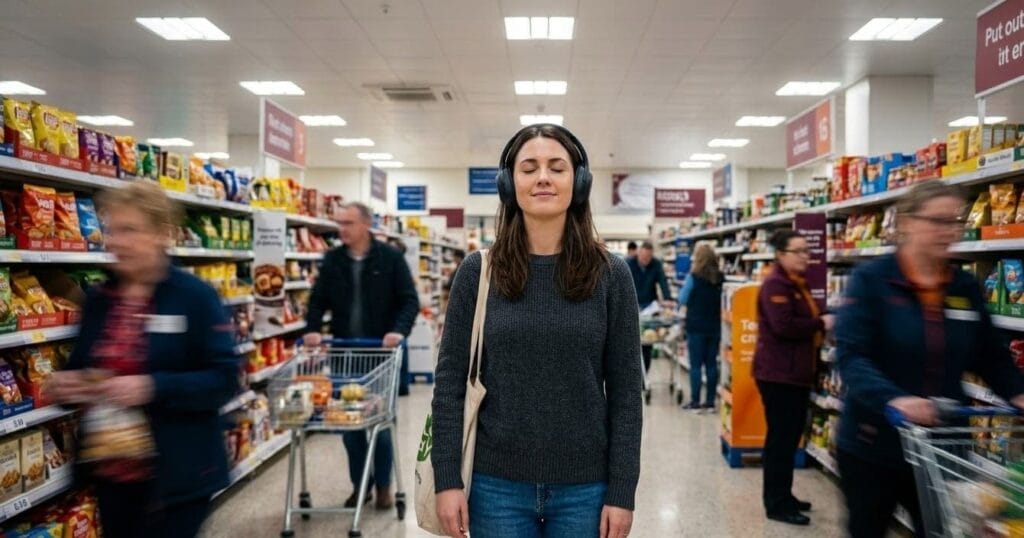
Sensory overload at the supermarket can turn an ordinary grocery trip into a tiring combination of bright lighting, background music, refrigeration noise, crowded aisles, strong smells, visual clutter, queues, and dozens of small decisions.
Some shoppers experience this occasionally when they are already tired, stressed, in pain, or short on time. For others, including many autistic people and people with sensory-processing differences, supermarkets may be consistently difficult environments.
This guide focuses on practical adjustments: choosing a quieter time, planning a shorter route, reducing decisions, using suitable sensory tools, arranging pickup, or replacing some supermarket trips with grocery delivery.
Affiliate disclosure: MindReset.org may earn a commission if you buy through our links. This does not increase your price and does not affect our editorial judgment.
As an Amazon Associate, we earn from qualifying purchases.
Research note: We have not personally tested Amazon Fresh in every delivery area or evaluated every strategy described here. This guide is based on current Amazon documentation, published research on sensory experiences in public environments, and practical comparison between in-store shopping, pickup, and home delivery.
What we assessed: sensory demands, predictability, shopping duration, decision load, delivery availability, fees, substitutions, order minimums, accessibility, and who may benefit from each option.
What we could not independently verify: individual sensory responses, delivery reliability in every ZIP code, produce quality, substitution accuracy, driver availability, customer-support quality, long-term pricing, or whether Amazon Fresh will reduce distress for a particular shopper. Availability, fees, order minimums, subscriptions, delivery windows, and promotions may change.
Health note: Sensory overload is not one universal diagnosis, and similar experiences can have different causes. Persistent dizziness, headaches, panic, pain, faintness, vision changes, or severe difficulty completing daily activities should not automatically be attributed to sensory input. Consider appropriate professional support when symptoms are persistent, worsening, or affecting daily life.
Quick Verdict
The cheapest solution is usually better planning rather than a new product. Shop at a quieter time, prepare a fixed list, follow a familiar route, limit optional browsing, and leave before discomfort becomes difficult to manage.
Pickup is often the best middle ground. You choose groceries online but avoid delivery fees, waiting at home, and walking through a crowded store.
Amazon Fresh may be worth using when supermarket visits repeatedly leave you exhausted, you already use Amazon, delivery is available in your area, and the time or energy saved justifies the fees and possible substitutions.
Skip regular delivery when you prefer selecting fresh food yourself, your local shop is already manageable, delivery fees outweigh the benefit, or substitutions create more frustration than the store visit.
Important: Grocery delivery is a convenience and accessibility option. It is not therapy, a treatment for anxiety, or a way to reset the nervous system.
Why Can Supermarkets Feel Overwhelming?
A supermarket combines several forms of sensory and cognitive demand at the same time:
- bright overhead lighting and reflective packaging;
- music, announcements, scanners, carts, conversations, and refrigeration units;
- food, cleaning-product, bakery, and perfume smells;
- crowded or narrow aisles;
- people moving unpredictably;
- long queues and uncertain waiting times;
- large numbers of products and prices to compare;
- temperature changes near refrigerators and freezers;
- pressure to make decisions quickly.
A qualitative study of autistic adults found that supermarkets were among the public environments most commonly described as disabling because of sensory input. Important themes included sensory burden, crowded space, unpredictability, lack of suitable adjustments, and difficulty finding space to recover.
Read the study through the U.S. National Library of Medicine.
The study focused on autistic adults and should not be used to diagnose every uncomfortable shopping experience. It does, however, support the practical idea that supermarket design and predictability can materially affect accessibility.
Common Signs That It Is Time to Pause or Leave
Responses vary, but a shopper may notice:
- increasing irritability or urgency;
- difficulty comparing products or following the list;
- feeling unable to filter background sound;
- headache, eye discomfort, or physical tension;
- forgetting why they entered an aisle;
- becoming unusually sensitive to carts, people, lights, or smells;
- a strong need to escape immediately;
- difficulty speaking, deciding, or responding;
- feeling drained for a long period after leaving.
Do not wait for the situation to become unbearable before changing the plan. A shorter successful trip is more useful than forcing yourself through every aisle and needing a long recovery afterwards.
Shopping Options Decision Table
| Your situation | Best option | Why | Skip if |
|---|---|---|---|
| You manage well when the store is quiet | Shop early or during a low-traffic period | Keeps in-person choice while reducing crowds and queues | Your store remains noisy at every hour |
| The aisles are the main problem | Curbside or store pickup | You choose products online and avoid entering the store | Pickup substitutions are unreliable locally |
| The entire trip is physically or mentally costly | Home delivery | Removes travel, crowds, queues, and most environmental input | Fees, availability, or substitutions create more difficulty |
| You want to select produce yourself | Short in-person trip plus delivery for heavy items | Combines personal selection with reduced carrying and exposure | Managing two separate orders adds too much complexity |
| You only need a few items | Small local shop | Fewer aisles and products may reduce decision load | The small store is crowded or substantially more expensive |
| You become disoriented when shopping alone | Shop with a trusted person | They can navigate, queue, communicate, or finish the list | Conversation or another person creates additional overload |
| You are uncertain what will help | Test one adjustment at a time | Makes it easier to identify what changes the experience | You need immediate accommodation rather than experimentation |
9 Practical Strategies for Sensory Overload at the Supermarket
1. Choose the most predictable time
Use a time when the store is usually quieter, shelves are stocked, and queues are shorter. Early mornings or later evenings may work, but traffic patterns differ between locations.
Some stores provide sensory-friendly or quiet shopping hours with reduced music, dimmer lighting, or fewer announcements. Check the specific location rather than assuming that every branch participates.
2. Use a fixed list and route
Arrange the list in the same order as the store: produce, bakery, pantry, refrigerated food, frozen food, and checkout. This reduces backtracking and unnecessary time in the building.
Save a reusable list of regular purchases so that every trip does not begin with the same decisions.
3. Separate essential items from optional browsing
Complete the essential list first. Browse promotions, new products, or non-food sections only when energy and time remain.
This also creates a simple exit option: once essential items are collected, the trip can end without being treated as a failure.
4. Reduce sound safely
Earplugs, filtered earplugs, noise-reducing headphones, or active noise cancellation may make background sound more manageable for some shoppers.
Maintain enough environmental awareness to hear people, carts, alarms, vehicles, and staff instructions. Complete sound isolation may be unsafe in car parks, crossings, or busy aisles.
5. Adjust visual input
A cap, visor, lightly tinted lenses, or choosing aisles with less direct glare may improve comfort for some people. Do not use lenses so dark that shelves, steps, labels, or moving carts become difficult to see.
Focus visually on the list and shelf section you need rather than scanning the entire aisle.
6. Pause in a safe location
Move to a quiet edge of the store, customer-service area, seating area, or outside entrance when a break is needed. Stop moving before closing your eyes or reducing visual attention.
A short pause can be used to drink water, check the remaining list, loosen physical tension, or decide whether to continue. It does not “reset the visual processor” or guarantee a neurological change.
7. Use the simplest checkout option
Self-checkout may reduce conversation and waiting for some shoppers. For others, scanning errors, unexpected prompts, and alarms make it more difficult.
Use the option that creates fewer demands for you rather than assuming that self-service is always calmer.
8. Divide large trips
A weekly two-hour trip may be harder than two shorter visits, pickup for household items, or delivery for heavy staples. Compare the total effort rather than only the number of trips.
9. Prepare an exit plan
Know what you will do when continuing no longer feels manageable:
- buy only the essentials already in the cart;
- leave the remaining items for another day;
- ask a companion to finish;
- switch the remaining list to pickup or delivery;
- leave the store when symptoms make shopping unsafe.
Is Amazon Fresh Worth Using?
Amazon Fresh can be a practical option when the supermarket environment is the main barrier. Customers in eligible areas can order groceries online for delivery and, in some locations, choose pickup.
The service may reduce:
- travel to and from the store;
- exposure to bright lighting, noise, smells, crowds, and queues;
- physical carrying and cart navigation;
- pressure to compare products quickly;
- unplanned in-store browsing.
It does not remove every demand. Online shopping still involves searching, comparing, approving substitutions, selecting delivery windows, unpacking bags, checking missing items, and managing possible customer-service problems.
Amazon Fresh and related grocery services are available only in eligible areas. Fees and delivery minimums vary according to location, cart total, Prime status, retailer, delivery window, and current subscription terms.
At the time of writing, Amazon advertises a separate grocery-delivery subscription for eligible Prime members. Do not subscribe until you have confirmed local availability, minimum-order requirements, renewal price, participating retailers, and how frequently you would genuinely use it.
Use Amazon Fresh if:
- supermarket trips repeatedly require substantial recovery time;
- delivery is consistently available at your address;
- you already know which products and brands you buy;
- you can accept reasonable substitutions or disable them;
- carrying groceries creates an additional difficulty;
- the time and energy saved are worth the total cost.
Skip Amazon Fresh if:
- the service is unreliable or unavailable in your area;
- you prefer personally checking produce, meat, and expiry dates;
- substitutions cause significant frustration;
- you cannot meet order minimums without buying unnecessary items;
- delivery fees and tips make the order poor value;
- a free pickup service solves the same problem.
Hidden Costs and Limitations of Grocery Delivery
Delivery and service fees
Delivery fees can depend on cart total, selected retailer, delivery speed, membership, and local availability. A low-cost grocery order may become poor value once fees and optional tips are added.
Subscription renewal
A grocery subscription creates another recurring charge. Calculate how many deliveries you expect to use rather than subscribing because one difficult store visit made the service look immediately attractive.
Order minimums
Minimums may encourage adding products that were not originally needed. Compare the cost with pickup, a smaller local order, or combining grocery purchases into a planned delivery.
Substitutions
Out-of-stock products may be replaced or removed. Review substitution settings carefully when brand, ingredients, size, price, sensory preference, dietary requirement, or packaging matters.
Fresh-food selection
You cannot personally inspect every piece of fruit, vegetable, meat, or bakery item before purchase. Delivery may be less suitable when freshness and exact selection are your highest priorities.
Delivery windows
You may need to remain available during a time window, respond to driver messages, provide building access, or retrieve temperature-sensitive food promptly.
Packaging and unpacking
Delivery can create additional bags, insulated materials, product checks, and unpacking. For some users this is easier than the supermarket; for others it simply moves the difficult part home.
Online impulse buying
Delivery removes shelf displays but not marketing. Recommendations, sponsored products, repeat-purchase prompts, and deals can still increase the final basket.
What to Do After a Difficult Shopping Trip
Recovery does not need to become an elaborate wellness ritual. Reduce additional demands and allow enough time before moving into another crowded, noisy, or decision-heavy activity.
- Move to a quieter environment.
- Drink water or eat when appropriate.
- Change uncomfortable clothing or lighting.
- Delay optional calls, messages, and errands.
- Use silence, familiar music, or steady background sound according to preference.
- Record which part of the trip was most difficult.
- Adjust the next shopping plan rather than relying on willpower.
Reading may be a suitable low-demand activity for some people, but it is not a therapeutic requirement. Our digital fatigue guide compares paper books, smartphones, tablets, and dedicated e-readers when visual and digital demands are already high.
If spoken audio or music feels more comfortable than silence, use a familiar low-volume option. A dedicated sound device such as the one discussed in our Sound Oasis S-680 review may be simpler than repeatedly browsing a streaming app.
Alternatives to Amazon Fresh
| Alternative | Main advantage | Main limitation | Best for |
|---|---|---|---|
| Store pickup | Avoids entering the supermarket and may cost less than delivery | Requires travel and may involve waiting | Shoppers comfortable driving or collecting orders |
| Local supermarket delivery | May offer familiar products and local loyalty pricing | Coverage and reliability vary | People already loyal to one store |
| Small local shop | Fewer aisles and products | Higher prices or limited selection | Short essential shopping trips |
| Meal-kit service | Reduces meal planning and ingredient selection | Subscription cost, packaging, and fixed recipes | People whose main difficulty is deciding what to cook |
| Shared household shopping | Another person completes the difficult part | Requires coordination and clear product preferences | Households able to divide responsibilities |
| Hybrid shopping | Buy produce in person and order heavy staples online | Requires two systems | People who want personal selection with shorter store visits |
What We Could Verify
- Sensory-processing differences are commonly reported by autistic adults.
- A published qualitative study identified supermarkets among public places commonly experienced as disabling sensory environments by autistic adults.
- Important environmental factors included sensory burden, crowds, unpredictability, adjustments, and access to recovery space.
- Amazon Fresh delivery and pickup are available only in eligible locations.
- Amazon grocery-delivery fees and minimums can vary by location, order total, delivery option, retailer, membership, and subscription.
- Amazon currently offers a separate grocery-delivery subscription to eligible Prime members.
- Customers can manage substitutions and delivery details during eligible orders.
What We Could Not Verify
- That every supermarket visit causes a cortisol spike.
- That sensory overload always means the thalamus or prefrontal cortex has stopped filtering information correctly.
- That closing the eyes for 30 seconds resets the visual system.
- That Amazon Fresh improves mental health or creates therapeutic progress.
- That reading, music, unpacking groceries, or cooking moves the brain into a specific therapeutic rhythm.
- That online grocery delivery will be cheaper, calmer, or more reliable for every shopper.
- Consistent produce quality, substitution accuracy, delivery timing, or customer support in every ZIP code.
Frequently Asked Questions
Why do supermarkets cause sensory overload?
Supermarkets can combine bright lighting, noise, smells, crowds, temperature changes, visual clutter, unpredictable movement, waiting, and decision-making. The effect differs between shoppers and should not be treated as one universal neurological response.
What is the fastest way to make grocery shopping easier?
Prepare a short list arranged by aisle, visit at a quieter time, buy essential items first, and use a clear exit plan. These changes cost nothing and can be tested before paying for delivery or equipment.
Can I wear headphones in a supermarket?
Noise-reducing tools may help some shoppers, but maintain enough awareness to hear people, carts, alarms, staff instructions, and vehicles. Avoid complete isolation in car parks, crossings, and busy aisles.
Is pickup better than grocery delivery?
Pickup may be better when you can travel to the store but want to avoid the aisles and delivery fee. Delivery may be better when travel, carrying bags, waiting, or entering the building is also difficult.
Do I need Prime to use Amazon Fresh?
Amazon Fresh eligibility, pricing, delivery benefits, subscriptions, and pickup options vary by location and current account terms. Enter the delivery address and review the checkout terms before assuming that Prime or another subscription is required.
Does Amazon Fresh have delivery fees?
Fees can apply depending on cart total, delivery option, location, retailer, Prime status, and grocery subscription. Review the complete order cost before checkout rather than comparing product prices alone.
Can I refuse Amazon Fresh substitutions?
Substitution controls may be available for eligible items and orders. Review each item carefully when brand, ingredients, size, packaging, price, or dietary requirements matter.
Should I speak to a professional about sensory overload?
Consider professional support when sensory difficulties frequently prevent shopping, work, travel, healthcare visits, or other necessary activities. An occupational therapist or another suitable clinician may help evaluate the broader pattern and practical accommodations.
Final Verdict
Sensory overload at the supermarket is best approached as a practical accessibility and planning problem, not as a personal failure or wellness trend.
Begin with free adjustments: quieter timing, a fixed list, a shorter route, fewer optional decisions, safe noise reduction, and an exit plan.
Use pickup when the store environment is the main difficulty but travel remains manageable.
Use home delivery when the complete trip—travel, crowds, aisles, queues, carrying, and recovery—costs more time or energy than the delivery fee.
Amazon Fresh is worth considering only after checking local availability, substitutions, order minimums, total fees, subscription terms, and produce preferences.
The best option is not automatically the most technologically advanced one. It is the shopping method that reliably gets suitable food into your home without creating unnecessary cost or an unmanageable experience.
Sources and Further Reading
- U.S. National Library of Medicine: Sensory Experiences of Autistic Adults in Public Spaces
- Amazon: Grocery Delivery Options
- Amazon Help: Grocery Delivery and Pickup Services
- Amazon Help: Amazon Fresh Delivery Fees and Savings
- Amazon Help: Amazon Fresh Checkout and Order Limits
- Amazon Help: Canceling a Grocery Subscription