
Table of Contents
Some nights, your mind does not feel tired. It feels crowded.
Tasks, messages, bills, ideas, unfinished conversations, work deadlines, family logistics, random worries, and “don’t forget this” thoughts all compete for attention at the same time. You may be lying in bed, but your brain is still trying to manage tomorrow.
That is where the brain dump technique can help.
A brain dump is not a cure for anxiety. It is not therapy. It does not magically solve every problem in your life.
It is a simple way to move mental clutter out of your head and onto paper, so you can see what is actually there, sort it, and decide what needs action.
Quick verdict: The brain dump technique is useful when your mind feels overloaded, especially in the evening. It works best as a short planning and reset habit, not as a medical solution for anxiety or sleep problems.
What Is the Brain Dump Technique?
The brain dump technique is a simple cognitive offloading practice.
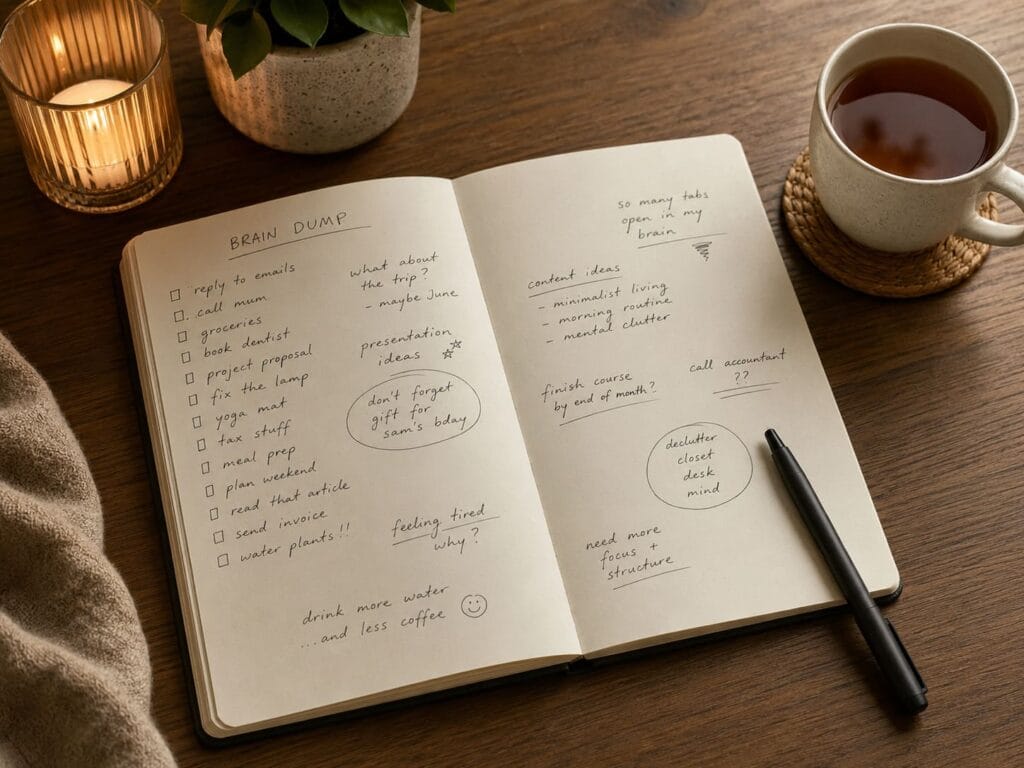
Instead of trying to hold every thought in your mind, you write everything down in one place. Tasks, reminders, worries, ideas, unfinished decisions, errands, appointments, money concerns, random thoughts — all of it goes onto the page.
The goal is not to write beautifully.
The goal is to stop using your mind as storage.
Once everything is visible, you can start separating what needs action from what is just mental noise.
Why Mental Clutter Feels So Heavy
Mental clutter builds up when too many unfinished thoughts stay open at the same time.
You might be trying to remember a work task, reply to a message, plan dinner, book an appointment, pay a bill, return something, finish a project, and make a decision — all without a clear system.
That creates a sense of pressure, even when nothing dramatic is happening.
A brain dump helps because it changes the job of your mind. Instead of trying to remember everything, your mind can look at the list and process one thing at a time.
This is why the technique works well as an evening reset. It gives your day a closing point.
Who Should Try a Brain Dump?
A brain dump may be useful if you often feel mentally overloaded, scattered, or stuck in loops of unfinished thoughts.
It can be especially helpful if you:
- keep remembering tasks at the wrong time;
- feel mentally busy at night;
- jump between too many priorities;
- struggle to start because everything feels mixed together;
- use your phone to avoid thinking;
- wake up remembering something you forgot to write down;
- feel like your mind is a messy browser with too many tabs open.
This is a support habit, not a diagnosis tool. If worry, panic, low mood, or sleep problems are intense or persistent, it is better to speak with a qualified professional.
When Is the Best Time to Do a Brain Dump?
The best time is usually evening.
A brain dump works well before bed because it helps you capture unfinished tasks before your head hits the pillow. It can also work on Sunday evening before a new week, or in the morning if your day starts with mental fog.
Good times to use it:
- before bed;
- after work;
- before planning the next day;
- before starting a focused work block;
- when you feel overwhelmed but cannot identify why;
- before a digital reset or screen-free evening.
You do not need to do it for an hour. Five to ten minutes is enough for most people.

The 3-Step Brain Dump Method
This version is simple and practical. Use paper if possible, but a notes app is still better than keeping everything in your head.
Step 1: The Unfiltered Download
Set a timer for 5–10 minutes.
Write down everything that comes to mind.
Do not organize yet. Do not judge the thoughts. Do not worry about spelling, structure, or whether something is important.
Write down:
- tasks;
- reminders;
- worries;
- ideas;
- appointments;
- things to buy;
- things to fix;
- people to reply to;
- decisions you are avoiding;
- random thoughts;
- anything your mind keeps repeating.
The rule is simple: if it is taking up space in your head, put it on the page.
Step 2: Sort the List
Now look at what you wrote and divide it into simple groups.
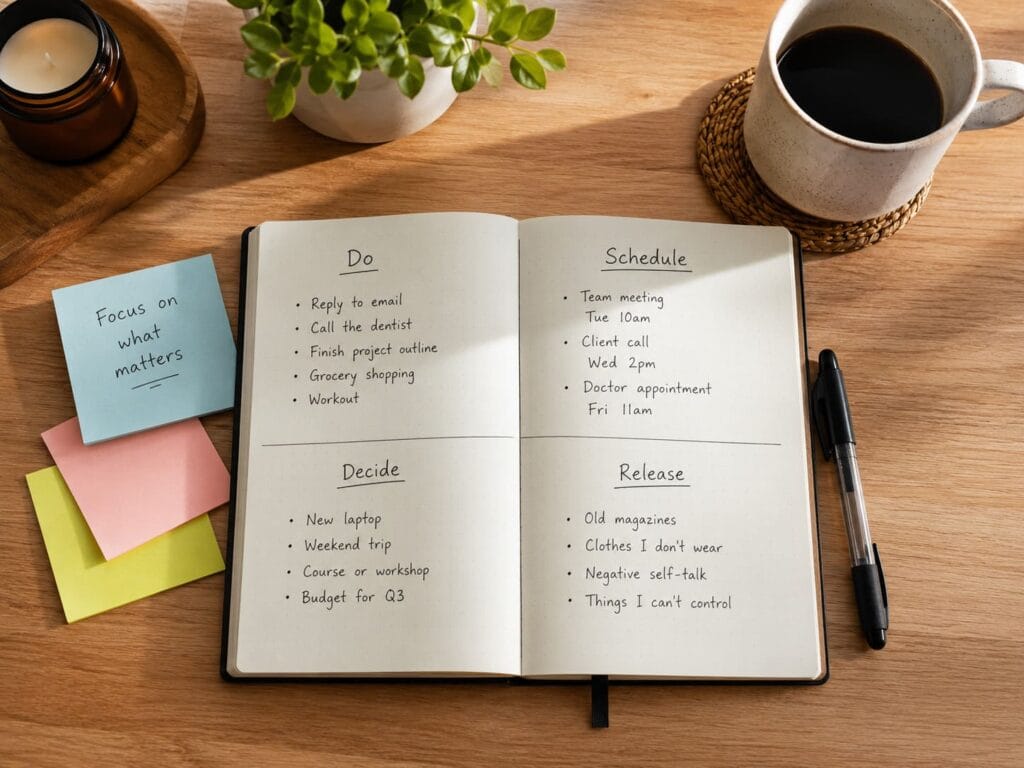
Use these four categories:
Do: tasks that need a real action.
Schedule: things that belong in a calendar.
Decide: open questions that need a decision.
Release: thoughts you cannot act on tonight.
This step matters because a raw brain dump can look messy. Sorting turns it into something usable.
Step 3: Choose the Next Tiny Action
Do not try to solve the whole list.
Choose one to three small next actions.
Examples:
- “Pay electricity bill tomorrow at 10:00.”
- “Text Sarah after breakfast.”
- “Book appointment on Monday.”
- “Add groceries to list.”
- “Put passport by the door.”
- “Decide on this later — not tonight.”
The goal is not to finish your life admin in one sitting.
The goal is to give your mind a clear signal: this has been captured, and there is a next step.

Brain Dump Template
Use this quick template:
1. Everything on my mind:
Write without filtering.
2. Tasks I can do:
List anything that needs action.
3. Things to schedule:
Move appointments, deadlines, calls, and reminders into a calendar.
4. Decisions I need to make:
Write down decisions, but do not force yourself to solve them all tonight.
5. Things I cannot control tonight:
Name them, then leave them on the page.
6. My top 3 actions for tomorrow:
Choose only three. Not ten. Not twenty.
Paper vs Notes App: Which Is Better?
Paper is often better for an evening brain dump because it is slower, quieter, and less likely to pull you into notifications.
Writing by hand also makes the practice feel like a boundary: the day is being closed, not extended.
But a notes app can still work if that is what you will actually use.
Use paper if:
- you want a screen-free evening;
- your phone pulls you into apps;
- you like physical lists;
- you need a calmer bedtime routine.
Use a notes app if:
- you need search;
- you travel often;
- you already manage tasks digitally;
- you need to copy items into a calendar or project tool.
The best method is the one you will repeat.

What to Do After the Brain Dump
After you finish, do not just leave the list as a pile of thoughts.
Take two minutes to close the loop.
Do this:
- Move appointments into your calendar.
- Pick the top three actions for tomorrow.
- Put small tasks into a task list.
- Cross out anything you cannot control tonight.
- Leave the notebook somewhere visible.
This turns the brain dump from emotional unloading into practical reset.
Common Mistakes
Mistake 1: Turning It Into a Perfect Journal
A brain dump does not need beautiful writing. It is a capture tool.
Mistake 2: Trying to Solve Everything
You are not trying to fix your whole life in ten minutes. You are trying to make the mental mess visible.
Mistake 3: Keeping the List Too Vague
“Sort life out” is not useful.
“Call dentist tomorrow” is useful.
Mistake 4: Doing It on Your Phone, Then Scrolling
If your notes app leads to social media, use paper instead.
Mistake 5: Writing the Same Worry Every Night Without Support
If the same fear, stressor, or emotional pattern keeps showing up, the brain dump may be showing you something that needs more than a list. That could mean a difficult conversation, a change in routine, or professional support.
A 5-Minute Evening Brain Dump Routine
Use this tonight:
Minute 1: Write everything on your mind.
Minute 2: Add any tasks, reminders, or appointments you forgot.
Minute 3: Circle anything that needs action tomorrow.
Minute 4: Choose your top three actions.
Minute 5: Close the notebook and do one low-stimulation activity: reading, stretching, breathing, tidying, or preparing for sleep.
That is enough.
The goal is not to empty your mind forever. The goal is to stop carrying tomorrow in your head all night.
Brain Dump vs Journaling
A brain dump is not the same as journaling.
Journaling is often reflective. You explore feelings, experiences, meaning, or personal patterns.
A brain dump is more functional. You capture mental clutter and turn it into categories, actions, or intentional release.
Both can be useful, but they serve different purposes.
Use journaling when you want to understand yourself.
Use a brain dump when your mind feels overloaded and you need to get organized.

Brain Dump vs To-Do List
A to-do list is usually for tasks.
A brain dump is wider.
It includes tasks, worries, reminders, ideas, decisions, and mental noise. After the dump, some items become to-do list entries. Others go to a calendar. Some get crossed out. Some simply stay on the page because they are not actionable right now.
That is why a brain dump can feel more relieving than a normal task list. It does not force every thought to become a task.
What a Brain Dump Can and Cannot Do
A brain dump can help you:
- reduce mental clutter;
- organize unfinished thoughts;
- prepare for tomorrow;
- create a calmer evening routine;
- notice repeated stress patterns;
- stop relying on memory for every task.
A brain dump cannot:
- cure anxiety;
- replace therapy;
- fix chronic insomnia;
- solve serious life problems by itself;
- make every worry disappear;
- replace medical or mental health support.
This matters. The technique is useful, but it should not be oversold.
Final Verdict: A Simple Reset for Mental Clutter
The brain dump technique is one of the simplest ways to reset a crowded mind.
It is not dramatic. It is not a cure. It is not a productivity miracle.
It is a practical habit: write everything down, sort it, choose the next small action, and stop using your brain as a storage unit.
Use it in the evening when your mind feels crowded. Use it before bed when tomorrow keeps interrupting tonight. Use it before a digital reset when you need to know what you are actually avoiding.
For a printable evening routine, download the Free Nervous System Reset Toolkit.
Your mind is better for thinking, choosing, creating, and resting.
It was never meant to hold every open loop alone. If your brain dump shows that most of your clutter comes from screens, try a practical digital reset next.