
Table of Contents
Micro rituals are short, repeatable actions that help mark a transition: work to home, scrolling to resting, planning to sleeping, or tension to a more settled activity. They do not “hack” the brain or force an emotional reset. Their value comes from making the next step clear and reducing the amount of input competing for your attention.
You do not need ten products, a perfect evening routine, or a special scent for every mood. A useful micro ritual can be as simple as changing the lighting, washing your face, putting your phone in another room, making tea, or writing down tomorrow’s first task.
Quick verdict: Choose one or two actions that are easy to repeat and connect them to a specific transition. Keep scent optional. The ritual should make your evening simpler, not become another performance target or shopping list.
Health note: This is an educational guide, not treatment for anxiety, depression, trauma, insomnia, panic, or another health condition. Persistent distress, major sleep changes, or difficulty functioning deserve professional support.
What Is a Micro Ritual?
Short answer: A micro ritual is a small action repeated in the same context to mark a change in activity.
A routine is something you do regularly. A ritual adds a little more intention to the action. The practical difference is not mystical: you pause, notice the transition, and deliberately begin the next part of the day.
Examples include:
- closing the laptop and clearing one small section of the desk;
- switching from overhead lighting to one warm lamp;
- putting the phone on charge outside the bedroom;
- changing from work clothes into comfortable clothes;
- making one familiar caffeine-free drink;
- writing tomorrow’s first task on paper;
- taking a five-minute walk after the final work call;
- using one familiar scent during a short evening routine.
The action does not need to produce an immediate emotional change. Its job is to create a reliable boundary between activities.
Why Can Small Transitions Feel Useful?
Short answer: They reduce decisions and give attention one clear place to go next.
Stressful days often do not end cleanly. Work messages continue into dinner, news follows you into bed, and unfinished tasks remain mentally active. A small transition will not solve the underlying problem, but it can interrupt the automatic continuation of the previous activity.
The CDC recommends healthy coping actions such as taking breaks from news and social media, making time to unwind, journaling, spending time outdoors, and choosing relaxing activities you enjoy. These are useful options, not guaranteed treatments. See the official CDC guidance on managing stress.
NIMH also suggests scheduling regular time for relaxing activities and low-stress hobbies as part of caring for mental health. Read the NIMH mental health self-care guidance.
Micro Ritual Decision Table
| Your situation | Best first ritual | Why it may help | Skip if |
|---|---|---|---|
| You keep checking work | Write tomorrow’s first task, then close the laptop | Creates a visible stopping point | You still have an urgent duty that must be handled |
| You keep scrolling | Charge the phone outside reach for 20 minutes | Removes the immediate trigger | You need the phone for safety or caregiving |
| You feel physically restless | Take a short familiar walk | Changes posture, location, and visual input | Walking is unsafe or medically unsuitable |
| Your mind is holding tasks | Do a three-minute brain dump | Moves reminders into a trusted place | Writing becomes prolonged rumination |
| The room still feels like work | Change lighting and clear one surface | Creates a visible environmental boundary | Household needs require bright task lighting |
| You want a sensory cue | Use one mild familiar scent briefly | Can become a consistent reminder of the routine | Anyone is sensitive to fragrance |
| You feel disconnected from the evening | Wash your face or change clothes | Marks the end of the previous role | The action feels forced or impractical |
1. Close the Workday With One Written Next Step
Do not finish work by staring at an unfinished list. Write down the single task that should happen first tomorrow.
Use this format:
Tomorrow at [time], I will begin by [specific action].
Examples:
- Tomorrow at 9:00, I will reply to the supplier’s last question.
- Tomorrow after breakfast, I will check the appointment details.
- Tomorrow at 10:30, I will review the first three invoices.
This does not complete the work. It reduces ambiguity about where to restart.
When several tasks are competing for attention, use the longer brain dump technique instead.
2. Put the Phone Somewhere Inconvenient
Turning on “Do Not Disturb” can help, but physical distance is often more effective than relying on willpower while the phone remains in your hand.
Try one of these:
- charge it across the room;
- leave it in the hallway for 20 minutes;
- put it face down inside a drawer;
- switch the screen to grayscale;
- move social apps off the home screen;
- use an app blocker during one defined period.
Do not make the ritual unrealistic. Keep essential calls available when you have caregiving, work, medical, or safety responsibilities.
For a broader plan, use our guide on how to stop doomscrolling.
3. Change the Lighting
Lighting can help mark a change in activity without making medical claims about “resetting” your nervous system.
At the end of work:
- turn off the brightest overhead light;
- switch on one familiar lamp;
- move away from the desk lighting;
- keep enough light for safe walking, cooking, reading, and medication use;
- avoid treating darkness as a test of whether you are relaxing correctly.
A salt lamp is not required. Any suitable warm lamp can create the same practical boundary. The lamp should be selected for safe illumination, not claims about ions, detoxification, or biological shielding.
For room-by-room sensory choices, see our sensory home sanctuary guide.
4. Wash Your Hands or Face Slowly
A familiar hygiene action can mark the end of commuting, household work, exercise, or screen time.
Keep it simple:
- notice the water temperature;
- use a product you already tolerate;
- do not add strong fragrance if your skin or airways are sensitive;
- finish by drying your hands or face without reaching immediately for the phone.
The usefulness comes from repetition and attention, not from a special ingredient.
5. Change Clothes to Mark the Role Change
Work can continue mentally when your body and environment still signal “on duty.” Changing clothes is a simple way to mark that the role has changed.
This can be especially useful for remote work, shift work, uniforms, or physically demanding jobs. The goal is not to wear ideal “self-care” clothing. It is to create a repeatable boundary.
Pair the action with one sentence:
Work is finished for today. The next task can wait until the time I chose.
6. Make One Familiar Drink
Tea, warm water, or another familiar drink can provide a predictable sequence: fill the kettle, wait, pour, sit, and drink.
The vessel does not need to be expensive. A Japanese cast-iron teapot can be attractive and durable, but it does not force mindfulness or create a complete mental reset.
Choose a caffeine-free option near bedtime when caffeine affects your sleep. Check ingredients when you take medication, have allergies, are pregnant, or use herbal products with known interactions.
7. Take a Short Transition Walk
A short walk can separate the end of one activity from the start of another. It does not need to be exercise training.
- Walk around the block.
- Walk to the end of the street and back.
- Walk slowly through the home when outdoor movement is not practical.
- Use a mobility aid when required.
- Choose a seated movement or change of room when walking is unsuitable.
Do not use pain, exhaustion, unsafe weather, or difficult terrain as proof that the ritual is working.
8. Use Scent as an Optional Cue
Short answer: A familiar scent can be part of a ritual, but it is not an emotional off-switch.
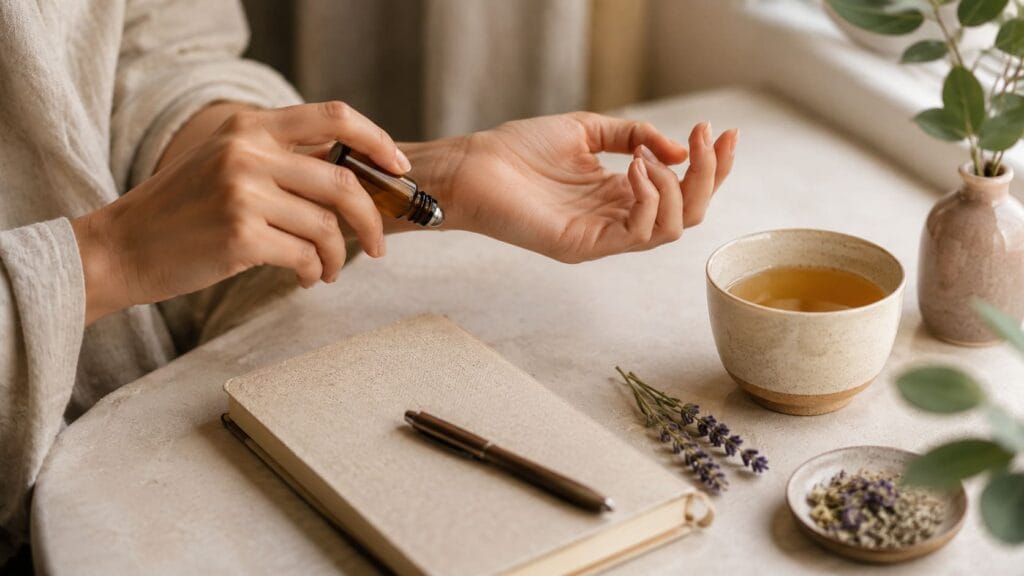
A scent cue may be useful when it is mild, familiar, and consistently paired with one ordinary action such as reading, stretching, or preparing for bed.
Options include:
- one brief diffuser session;
- a scented hand cream you already tolerate;
- a cup of herbal tea with a familiar aroma;
- a pillow spray used according to its label;
- fresh air from an open window;
- unscented air when fragrance is uncomfortable.
The National Center for Complementary and Integrative Health describes aromatherapy as a complementary approach in which essential oils are commonly inhaled or used in diluted topical form. Evidence and safety vary by oil, product, route, and person. Read the official NCCIH aromatherapy overview.
Essential oils are concentrated. They can irritate the skin, eyes, or airways, and some are poisonous when swallowed. Poison Control advises that “natural” does not mean harmless. See its guidance on essential oil safety.
Stop use and ventilate the room if anyone develops coughing, headache, nausea, wheezing, eye irritation, or breathing discomfort. Keep oils away from children and pets, and do not ingest them.
If you want a device rather than a topical product, compare practical options in our essential oil diffuser buyer guide.
9. Clear One Small Surface
Do not attempt a full home reset at the end of a difficult day. Choose one surface:
- the desk;
- one bedside table;
- one section of the kitchen counter;
- the chair where clothing accumulates;
- the area where you plan to sit.
Use a five-item limit. Put away, discard, or relocate five things, then stop. The purpose is to make the next activity easier, not to earn rest through housework.
10. Sit Quietly for Three Minutes
Silence is not automatically calming, and meditation is not compulsory. This ritual simply removes tasks for three minutes.
You can:
- sit with both feet supported;
- look at one neutral object;
- listen to familiar instrumental audio;
- notice sounds in the room;
- use a comfortable breathing pace;
- stand or walk slowly instead of sitting.
Do not force slow breathing when it makes you dizzy, breathless, or more anxious. External grounding or gentle movement may be a better choice.
For additional options, see our breathing techniques guide.

A Five-Minute After-Work Micro Ritual
Use this when you want one ready-made sequence:
- Minute 1: Write tomorrow’s first task.
- Minute 2: Close the laptop and silence non-urgent notifications.
- Minute 3: Wash your hands or face.
- Minute 4: Change the lighting or move to another room.
- Minute 5: Make a drink, open a window, or sit quietly.
Repeat the same sequence for one week before adding anything. Consistency matters more than complexity.
A Five-Minute Bedtime Micro Ritual
- Put the phone on charge away from the bed.
- Write down anything you need to remember tomorrow.
- Prepare water, medication, clothing, or another practical morning item.
- Lower unnecessary light while keeping the room safe.
- Choose one quiet activity rather than switching repeatedly between apps.
This routine does not guarantee sleep. Persistent insomnia needs more than a scented product or bedtime checklist.
When thoughts remain crowded at night, use our guide on how to slow racing thoughts safely.
What Not to Expect From Micro Rituals
Do Not Expect an Instant Emotional Switch
A ritual may create structure without immediately changing how you feel. That does not mean it failed.
Do Not Use Scent as Treatment
A diffuser, candle, roll-on, incense stick, or pillow spray should not be presented as treatment for anxiety, panic, trauma, depression, or insomnia.
Do Not Treat Smoke as Air Cleansing
Burning palo santo or incense adds smoke and particles to indoor air. It does not physically “clear” a room of stress or negative emotion. Avoid smoke when anyone has respiratory sensitivity, and never leave burning products unattended.
Do Not Assume Luxury Means Safer
A premium candle, diffuser, tea set, or eye mask may be attractive, but price and branding do not create a biological signal of safety.
Do Not Force Relaxation
Turning the evening into a test—“Am I calm yet?”—can add pressure. Aim for a clearer next action rather than a perfect internal state.
Do Not Replace Professional Help With Rituals
Seek professional support when stress or anxiety is persistent, worsening, interfering with daily life, or accompanied by severe sleep disruption, major mood changes, substance misuse, or thoughts of self-harm.
A Seven-Day Micro Ritual Experiment
This is not a treatment program. It is a simple way to identify which transitions genuinely help your evening.
Day 1: Choose one transition.
Select work-to-home, scrolling-to-reading, or evening-to-bed.
Day 2: Remove one source of friction.
Prepare the notebook, charger, lamp, mug, or clothing in advance.
Day 3: Repeat the same action.
Do not add extra products.
Day 4: Notice what interrupts it.
Record whether the barrier is time, phone use, household demands, discomfort, or unrealistic expectations.
Day 5: Adjust the ritual.
Make it shorter, easier, or more accessible.
Day 6: Try it without scent.
This helps reveal whether the routine itself is useful.
Day 7: Keep, change, or remove it.
Retain only actions that make the transition easier in real life.
FAQ
How long should a micro ritual take?
One to five minutes is enough for many transition rituals. A longer activity is fine when you enjoy it, but duration is not proof of effectiveness.
Do micro rituals reduce stress?
They may make transitions feel clearer and reduce unnecessary input for some people. They are not guaranteed to reduce stress and do not replace treatment or changes to the source of the problem.
Do I need aromatherapy for a micro ritual?
No. Lighting, movement, clothing, tea, journaling, phone boundaries, and environmental changes can all work without fragrance.
Can I use the same scent every evening?
You can use one familiar scent briefly when everyone in the household tolerates it and the product instructions allow it. Stop if it causes headache, coughing, irritation, nausea, or breathing discomfort.
Are candles and incense good micro ritual tools?
They can mark a transition, but they add flame, smoke, or fragrance exposure. A lamp, electric candle, open window, or unscented object may be a safer alternative in many homes.
What is the best micro ritual after work?
Write tomorrow’s first task, close the laptop, silence non-urgent notifications, and change one element of the environment. This combination addresses unfinished work, digital input, and the lack of a visible stopping point.
What if the ritual starts feeling like another obligation?
Shorten it or remove it. A useful ritual lowers friction. It should not become another standard you use to judge yourself.
Final Verdict: Build a Clear Transition, Not a Perfect Mood
The best micro rituals are ordinary actions attached to a specific moment. They work by creating a boundary and making the next step easier—not by bypassing the conscious mind, controlling cortisol, forcing sedation, or “mastering” the nervous system.
Start with one transition:
- write tomorrow’s first task;
- put the phone away;
- change the lighting;
- wash your face;
- change clothes;
- make a drink;
- take a short walk;
- use a mild scent only when appropriate;
- clear one surface;
- sit quietly for three minutes.
Keep what helps. Remove what creates pressure. The goal is not to manufacture an instant emotional reset. It is to end one part of the day deliberately and begin the next with less friction.
For a broader low-pressure approach to daily routines, continue with our slow living guide.