Table of Contents
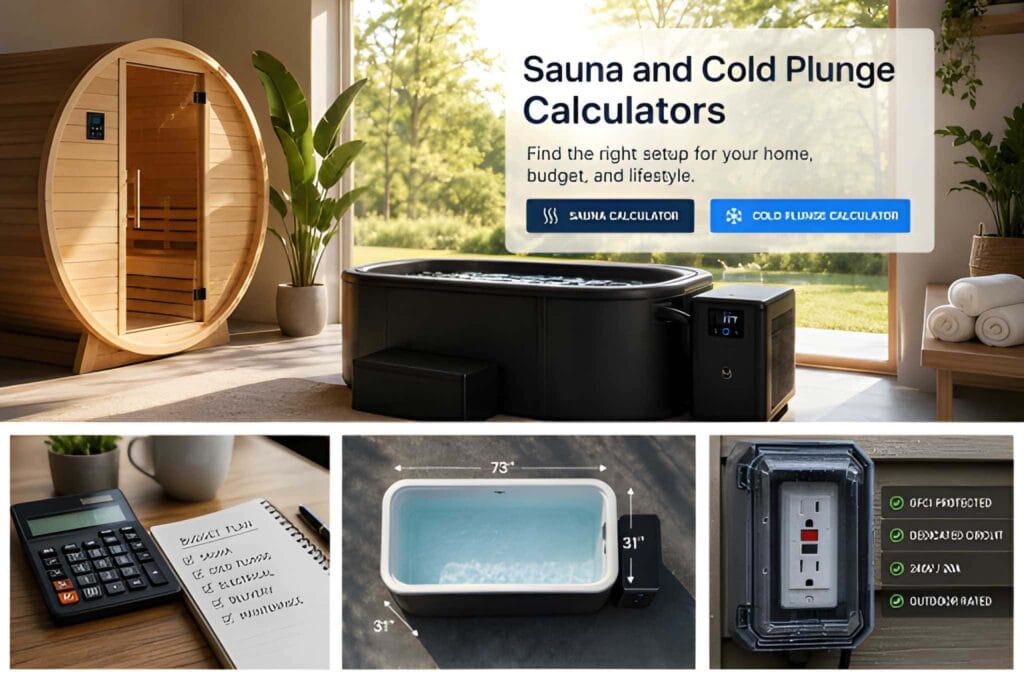
The sauna and cold plunge calculators from MindReset are built around a simple idea: choose the equipment that fits your home and routine before choosing the brand.
That sounds obvious.
In practice, the wellness market often works in the opposite direction.
You see a beautiful cedar sauna, a stainless-steel plunge or a perfectly styled backyard contrast-therapy setup. Then you start checking the details and discover that the sauna needs a dedicated 240V circuit, the plunge will not fit through the intended doorway, curbside delivery means exactly that, or the “complete” system still needs electrical work, drainage, filters, installation or additional equipment.
A product can be excellent and still be completely wrong for your property.
MindReset built two separate buyer tools to reduce that problem:
Use the free Cold Plunge Calculator
They are not medical calculators and they are not designed to tell everybody to buy the same product.
They are designed to narrow a messy market into options that can actually make sense for the person answering the questions.
Affiliate disclosure: MindReset.org may earn a commission if you buy through our links. This does not increase your price and does not affect our editorial judgment.
Research note: We have not personally tested every product included in these tools. Calculator results are based on structured product specifications, manufacturer documentation, pricing and configuration data, documented limitations, available research, and buyer-fit comparisons.
Quick Verdict
If you already know exactly which sauna or cold plunge you want, you may not need a calculator.
If you are still comparing products, use the calculator before spending hours reading individual reviews.
The Sauna Calculator is useful for sorting products by practical constraints such as:
- indoor or outdoor placement;
- sauna technology;
- seating capacity;
- purchase budget;
- electrical requirements;
- verified temperature capability.
The Cold Plunge Calculator goes further into water-system ownership and considers factors such as:
- budget;
- indoor or outdoor use;
- portability;
- cooling and heating capability;
- immersion style;
- easier entry requirements;
- available dimensions;
- freight and access;
- electrical readiness;
- maintenance tolerance;
- quote-required products;
- custom installation.
The result is not necessarily “the best sauna” or “the best cold plunge.”
It is closer to:
Which of the products we can verify makes the most sense under the conditions you actually gave us?
That is a much more useful buying question.
Why Are There Two Calculators Instead of One Hot-and-Cold Quiz?
Because a sauna and a cold plunge can sit three feet apart and still create completely different buying problems.
A sauna purchase may depend heavily on:
- heat technology;
- indoor vs outdoor rating;
- capacity;
- electrical service;
- heater inclusion;
- operating temperature;
- assembly;
- ventilation;
- required clearances.
A cold plunge adds another set of variables:
- water capacity;
- tub shape;
- chiller configuration;
- drainage;
- filtration;
- sanitation;
- outdoor weather exposure;
- access height;
- filled weight;
- electrical protection around water;
- ongoing water care.
Combining all of that into one glossy “What contrast therapy setup are you?” quiz would make the tool simpler.
It would also make it less useful.
The two purchases should first survive their own buyer-fit checks.
Only then does it make sense to ask whether they belong together.
What Does the MindReset Sauna Calculator Actually Check?
The MindReset Sauna Calculator currently compares structured data across 192 sauna configurations from 65 product families. Not every configuration is allowed into personalized matching; products with unresolved information can be excluded rather than treated as if the missing specification were known.
That distinction matters.
A sauna should not become your top result simply because the manufacturer has good photography or because MindReset has an affiliate relationship with the seller.
Indoor or outdoor?
This is more fundamental than it sounds.
Some cabins are built strictly for protected indoor installation. Others are designed for outdoor exposure. An attractive indoor sauna is not an outdoor sauna just because there happens to be room for it on your patio.
Placement can therefore eliminate products before smaller feature differences matter.
What kind of sauna do you actually want?
Traditional and infrared saunas are not interchangeable simply because both produce heat.
A buyer specifically looking for a traditional stone-heater experience should not receive an infrared cabin as the strongest personalized match just because the infrared model is cheaper or easier to install.
Likewise, someone who specifically wants infrared should not have traditional heat forced into the shortlist.
For a broader look at the categories before using the calculator, see our Best Home Saunas guide. It compares indoor, outdoor, infrared and traditional options from a wider buyer perspective.
How many people will actually use it?
Capacity is one of the easiest specifications to overbuy.
A six-person sauna looks impressive.
That does not automatically make it a better purchase for a couple who will use it alone 95% of the time.
Larger cabins usually mean more space, more material, potentially greater electrical requirements and a higher purchase price.
The useful question is not:
How many people could I theoretically fit inside?
It is:
How many people are realistically going to sit in this sauna on a normal evening?
Can your electrical setup support it?
This is where brochure shopping collides with the house.
Some home saunas can operate on relatively straightforward electrical arrangements. Others need a dedicated high-amperage or 240V circuit and professional electrical work.
The calculator uses verified electrical information where available rather than treating it as a minor installation detail.
If a product’s relevant electrical specifications cannot be verified clearly enough, that uncertainty can affect whether it qualifies for personalized matching.
Is the heater actually included?
This sounds ridiculous until you start shopping sauna kits.
Not every sauna package contains everything required to create a functioning sauna.
Some kits may be sold without the heater or with important components depending on configuration.
That is one reason MindReset works with individual product configurations instead of assuming every product carrying the same family name is identical.
How hot is it verified to get?
Temperature claims matter when temperature is part of your preference.
But MindReset does not treat a larger maximum number as automatically better.
If you prefer moderate infrared heat, there is little value in ranking a 220°F traditional sauna above everything else merely because 220 is a larger number.
The temperature needs to fit the intended experience.
What Does the Cold Plunge Calculator Check?
The MindReset Cold Plunge Calculator currently evaluates 124 public configurations across 89 public product families in its candidate set. The process takes the buyer through eight groups of decisions before producing matches or comparison options.
This calculator is intentionally more demanding because a cold plunge is not just a tub.
A complete system may combine water, cooling equipment, filtration, sanitation, hoses, drainage, electricity and hundreds of pounds of filled weight.
1. What is your real maximum budget?
Not the budget after three upsells.
Not “$5,000, but I suppose $8,000 if the sales page looks convincing.”
Your actual ceiling.
The calculator currently allows buyers to work with several budget ranges or leave the budget undecided.
Price is not the only ranking factor, but a product that breaks a genuine hard budget constraint should not magically become a great recommendation.
2. Indoors or outdoors?
Indoors, you may need to think about:
- water on the floor;
- drainage;
- condensation;
- ventilation around equipment;
- outlet location;
- filled weight;
- access to the installation room.
Outdoors, the problems change:
- rain and weather exposure;
- ambient heat;
- freezing temperatures;
- insulation;
- sunlight;
- outdoor electrical requirements;
- chiller workload.
Placement is therefore a functional requirement rather than a lifestyle preference.
3. Permanent or portable?
“Portable” is one of the most abused words in cold-plunge marketing.
A tub may weigh very little when empty and hundreds of pounds once filled with water.
For MindReset, portability matters most when it matters to the buyer.
Someone renting a property or expecting to relocate may place far more value on a packable tub than someone building a permanent backyard recovery room.
4. Cold only, or heating and cooling?
Some plunge systems only cool.
Others can also heat the water.
More capability can be useful, but it is not automatically more valuable.
If you never intend to use the plunge as a hot tub, paying extra for heating may be wasted money.
If the ability to alternate temperatures inside the same system matters to you, it can be a legitimate requirement.
The calculator lets the buyer decide instead of awarding points simply for having more functions.
5. Upright or horizontal immersion?
A vertical plunge and a longer reclined tub use space differently and feel different in use.
An upright design can work well where floor area is limited.
A horizontal design may suit buyers who prefer a more reclined immersion position.
There is no universal winner.
There is only the version that fits your body preference and your available room.
6. Will the tub physically fit?
This is where product dimensions become more valuable than lifestyle photography.
The calculator can use maximum available length and width when you know them.
And the tub dimensions may still not represent the entire installation.
You may need additional room for:
- a separate chiller;
- hoses;
- ventilation;
- a cover;
- drainage access;
- steps;
- safe entry;
- service access.
Measure before buying.
It is considerably easier than discovering the mistake when freight arrives.
7. Can you get it where it needs to go?
A 300- or 500-pound product reaching your curb is not the same thing as the product reaching your basement.
The calculator therefore asks about delivery requirements and difficult or stair-dependent access.
For high-ticket equipment, this is a serious purchasing issue.
Curbside freight can be completely acceptable for a buyer with a wide driveway, garage and several helpers.
It can be a disaster for someone expecting the carrier to navigate stairs, narrow hallways or a difficult garden entrance.
8. Is the electrical installation ready?
The calculator asks about GFCI availability, circuit amperage, voltage, outlet location and whether the buyer would hire an electrician if necessary.
Those questions should not be skipped around water-based electrical equipment.
The U.S. Consumer Product Safety Commission warns that wet surfaces increase electrical risk and specifically discusses GFCI protection and electrical equipment around pools, spas and similar wet environments.
Read CPSC electrical safety guidance.
The product manual and local electrical requirements remain the final authority for the actual installation.
The Calculator Also Asks the Question Marketing Usually Avoids: How Much Maintenance Will You Tolerate?
This matters.
A cold plunge does not become maintenance-free because it has an expensive chiller and a beautiful shell.
Depending on the system, ownership can involve:
- filters;
- water replacement;
- sanitizer;
- ozone or UV components;
- surface cleaning;
- plumbing checks;
- winterization;
- replacement cartridges;
- monitoring water quality.
Some people do not mind this.
Others will hate it.
The Cold Plunge Calculator therefore lets the buyer distinguish between low-touch ownership, routine care and more hands-on maintenance.
That is not a glamorous specification.
It may be one of the best predictors of whether the equipment is still being used a year later.
For a broader look at the available formats before running the calculator, see our Best Home Cold Plunges guide.
Sauna and Cold Plunge Calculators: What Is the Difference?
| Buyer question | Sauna Calculator | Cold Plunge Calculator |
|---|---|---|
| Purchase budget | Yes | Yes |
| Indoor/outdoor placement | Yes | Yes |
| Product technology/type | Sauna technology | Cooling/heating and immersion style |
| Capacity/body fit | Seating capacity | Immersion position and easier entry |
| Electrical requirements | Yes | Yes |
| Available dimensions | Product/install fit | Explicit tub dimension filtering |
| Delivery access | Verify before buying | Included in buyer inputs |
| Maintenance tolerance | Product-specific consideration | Included in buyer inputs |
| Quote-required systems | May be limited by available evidence | Buyer can choose whether to consider them |
| Custom installation | Product dependent | Buyer can choose whether to consider it |
| Affiliate commission controls ranking | No | No |
The important similarity is the last row.
Both tools are supposed to choose by buyer fit first.
MindReset states on both calculator pages that affiliate relationships do not determine product ranking.
What Do Strong, Moderate and Weak Matches Actually Mean?
A percentage without context is not very useful.
That is why the calculators communicate how much of the buyer profile can actually be supported by available product evidence.
Strong match
Several meaningful requirements can be supported by verified product information.
This is the highest-confidence result, not a guarantee that the product is perfect.
Moderate match
The product fits multiple important preferences, but some buyer-specific information remains limited or unresolved.
This is a shortlist candidate that still deserves verification.
Weak match
Only part of the profile can be verified.
It may still be useful as a comparison product, but you should not interpret it as “MindReset says buy this.”
No verified personalized match
Sometimes the buyer provides a meaningful preference and MindReset does not have enough reliable product information to rank a personalized winner.
That is different from saying the product is bad.
It means the evidence is not strong enough to tell you that it fits.
No safe match
The Cold Plunge Calculator can also refuse to force a result when it cannot verify a product satisfying all required constraints.
We consider that a feature.
A product finder that always produces a winner is suspiciously convenient for the seller.
Why Doesn’t the Cheapest Product Automatically Win?
Because “cheapest” and “best value for this buyer” are different questions.
Suppose Cold Plunge A costs $2,500 and Cold Plunge B costs $4,000.
A is cheaper.
But what if:
- A does not fit your available space;
- A cannot reach your required temperature;
- A is not approved for your intended placement;
- A creates a delivery problem;
- or A requires an electrical arrangement you cannot provide?
The $2,500 option has not saved you $1,500.
It has failed the assignment.
The same applies to saunas.
A cheap cabin that does not provide the heat technology, capacity or installation fit you require is not automatically good value.
Price needs context.
Why Doesn’t the Most Expensive Product Automatically Win?
For the same reason.
Premium wellness equipment often adds:
- better materials;
- architecture;
- larger capacity;
- more integrated controls;
- additional filtration;
- automation;
- luxury finishes;
- higher maximum performance.
Some buyers genuinely need or value those things.
Others do not.
If two people normally use a sauna, paying thousands more for unused six-person capacity may be a poor allocation of money.
If 50°F water is already cold enough for your routine, paying dramatically more for a machine capable of producing floating ice may offer little practical value.
The calculators are designed to make those trade-offs visible before the purchase.
Should You Build a Full Sauna + Cold Plunge Contrast-Therapy Setup?
Maybe.
But do not start by buying “the pair.”
Run the two decisions separately.
First find a sauna that makes sense.
Then find a plunge that makes sense.
Then combine the requirements.
At that point ask:
- Can the property support both electrical loads?
- Is there enough real installation space?
- Is water drainage manageable?
- Will both products be accessible for servicing?
- Can both be delivered to their final positions?
- What is the actual combined cost?
- What ongoing maintenance does the pair create?
- Will you honestly use both?
Our Renu Therapy Sauna and Cold Plunge Buyer Guide looks at this combined-purchase problem in more detail. Its central buying question is whether both modalities will be used consistently enough to justify their combined cost, space and maintenance.
You can also browse the wider MindReset Contrast Therapy section for individual sauna reviews, cold plunge reviews and comparison guides.
Do You Actually Need Both?
No.
This may be the most useful answer on the page.
The wellness industry is very good at turning one purchase into five.
You buy a sauna.
Then somebody explains why you need a plunge.
Then red light.
Then compression.
Then another recovery device.
Eventually your “simple recovery routine” needs its own equipment manager.
If you love sauna and dislike cold immersion, buy a sauna.
If you already cold plunge consistently and rarely use heat, buy the plunge.
If both are established parts of your routine and the property can support both, a combined setup can make sense.
The purpose of these calculators is not to maximize the number of products you own.
It is to reduce the number of expensive products you regret buying.
What the Calculators Can Verify — and What They Cannot
Structured product data is useful.
It can help verify things such as:
- dimensions;
- capacity;
- voltage;
- amperage;
- placement;
- temperature capability;
- product configuration;
- included components;
- known purchase price;
- documented installation requirements.
It cannot reliably tell us everything about years of ownership.
Across the products in these tools, MindReset cannot consistently verify:
- long-term comfort;
- component degradation;
- app stability;
- customer-service quality;
- installation experience in every property;
- real-world durability over years;
- exact local installation cost;
- every electricity or water expense;
- every repair cost.
The calculators deliberately keep that distinction.
Missing information is not silently converted into a positive specification.
What Should You Verify Before Paying?
Even after receiving a strong match, verify the final purchase.
For a sauna, that normally means checking:
- current price;
- exact configuration;
- what is included;
- dimensions and clearances;
- indoor/outdoor rating;
- heater inclusion;
- voltage and circuit requirements;
- maximum temperature;
- delivery;
- assembly;
- warranty;
- return policy;
- shipping availability.
For a cold plunge, also check:
- chiller included or separate;
- cooling and heating range;
- water capacity;
- filled weight;
- drainage;
- filtration;
- sanitation;
- replacement filters;
- winterization;
- delivery type;
- ongoing maintenance;
- recurring costs.
Specifications and commercial terms can change after our data was collected.
A calculator should narrow the decision.
It should never replace the product manual or final confirmation with the seller.
A Short Safety Reality Check
The calculators help determine whether equipment fits a buying situation.
They do not determine whether heat or cold exposure is medically appropriate for an individual.
Cold-water immersion can trigger a rapid cold-shock response involving increased breathing, heart rate and blood pressure, according to the American Heart Association. Read the AHA guidance on cold-water immersion.
Sauna also creates substantial heat exposure. Harvard Health advises people with uncontrolled high blood pressure or heart disease to consult their doctor before sauna use and recommends basic precautions such as sensible session length and hydration. Read Harvard Health’s sauna safety guidance.
If you have a relevant medical condition, are pregnant, take medication that may affect your response to heat or cold, have a history of fainting or are otherwise unsure, discuss thermal exposure with an appropriate healthcare professional.
Which Calculator Should You Use First?
If you are buying only one product, the answer is easy.
You want a sauna
Start with the MindReset Sauna Calculator →
Use it to narrow products by placement, heat technology, capacity, budget, electrical requirements and verified temperature capability.
You want a cold plunge
Start with the MindReset Cold Plunge Calculator →
Use it to work through budget, placement, portability, temperature requirements, immersion position, space, delivery access, electrical readiness and maintenance.
You want both
Run both calculators independently.
Then compare the combined installation only after each product has earned its place.
Final Verdict: Calculate First, Shop Second
There are plenty of good saunas.
There are plenty of good cold plunges.
That is not the hard part.
The hard part is finding the one that fits:
your house, your electrical setup, your available space, your budget, your tolerance for maintenance and the way you will actually use it.
That is what the MindReset sauna and cold plunge calculators are built to do.
They will not eliminate every uncertainty.
They will not make every expensive product worth buying.
And sometimes they will refuse to give you the neat answer a sales funnel would prefer.
Good.
A $5,000, $10,000 or $20,000 purchase deserves something better than:
“This one is popular.”
Start with the constraints.
Find the compatible options.
Verify the finalists.
Then spend the money.
Ready to compare?
Frequently Asked Questions
Are the MindReset sauna and cold plunge calculators free?
Yes. Both are free buyer tools available directly on MindReset.org.
Does MindReset recommend only affiliate products?
No. Both calculator methodologies state that affiliate relationships do not determine recommendation ranking. Product fit is evaluated separately from commercial status.
How many products are included?
The current Sauna Calculator dataset covers 192 configurations across 65 product families, with 61 configurations currently eligible for personalized matching. The Cold Plunge Calculator currently has 124 public candidate configurations across 89 public product families. Those numbers can change as the databases are updated.
Why didn’t the calculator recommend the product I expected?
A product can be filtered or downgraded because of budget, placement, dimensions, electrical requirements, configuration, temperature capability or missing information. The calculator does not treat missing evidence as a verified match.
Does a Strong Match mean I should definitely buy it?
No. A Strong Match means the available evidence supports several of the requirements you supplied. You should still verify current specifications, price, availability, warranty, returns and installation requirements before ordering.
Why would the calculator show no personalized match?
Because sometimes the available product evidence does not support all of the buyer’s required constraints. Rather than inventing certainty, the tool can show weaker comparison options or no verified safe match.
Can I use the calculators for a complete contrast-therapy room?
Yes. Run the Sauna Calculator and Cold Plunge Calculator separately first, then evaluate the combined footprint, electrical work, drainage, delivery, maintenance and total cost.
Are these medical calculators?
No. They are product-selection tools. They do not diagnose conditions, recommend treatment or determine whether sauna heat or cold-water immersion is medically appropriate for you.