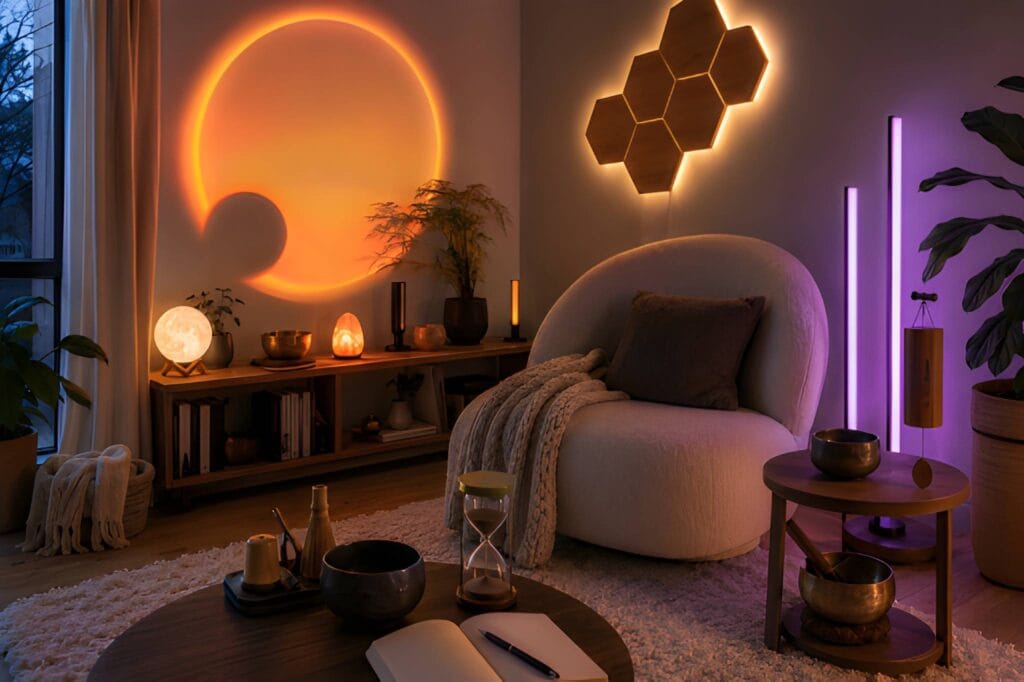
A sensory home sanctuary is not a room filled with expensive wellness gadgets. It is a space where lighting, sound, texture, scent, and everyday objects make it easier to step away from screens, lower stimulation, and follow a more intentional evening or focus routine.
This guide compares 13 practical sensory tools for different homes and budgets. Some create softer lighting, some provide a simple sound or tactile activity, and others turn an ordinary routine such as showering or making tea into a more deliberate transition between work and rest.
Affiliate disclosure: MindReset.org may earn a commission if you buy through our links. This does not increase your price and does not affect our editorial judgment.
Amazon disclosure: As an Amazon Associate, we earn from qualifying purchases.
Research note: We have not personally tested every product featured in this guide. This buyer guide is based on current product listings, manufacturer information, public customer feedback, practical use-case analysis, and comparison with similar sensory and home-environment tools.
What we assessed: intended use, sensory input, setup requirements, app dependency, noise, brightness, fragrance, physical controls, likely hidden costs, maintenance, safety considerations, and buyer fit.
What we could not independently verify: long-term durability, real-world brightness, sound quality, scent strength, app stability, product consistency between sellers, customer support, or whether any item will produce the same subjective experience for every user. Prices, availability, specifications, and return terms may change.
Health and safety note: These products are environmental and routine tools, not treatments for anxiety, insomnia, migraines, sensory disorders, or other health conditions. Avoid fragrances that irritate you, supervise children around small parts and strong magnets, and follow all electrical, mounting, fire, and product-safety instructions.
Quick Verdict: What Should You Buy First?
Most people do not need all 13 products. Start with the sensory problem you actually have.
- Harsh evening lighting: start with a dimmable warm lamp, sunset projector, or Nanoleaf Elements.
- A room that feels visually flat: compare a galaxy projector, levitating moon lamp, or ferrofluid display.
- Too much screen-based entertainment: consider a singing bowl, tongue drum, chime, matcha set, or analog sand timer.
- You want a short transition ritual: shower steamers or a simple tea-making set may be more useful than another connected device.
- You want app-controlled ambience: Govee light bars offer more flexibility but also add Wi-Fi, app setup, and screen interaction.
The safest strategy is to choose one lighting tool and one screen-free ritual. Adding too many moving lights, scents, sounds, and decorative objects can create more stimulation and clutter rather than a calmer room.
Who Should Build a Sensory Home Sanctuary?
This type of setup may suit people who want:
- a clearer transition between work time and personal time;
- a less screen-dependent evening routine;
- softer alternatives to bright ceiling lights;
- simple visual or tactile objects for quiet breaks;
- a dedicated corner for reading, journaling, meditation, stretching, or tea;
- a home environment that feels more deliberate and less cluttered.
Who Should Avoid These Products?
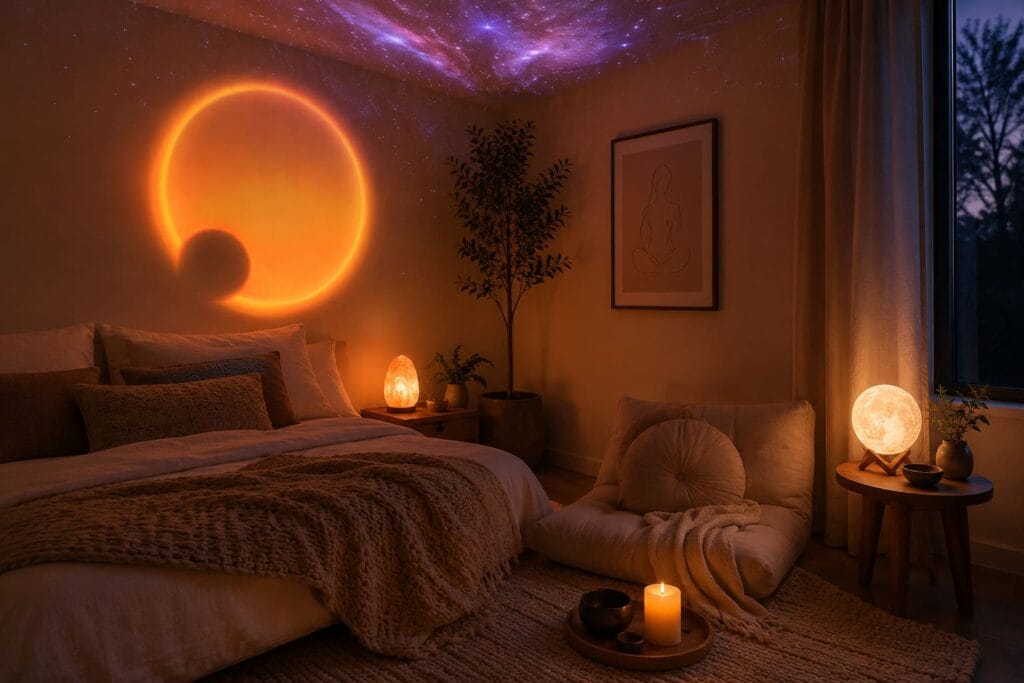
Skip or simplify this setup if you are highly sensitive to moving lights, repetitive sounds, fragrance, visual clutter, or connected devices. A plain dimmable lamp, comfortable chair, blanket, and phone-free corner may work better than an elaborate sensory installation.
People with fragrance sensitivity, respiratory concerns, pets, small children, or shared living spaces should be especially careful with scented products, magnets, small instruments, hot bulbs, wall-mounted panels, and breakable glass objects.
Sensory Home Sanctuary Decision Table
| Use case | Best option to compare | Why | Skip if |
|---|---|---|---|
| Immersive ceiling visuals | Galaxy projector | Large projected scenes with a timer | Moving images distract you |
| Minimal decorative light | Levitating moon lamp | Small visual focal point | You dislike fiddly magnetic alignment |
| Low-cost warm ambience | Sunset projector | Simple projected color without a full smart system | You need useful room illumination |
| Interactive desk object | Ferrofluid display | Screen-free visual and tactile interaction | Strong magnets or glass are unsuitable |
| App-controlled lighting | Govee light bars | Flexible scenes, colors, and automation | You want fewer apps and connected devices |
| Premium wall ambience | Nanoleaf Elements | Wood-look panels work as decor when switched off | You rent or dislike wall mounting |
| Warm bedside glow | Dimmable salt lamp | Simple amber decorative light | You expect air-purifying or medical benefits |
| Short scented routine | Shower steamers | No diffuser or long bath required | You are fragrance-sensitive |
| Gentle sound cue | Koshi chime | Short, physical sound ritual | You share a quiet space |
| Hands-on sound practice | Singing bowl or tongue drum | Screen-free sound and tactile activity | You need silence or live with noise-sensitive people |
| Intentional drink ritual | Matcha set | Structured preparation process | You avoid caffeine |
| Analog focus sessions | 30-minute sand timer | No phone, alarm, or digital display | You need precise timing |
How to Build the Room Without Overbuying
Use three layers:
- Functional foundation: comfortable seating, reduced clutter, suitable temperature, and practical lighting.
- One main sensory cue: a warm lamp, gentle sound object, tactile tool, or subtle scent.
- One repeated routine: reading, tea, stretching, journaling, breathing practice, or a phone-free 30-minute block.
For a wider lighting plan, read our guide on how to optimize your light environment. For bedroom-specific changes, use the sleep-friendly bedroom setup guide.
Visual Tools: Ambient Light and Screen-Free Objects
Light and dark are important environmental signals for daily rhythms. The U.S. National Institute of General Medical Sciences explains that light and dark have the strongest environmental influence on circadian rhythms. That does not make every colored lamp a sleep device, but it is a good reason to treat evening brightness and timing more seriously. See the NIGMS overview of circadian rhythms.
1. Galaxy Projector: Best for Immersive Ceiling Visuals
A galaxy projector can turn a plain ceiling into a large visual scene without requiring permanent installation. The current product linked below includes interchangeable projection discs, adjustable focus, moving effects, RGB ambience, and automatic timer options.
Best for: bedrooms, reading corners, family rooms, and people who enjoy slow visual movement.
Skip if: moving patterns keep you alert, the projector fan is noticeable, or you prefer a dark uncluttered bedroom. Check timer controls and minimum brightness before buying.
2. Levitating Moon Lamp: Best Small Visual Focal Point
A levitating moon lamp combines decorative lighting with a rotating magnetic display. It works better as a visual anchor or desk object than as practical room lighting.
Best for: a shelf, meditation corner, desk, or small reading area.
Skip if: you need a lamp bright enough for reading or dislike aligning magnetic levitation products. Strong magnets and breakable components also require sensible placement.
3. Sunset Projector: Best Budget Ambient Light
A sunset projector creates a circular area of warm or colored light on a wall. It is primarily decorative and should not be confused with a sunrise alarm, light-therapy device, or full-room lamp.
Best for: inexpensive wall ambience, photography backgrounds, and a softer alternative to bright overhead lighting.
Skip if: you need accurate color temperature, high-quality task lighting, or a lamp that can illuminate an entire room.
4. Ferrofluid Display: Best Interactive Desk Object
A sealed ferrofluid display changes shape when you move a magnet around it. The appeal is not a wellness claim; it is a compact screen-free object that rewards slow observation and physical interaction.
Best for: desk breaks, visual curiosity, and people who enjoy kinetic objects.
Skip if: glass containers, liquid-filled objects, small magnets, or strong magnets are unsuitable for your household or workspace.
5. Govee Smart LED Light Bars: Best for App-Controlled Scenes
Govee light bars offer more control than a basic decorative lamp. They can be positioned around a television, monitor, shelf, or wall and adjusted through connected controls and scene settings.
Best for: multipurpose rooms where you want different lighting for work, movies, gaming, or evening ambience.
Skip if: you want a phone-free environment. Music sync, rapidly changing effects, and high brightness may add stimulation rather than reduce it, so simple static scenes are usually the more practical choice for a quiet room.
6. Nanoleaf Elements: Best Premium Wall Lighting
Nanoleaf Elements panels use a wood-look finish, which makes them less visually technical than many RGB wall panels. They can function as wall decor when switched off and provide adjustable ambient light when in use.
Best for: a permanent reading area, living room, studio, or premium home-office wall.
Skip if: you rent, dislike adhesive mounting, want inexpensive lighting, or do not want another smart-home ecosystem.
7. Dimmable Himalayan Salt Lamp: Best Simple Amber Glow
A salt lamp is useful as a decorative amber light, not as an air purifier, ion generator, or medical product. Its main buyer value is the warm appearance and simple dimming control.
Best for: low-level bedside ambience, shelves, and reading corners where appearance matters more than brightness.
Skip if: you need strong illumination, have pets that may lick salt, or expect unsupported health benefits. Place it on a stable moisture-resistant surface.
Sound and Touch Tools: Screen-Free Attention Anchors
Sound objects work best when they give a routine a clear beginning or ending. They do not need special frequencies or therapeutic claims. A short chime, a few bowl tones, or several minutes with a simple instrument can be enough to mark a break from work or scrolling.
For more low-tech options, see our guide to sensory and tactile reset tools.
8. Koshi Chime: Best for a Short Sound Cue
A Koshi chime creates a layered acoustic sound when moved gently. It is useful as a short ritual cue rather than continuous background audio.
Best for: starting meditation, ending work, opening a yoga session, or marking a short phone-free break.
Skip if: you share a quiet room, live with someone sensitive to repeated sounds, or expect it to cover traffic, voices, or other environmental noise.
9. Tibetan Singing Bowl: Best for a Hands-On Sound Ritual
A singing bowl adds both sound and physical interaction. Learning to strike or circle the bowl slowly can create a repeatable screen-free activity, but sound quality varies considerably between inexpensive sets.
Best for: meditation corners, stretching routines, and people who prefer active participation over recorded sound.
Skip if: you expect professional instrument quality from a small entry-level bowl or need a silent activity.
10. Mini Steel Tongue Drum: Best for Easy Musical Play
A small tongue drum provides a more playful sound activity than a single chime or bowl. Its limited note range makes casual experimentation easier for beginners.
Best for: short creative breaks, families, beginners, and people who want a physical activity without a screen.
Skip if: you want rich low-frequency sound or a full-size musical instrument. A three-inch model is compact and portable, but its tonal depth will be limited.
11. Thirty-Minute Sand Timer: Best Analog Focus Tool
A sand timer creates a visible block of time without notifications, alarms, or a glowing display. It can be used for reading, journaling, quiet work, stretching, or a phone-free evening period.
Best for: analog focus sessions and people who reach for their phone whenever they use a timer app.
Skip if: you need exact timing. Consumer hourglasses can have meaningful time variation and should not be used for medication, cooking safety, appointments, or other precision tasks.
Scent and Routine Tools
Scent is optional. A sensory sanctuary does not need fragrance, and stronger is not better. People who experience headaches, respiratory irritation, nausea, fragrance sensitivity, or discomfort around essential oils should choose fragrance-free routines instead.
12. BodyRestore Shower Steamers: Best Short Scented Routine
Shower steamers release fragrance as they dissolve away from the direct water stream. Their practical value is convenience: they add a sensory cue to a routine you already perform without requiring a bathtub or electric diffuser.
Best for: people who already tolerate scented shower products and want a brief transition after work or exercise.
Skip if: fragrance causes discomfort, you have respiratory sensitivity, the bathroom has poor ventilation, or children or pets could access the tablets. They are not medication and should not be applied directly to the skin.
13. Teanagoo Matcha Set: Best Intentional Preparation Ritual
A matcha set turns drink preparation into a manual sequence: measure, add water, whisk, pour, and clean. The product itself is not a mind-reset device; the value comes from repeating a slower routine without multitasking.
Best for: a morning or daytime ritual, tea enthusiasts, and people who enjoy practical objects more than decorative gadgets.
Skip if: you avoid caffeine, want an evening drink, dislike matcha, or do not want to maintain a bamboo whisk. A caffeine-free herbal tea ritual may be a better evening alternative.
What We Removed From the Original List
Migraine roll-on: We removed it because a page about home ambience should not imply that a scented topical product treats headaches, migraines, stress, or other health conditions.
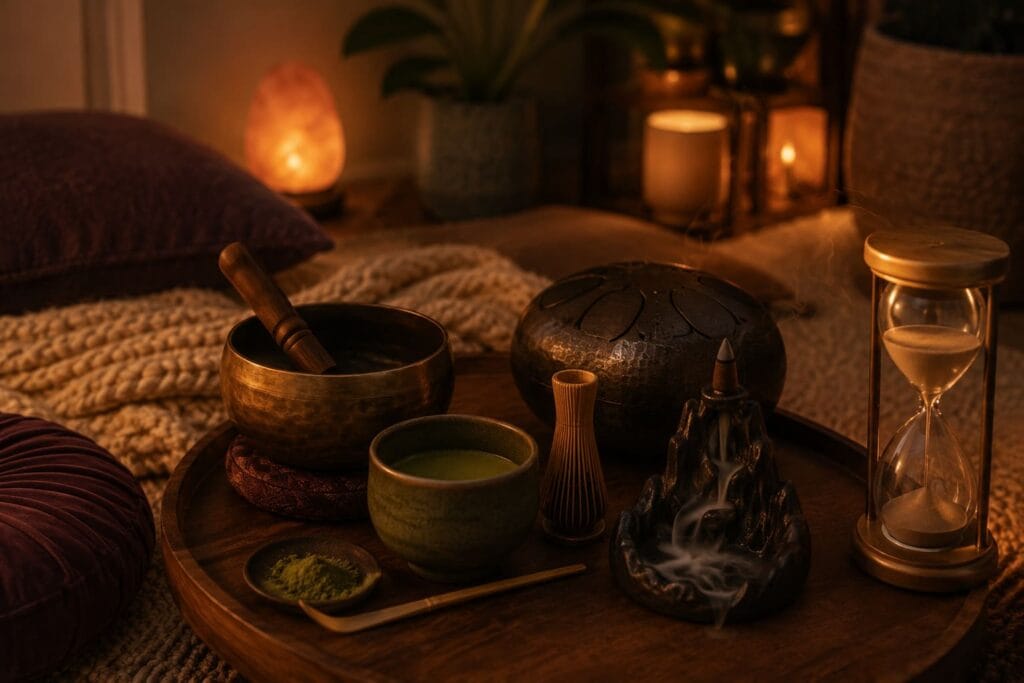
Backflow incense burner: We removed it because the visible smoke effect comes from combustion. The U.S. Environmental Protection Agency notes that incense smoke can be a significant source of indoor particulate matter. A smoke-free visual object or fragrance-free routine is a cleaner fit for this guide.
We also removed claims that decorative objects create neurological recovery, force melatonin production, act as sound therapy, or automatically regulate the nervous system.
Hidden Costs and Buyer Traps
App and Wi-Fi dependency
Govee and Nanoleaf products may require an account, app setup, firmware updates, Wi-Fi troubleshooting, and permissions. Decide whether more control is worth adding another connected system.
Replacement parts and consumables
Shower steamers run out. Matcha sets require tea and eventual whisk replacement. Some lamps need replacement bulbs, power adapters, mounting strips, or compatible accessories.
Wall and surface damage
Wall panels, light bars, cables, and adhesive mounting can mark paint or require additional clips. Renters should confirm removal requirements before installation.
Sensory overload
Several colored lights, moving projections, fragrance, music, and decorative objects running together can make a room busier. Add one sensory layer at a time and remove anything you stop using.
Return policy
Test brightness, noise, controls, scent, mounting, and room fit before discarding packaging. Marketplace sellers, availability, and return terms can change.
What We Could Verify
- The current linked listings describe the basic product type, included features, controls, and intended use.
- The guide uses existing Amazon.com affiliate links with the MindReset tracking tag.
- The selected products cover visual, sound, tactile, scent, and routine-based use cases.
- Govee and Nanoleaf are app-connected lighting products, while the chime, bowl, drum, tea set, and sand timer can be used without a phone.
- The linked galaxy projector includes timer-based operation, and the linked sand timer is intended as an approximate 30-minute analog timer.
What We Could Not Verify
- How calming, pleasant, distracting, bright, loud, or irritating each product will feel in your room.
- Long-term reliability, app stability, mounting durability, scent consistency, and seller support.
- Whether the sound quality of inexpensive instruments will meet experienced musicians’ expectations.
- Whether smart-light colors and brightness match promotional images.
- Whether any product will improve sleep, stress, focus, mood, or health outcomes.
FAQ
What is a sensory home sanctuary?
It is a deliberately arranged home area that uses manageable lighting, sound, texture, scent, and routine cues to support activities such as reading, journaling, stretching, meditation, tea, or quiet screen-free time.
Do I need special products to create one?
No. A comfortable chair, reduced clutter, warm lamp, blanket, book, and phone-free routine may be enough. Products are useful only when they solve a specific problem.
Which product should I buy first?
Start with lighting if the room feels harsh at night. Choose a sound or tactile tool if screen use is the bigger problem. Choose a routine product only when you already enjoy the activity.
Are salt lamps good for air quality?
Do not buy a salt lamp as an air purifier or health device. Its practical role in this guide is decorative amber lighting.
Are smart lights better than ordinary lamps?
Smart lights offer scenes, schedules, and remote control, but they also add setup and app dependency. A basic dimmable warm lamp is often the simpler choice.
Should I use scent in a sensory room?
Only when you tolerate and enjoy it. Fragrance is optional, and a fragrance-free space is often easier to share with other people and pets.
Final Verdict: Build a Routine, Not a Product Collection
A useful sensory home sanctuary should make one or two daily transitions easier. It might help you move from work to personal time, replace evening scrolling with reading, create a dedicated tea ritual, or give you a quiet place for stretching and reflection.
For most people, the strongest starting combination is:
- one adjustable or warm ambient light;
- one screen-free tactile or sound object;
- one repeated routine with a clear start and finish.
Do not buy all 13 tools. Choose the smallest setup that you will use consistently, remove anything that creates clutter, and adjust the room based on your actual experience rather than wellness marketing.
For a broader physical-space approach, continue with our guide to somatic architecture and deep tension release. For reducing device-based stimulation, see our digital detox tools guide.