Table of Contents
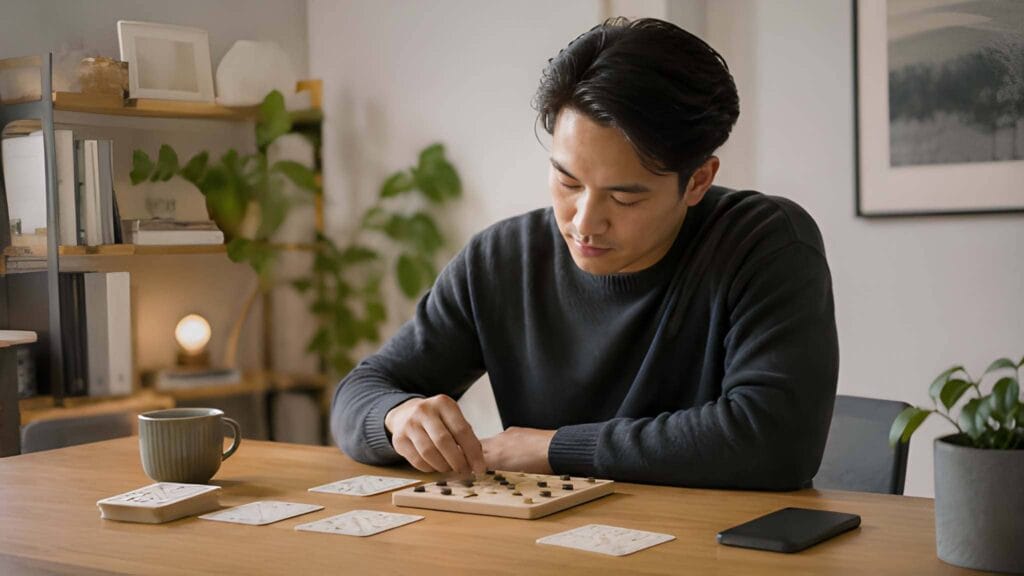
When your attention gets trapped in the same repetitive thought, another meditation app or motivational video may not be what you need. Sometimes the more practical move is to give your hands and attention a concrete problem to solve for ten or fifteen minutes.
That is the idea behind using logic puzzles for overthinking. A mechanical puzzle, spatial challenge, or single-player logic game can create a temporary shift from inward repetition toward an external task with clear rules and visible progress.
This does not make puzzles a treatment for anxiety, intrusive thoughts, depression, or persistent rumination. Their value is narrower and more realistic: they can provide a structured, screen-free focus task when your mind needs somewhere specific to go.
If your main problem is phone distraction rather than repetitive thinking, start with our guide to practical digital detox and focus tools.
Affiliate disclosure: MindReset.org may earn a commission if you buy through our links. This does not increase your price and does not affect our editorial judgment. As an Amazon Associate, we earn from qualifying purchases.
Research note: We have not personally tested every puzzle included in this guide. Our recommendations are based on official product information, available research on attention and rumination, product design, difficulty range, portability, visible customer feedback, and comparison with similar screen-free focus tools.
What we assessed: task clarity, physical engagement, difficulty progression, portability, reset time, replay value, frustration risk, practical buyer fit, and whether each puzzle offers a meaningfully different type of attention challenge.
What we could not independently verify: long-term durability, missing-piece risk, Amazon seller quality, individual frustration tolerance, or whether a particular puzzle will reliably interrupt repetitive thinking for every user.
Wellness note: Logic puzzles may provide a temporary attention shift, but they are not mental-health treatment. Seek appropriate professional support if repetitive thoughts are severe, persistent, distressing, linked to self-harm, or interfering substantially with sleep, work, relationships, or daily functioning.
Quick Verdict: Which Logic Puzzle Should You Buy?
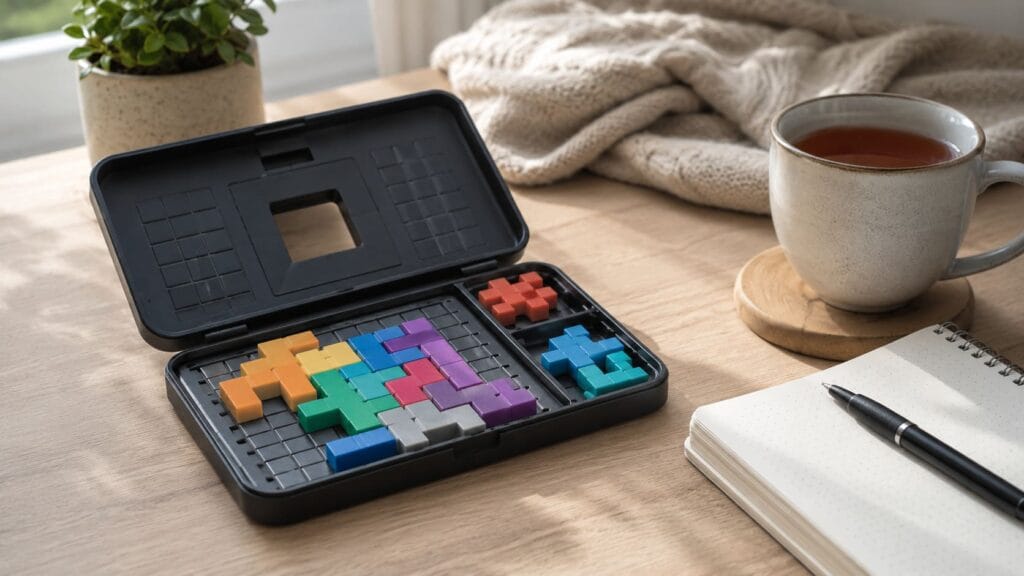
Kanoodle Genius is the best overall choice for most buyers. It is compact, has a clear progression system, includes both 2D and 3D challenges, and is easy to use for a short screen-free reset without taking over a room.
ThinkFun Rush Hour Deluxe is the best option for structured planning. Its progressive traffic challenges reward sequential thinking and make it easy to choose an appropriate difficulty level.
Hanayama Cast Enigma is best for experienced puzzle users who want one difficult tactile object rather than a collection of cards or plastic pieces. It is not the best starting point for someone who becomes frustrated easily.
Solitaire Chess is the best travel-friendly logic game for people who like chess movement but do not want to play against another person.
Shashibo is the lowest-pressure tactile choice. It offers geometric exploration without requiring you to complete a formal challenge every time.
Cluebox is the most immersive option for someone who wants a longer escape-room-style experience rather than a five-minute desk reset.
Logic Puzzle Decision Table
| Buyer need | Best option | Why | Skip if |
|---|---|---|---|
| Best overall screen-free focus puzzle | Kanoodle Genius | Compact, progressive, and easy to use in short sessions | You dislike small loose pieces |
| Step-by-step planning | Rush Hour Deluxe | Clear rules and 120 progressive challenges | You want something pocket-sized |
| Advanced tactile challenge | Hanayama Cast Enigma | Premium metal construction and very high difficulty | You become frustrated by slow progress |
| Chess-style logic without an opponent | Solitaire Chess | Uses familiar chess movement in single-player challenges | You strongly dislike chess rules |
| Low-pressure hand engagement | Shashibo | Flexible geometric play without a fixed finish line | You need structured difficulty levels |
| Long immersive puzzle session | Cluebox | Combines mechanical tasks with an escape-room narrative | You only want five-minute resets |
Can a Logic Puzzle Really Interrupt Overthinking?
It can sometimes redirect attention temporarily, but the mechanism should not be exaggerated.
Rumination involves repetitive attention returning to the same thoughts, questions, memories, or perceived problems. Research has associated maladaptive rumination with differences in how large-scale brain networks interact, including the default mode network and task-related attention networks.
However, these networks are not simple on-and-off switches. Solving a puzzle does not literally shut down one network, starve thoughts of neural energy, or guarantee that a difficult emotional issue disappears.
A more defensible explanation is that a demanding external task competes for limited attention and working-memory resources. Some experimental research suggests that brief distraction can help people move out of a temporary ruminative state, although the evidence does not prove that commercial logic puzzles provide a lasting mental-health benefit.
You can read an overview of the relationship between rumination and brain networks in this study of default-mode and task-positive network activity. A separate study comparing brief distraction and mindfulness strategies found that both approaches could help participants move out of an induced ruminative state.
The practical takeaway is modest: use a puzzle as a short attention tool, not as proof that you have treated the cause of repetitive thinking.
How to Use a Logic Puzzle as a Focus Reset
- Choose a defined window: Start with 10–20 minutes rather than an open-ended session.
- Use medium difficulty: The puzzle should require attention without creating immediate defeat.
- Put the phone away: The benefit is weaker if notifications keep pulling you into a second attention loop.
- Stop if frustration rises: A puzzle should redirect attention, not become a new source of agitation.
- Return to a real next step: When the timer ends, write down one practical action related to the original problem—or deliberately leave it for later.
- Do not use puzzles to avoid every difficult feeling: Temporary redirection and permanent avoidance are not the same thing.
For more screen-free ways to engage attention without passive scrolling, see our guide to creative and cognitive engagement.
1. Kanoodle Genius: Best Overall Logic Puzzle for Short Focus Sessions

Kanoodle Genius is the easiest recommendation for most adults who want a practical, portable logic puzzle rather than a decorative desk object. The set includes 202 challenges using colorful pieces arranged in 2D and 3D configurations.
Its strongest advantage is adjustable difficulty. You can choose an approachable challenge when your attention is scattered instead of immediately confronting a puzzle that may take several days to solve.
The compact carrying case also makes Kanoodle useful for travel, office breaks, waiting rooms, and evenings when you want a screen-free activity that does not require a large setup.
Best for: beginners, travel, short breaks, progressive difficulty, and buyers who want many challenges in one small set.
Skip if: small pieces are likely to get lost or you prefer a heavier mechanical object.
2. ThinkFun Rush Hour Deluxe: Best for Sequential Planning

Rush Hour Deluxe uses a simple traffic-jam format: move cars and trucks in the correct sequence until the red vehicle can escape. The deluxe version includes 120 challenges that progress from beginner to expert.
This is a strong choice when you want a clear, rule-based problem. Every move changes what becomes possible next, which encourages planning rather than random trial and error.
Rush Hour is also easier to approach than an abstract metal puzzle because the goal is immediately visible. That makes it a better option for someone who wants cognitive engagement without spending twenty minutes trying to understand what the puzzle is asking.
Best for: step-by-step thinking, planning, home use, and buyers who want a long difficulty progression.
Skip if: you need a pocket-sized puzzle or dislike resetting physical pieces.
3. Hanayama Huzzle Cast Enigma: Best Advanced Tactile Puzzle

Hanayama Cast Enigma is a compact metal disentanglement puzzle from the company’s highest difficulty category. The goal is to separate its intertwined pieces and then rebuild the original form.
The attraction is physical precision. You cannot solve it by swiping, searching for a shortcut, or randomly pressing buttons. Progress depends on observation, spatial reasoning, controlled movement, and patience.
That same difficulty is also the main risk. Enigma is not a sensible first puzzle for someone who becomes irritated when progress is invisible. A medium-difficulty Hanayama puzzle may be a better entry point.
Best for: experienced puzzle users, tactile focus, collectors, and buyers who want a durable object with no loose components.
Skip if: you want quick wins, written challenges, or a beginner-friendly learning curve.
4. ThinkFun Solitaire Chess: Best Chess-Inspired Travel Puzzle

Solitaire Chess combines familiar chess movement with a single-player elimination puzzle. Each move must capture another piece, and the objective is to finish with only one piece remaining.
The magnetic travel version includes 120 challenges ranging from beginner to expert. You do not need an opponent, and you do not need to be an advanced chess player, although basic familiarity with how the pieces move will make the start easier.
This is a good fit for people who enjoy rules, prediction, and evaluating several possible moves before acting. It offers more structure than a fidget object without requiring a full chess match.
Best for: travel, chess fans, structured logic, quiet solo play, and progressive difficulty.
Skip if: chess movement feels tedious or you want a purely tactile mechanical puzzle.
5. Shashibo Shape-Shifting Box: Best Low-Pressure Tactile Option

Shashibo is different from the other products in this guide. It is a magnetic shape-shifting cube rather than a formal sequence of logic challenges. Its connected panels fold into a large range of geometric forms.
This makes it suitable for people who want their hands occupied but do not want the pressure of getting a correct answer. You can explore shapes, reverse movements, connect compatible cubes, or simply manipulate it during a short break.
The trade-off is that Shashibo provides less structure. It may support tactile engagement, but it does not offer the clear progression, solutions, or measurable completion that Kanoodle or Rush Hour provides.
Best for: low-pressure hand engagement, desk use, geometric exploration, and buyers who dislike formal challenge cards.
Skip if: you specifically want progressive logic problems with correct solutions.
6. iDventure Cluebox: Best Immersive Mechanical Puzzle

The iDventure Cluebox is closer to a compact escape room than a standard desk puzzle. The Trial of Camelot version uses a handmade wooden structure, hidden mechanisms, logic tasks, and a narrative goal.
This is the strongest choice when you want a longer session that holds attention through curiosity and discovery. It creates more immersion than repeatedly solving short challenge cards.
Cluebox is less suitable as an everyday five-minute reset. Once solved, it can be reassembled for someone else, but the first full experience is the main value.
Best for: longer weekends, gifts, escape-room fans, mechanical exploration, and buyers who want a narrative challenge.
Skip if: you need unlimited replay value or only want very short attention breaks.
Who Should Buy a Screen-Free Logic Puzzle?
- People who reach for their phone whenever attention becomes uncomfortable.
- Remote workers who want a defined screen-free break between tasks.
- Buyers who enjoy solving visible, rule-based problems.
- People who want an evening activity that does not involve another app.
- Travelers looking for compact solo entertainment.
- Adults who prefer tactile engagement to passive scrolling.
Who Should Skip These Puzzles?
- Anyone expecting a puzzle to treat anxiety, depression, OCD, intrusive thoughts, insomnia, or another health condition.
- People who become more agitated when they cannot solve something quickly.
- Buyers who dislike storing physical pieces or resetting challenge layouts.
- Anyone whose repetitive thoughts require professional support rather than temporary redirection.
- People who already have unused puzzles at home and are mainly responding to another buying impulse.
How to Choose the Right Puzzle
Choose for your actual attention span. A ten-minute reset needs a different product from a two-hour escape-room experience.
Choose difficulty carefully. The best puzzle is challenging enough to hold attention but not so difficult that it becomes another source of frustration.
Decide whether you need structure or movement. Kanoodle, Rush Hour, and Solitaire Chess provide defined problems. Shashibo provides open-ended tactile movement. Hanayama and Cluebox sit between those categories.
Consider replay value. Challenge books offer many repeatable sessions. A mechanical mystery box offers a stronger first experience but less long-term variety.
Do not buy based on the word “brain.” A product can be enjoyable and useful as a focus activity without needing exaggerated claims about neuroplasticity, intelligence, or mental-health transformation.
What We Could Verify
We could verify the official formats and published challenge counts for the products included in this guide. Kanoodle Genius includes 202 listed challenges, Rush Hour Deluxe and the current magnetic Solitaire Chess each include 120, Hanayama classifies Cast Enigma in its highest difficulty tier, Shashibo uses connected magnetic panels to create many geometric forms, and Cluebox combines mechanical tasks with an escape-room-style narrative.
We could also verify research supporting the broader idea that shifting attention toward a structured external task may temporarily reduce a ruminative state for some people. That evidence does not establish a lasting therapeutic effect from these commercial products.
What We Could Not Verify
We could not verify that any specific puzzle reduces a person’s baseline rumination, changes brain-network activity in a predictable way, improves mental health, prevents intrusive thoughts, or provides lasting cognitive benefits.
We also could not verify long-term product durability, missing-piece risk, Amazon seller consistency, current regional availability, return handling, or whether each puzzle’s difficulty will feel engaging rather than frustrating to a particular buyer.
FAQ
Can a logic puzzle stop rumination?
A demanding puzzle may temporarily redirect attention away from repetitive thoughts, but it cannot be expected to stop the underlying pattern permanently. Treat it as a short focus tool rather than therapy.
How long should a cognitive-switching puzzle session last?
Ten to twenty minutes is a practical starting point. The goal is to create a deliberate attention shift and then return to the next useful action—not disappear into a puzzle for the rest of the day.
What is the best logic puzzle for beginners?
Kanoodle Genius or standard ThinkFun Rush Hour is easier to recommend than an advanced Hanayama puzzle because both provide progressive difficulty and clear instructions.
Which puzzle is best for travel?
Kanoodle Genius and Solitaire Chess Magnetic Travel Puzzle are the strongest travel options because their pieces and challenge materials fit into compact cases.
Should I choose the hardest puzzle?
Usually not. Excessive difficulty can increase frustration and encourage you to abandon the activity. Choose a puzzle that offers progression rather than one designed mainly to prove how difficult it is.
Final Verdict
Kanoodle Genius is the best starting point for most buyers because it is compact, progressive, replayable, and suitable for short sessions.
Choose Rush Hour Deluxe for structured planning, Solitaire Chess for chess-style logic, and Hanayama Cast Enigma only if you genuinely enjoy high-difficulty mechanical puzzles.
Choose Shashibo when you want tactile movement without a strong success-or-failure condition. Choose Cluebox when you want a longer, immersive experience rather than a daily desk reset.
The useful promise is not that these products can rewire your brain or eliminate rumination. It is that they can give your attention a clear, physical, screen-free task when repetitive thinking is getting you nowhere.